Restrooms
Explorați ghidul nostru de economisire a energiei pentru grupuri sanitare, creat pentru a vă ajuta să înțelegeți și să implementați soluții cu senzori de prezență pentru un control eficient al iluminatului, în conformitate cu codurile energetice din SUA.
Maximize Energy Efficiency in Restrooms with Occupancy Sensors
Restrooms in commercial buildings are frequently used spaces that often remain lit even when unoccupied, leading to significant energy wastage. These spaces typically use high-intensity lighting fixtures that consume substantial amounts of energy. The sporadic and unpredictable nature of restroom usage further exacerbates this issue, as lights are often left on unnecessarily during periods of non-use.
Given these factors, the potential for energy savings in restrooms is substantial. By implementing occupancy sensor solutions, commercial facilities can significantly reduce their lighting energy consumption. Occupancy sensors detect the presence or absence of people and automatically control the lighting accordingly, ensuring lights are only on when needed. This not only saves energy but also extends the lifespan of lighting fixtures, leading to additional cost savings.
Respectarea codurilor de energie

International Energy Conservation Code (IECC) este un cod model dezvoltat de International Code Council (ICC) pentru a stabili cerințele minime de proiectare și construcție privind eficiența energetică a clădirilor. IECC este actualizat la fiecare trei ani pentru a încorpora cele mai recente practici și tehnologii în domeniul conservării energiei.
IECC: De ce ar trebui să vă intereseze
IECC este adoptat pe scară largă de state și municipalități din întreaga regiune a Statelor Unite. IECC acoperă diverse aspecte ale utilizării energiei, inclusiv anvelopa clădirii (pereți, acoperișuri și ferestre), sistemele de încălzire și răcire, precum și sistemele de iluminat.
IECC impune controale specifice ale iluminatului, cum ar fi senzorii de prezență, pentru a minimiza risipa de energie în spațiile neocupate din diverse zone.

Standardul ANSI/ASHRAE/IES 90.1, Energy Standard for Sites and Buildings Except Low-Rise Residential Buildings, este un standard de energie recunoscut la nivel larg, publicat de American Society of Heating, Refrigerating and Air-Conditioning Engineers (ASHRAE).
ASHRAE 90.1: De ce ar trebui să vă intereseze
ASHRAE 90.1 este utilizat ca punct de referință pentru codurile de energie ale clădirilor din Statele Unite și servește ca cale de conformitate în cadrul IECC, stabilind cerințele minime pentru performanța energetică a componentelor clădirilor comerciale, inclusiv anvelopele clădirilor, sistemele HVAC, sistemele de încălzire a apei și sistemele de iluminat.
Standardul ASHRAE 90.1 specifică densitățile maxime admise ale puterii de iluminat și cerințele minime de control al iluminatului, inclusiv utilizarea senzorilor de prezență în anumite zone.

Title 24, partea 6 din California Building Standards Code, cunoscut oficial sub numele de Building Energy Efficiency Standards for Residential and Nonresidential Buildings, Title 24 este administrat de California Energy Commission și este actualizat periodic pentru a reflecta noile tehnologii și metode de eficiență energetică.
Title 24: De ce ar trebui să vă intereseze
Title 24 este cunoscut pentru cerințele sale riguroase, fiind adesea considerat mai strict decât multe alte coduri energetice din Statele Unite. Title 24 impune standarde stricte de performanță energetică pentru toate aspectele construcției clădirilor, care includ încălzirea, ventilația, aerul condiționat (HVAC), încălzirea apei și iluminatul.
Title 24 necesită instalarea de senzori de prezență care ajustează iluminatul în funcție de gradul de ocupare a încăperii în anumite zone ale clădirilor comerciale, pentru a se asigura că energia nu este risipită.
Adoptarea codului de energie pe state
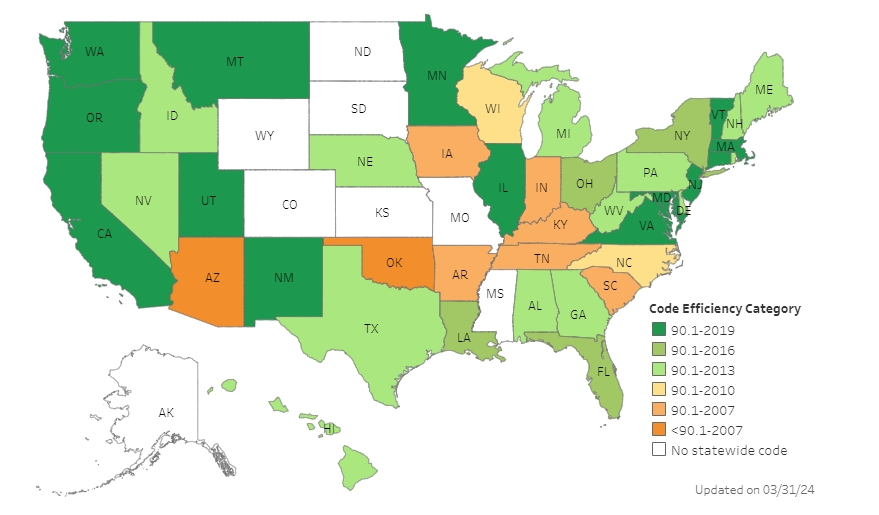
Extindeți pentru a vedea tabelul detaliat ↓
| Stat | Cod comercial actual | Categorie de eficiență a codului comercial |
|---|---|---|
| Alabama | 90.1-2013 | 90.1-2013 |
| Alaska | Niciunul la nivel de stat | Fără cod la nivel de stat |
| Arizona | Autonomie locală | <90.1-2007 |
| Arkansas | 2009 IECC și 90.1-2007 | 90.1-2007 |
| California | Standardele de Eficiență Energetică a Clădirilor din 2022 | 90.1-2019 |
| Colorado | Autonomie locală | Fără cod la nivel de stat |
| Connecticut | IECC 2021 și 90.1-2019 | 90.1-2019 |
| Delaware | IECC 2018 și 90.1-2016 | 90.1-2013 |
| Districtul Columbia | 90.1-2013^ | 90.1-2019 |
| Florida | IECC 2021 și 90.1-2019^ | 90.1-2016 |
| Georgia | IECC 2015 și 90.1-2013^ | 90.1-2013 |
| Hawaii | Autonomie locală | 90.1-2013 |
| Idaho | IECC 2018 și 90.1-2016 | 90.1-2013 |
| Illinois | IECC 2021 și 90.1-2019 | 90.1-2019 |
| Indiana | 90.1-2007 | 90.1-2007 |
| Iowa | 2012 IECC și 90.1-2010 | 90.1-2007 |
| Kansas | Autonomie locală | Fără cod la nivel de stat |
| Kentucky | 2012 IECC și 90.1-2010 | 90.1-2007 |
| Louisiana | IECC 2021 și 90.1-2019^ | 90.1-2016 |
| Maine | 2015 IECC și 90.1-2013 | 90.1-2013 |
| Maryland | IECC 2021 și 90.1-2019^ | 90.1-2019 |
| Massachusetts | 2018 IECC și 90.1-2016^ | 90.1-2019 |
| Michigan | IECC 2015 și 90.1-2013^ | 90.1-2013 |
| Minnesota | 90.1-2019^ | 90.1-2019 |
| Mississippi | Niciunul la nivel de stat | Fără cod la nivel de stat |
| Missouri | Autonomie locală | Fără cod la nivel de stat |
| Montana | IECC 2021 și 90.1-2019 | 90.1-2019 |
| Nebraska | IECC 2018 și 90.1-2016 | 90.1-2013 |
| Nevada | IECC 2018 și 90.1-2016 | 90.1-2013 |
| New Hampshire | 2018 IECC și 90.1-2016^ | 90.1-2013 |
| New Jersey | 90.1-2019 | 90.1-2019 |
| Noul Mexic | IECC 2021 și 90.1-2019^ | 90.1-2019 |
| New York | 2018 IECC și 90.1-2016^ | 90.1-2016 |
| Carolina de Nord | IECC 2015 și 90.1-2013^ | 90.1-2010 |
| Dakota de Nord | Autonomie locală | Fără cod la nivel de stat |
| Ohio | IECC 2021 și 90.1-2019^ | 90.1-2016 |
| Oklahoma | 2006 IECC și 90.1-2004 | <90.1-2007 |
| Oregon | 90.1-2019 | 90.1-2019 |
| Pennsylvania | IECC 2018 și 90.1-2016 | 90.1-2013 |
| Rhode Island | 2018 IECC și 90.1-2016^ | 90.1-2013 |
| Carolina de Sud | 2009 IECC și 90.1-2007 | 90.1-2007 |
| Dakota de Sud | Autonomie locală | Fără cod la nivel de stat |
| Tennessee | 2021 IECC și 90.1-2013 | 90.1-2007 |
| Texas | 2015 IECC și 90.1-2013 | 90.1-2013 |
| Utah | IECC 2021 și 90.1-2019^ | 90.1-2019 |
| Vermont | IECC 2021 și 90.1-2019^ | 90.1-2019 |
| Virginia | IECC 2021 și 90.1-2019^ | 90.1-2019 |
| Washington | Codul Energetic al Statului Washington din 2018 | 90.1-2019 |
| Tennessee | 2012 IECC și 90.1-2010 | 90.1-2007 |
| Texas | 2015 IECC și 90.1-2013 | 90.1-2013 |
| Utah | IECC 2021 și 90.1-2019^ | 90.1-2019 |
| Vermont | 2018 IECC și 90.1-2016^ | 90.1-2019 |
| Virginia | IECC 2021 și 90.1-2019^ | 90.1-2019 |
| Washington | Codul Energetic al Statului Washington din 2018 | 90.1-2019 |
| Virginia de Vest | 90.1-2013 | 90.1-2013 |
| Wisconsin | IECC 2015 și 90.1-2013^ | 90.1-2010 |
| Wyoming | Autonomie locală | Fără cod la nivel de stat |
- ^ When an amendment impacting energy efficiency can be quantified using DOE Prototype Building Models, they were captured in the analysis.
- For states adopting both IECC and 90.1, the IECC code is usually analyzed as the state current code in this study except for states with extensive amendments to the IECC.
Concepte cheie din ghidul de proiectare pentru grupuri sanitare
Proiectarea unei soluții eficiente din punct de vedere energetic pentru controlul iluminatului în grupurile sanitare implică plasarea strategică a senzorilor de prezență, pentru a asigura acoperirea completă a spațiului.
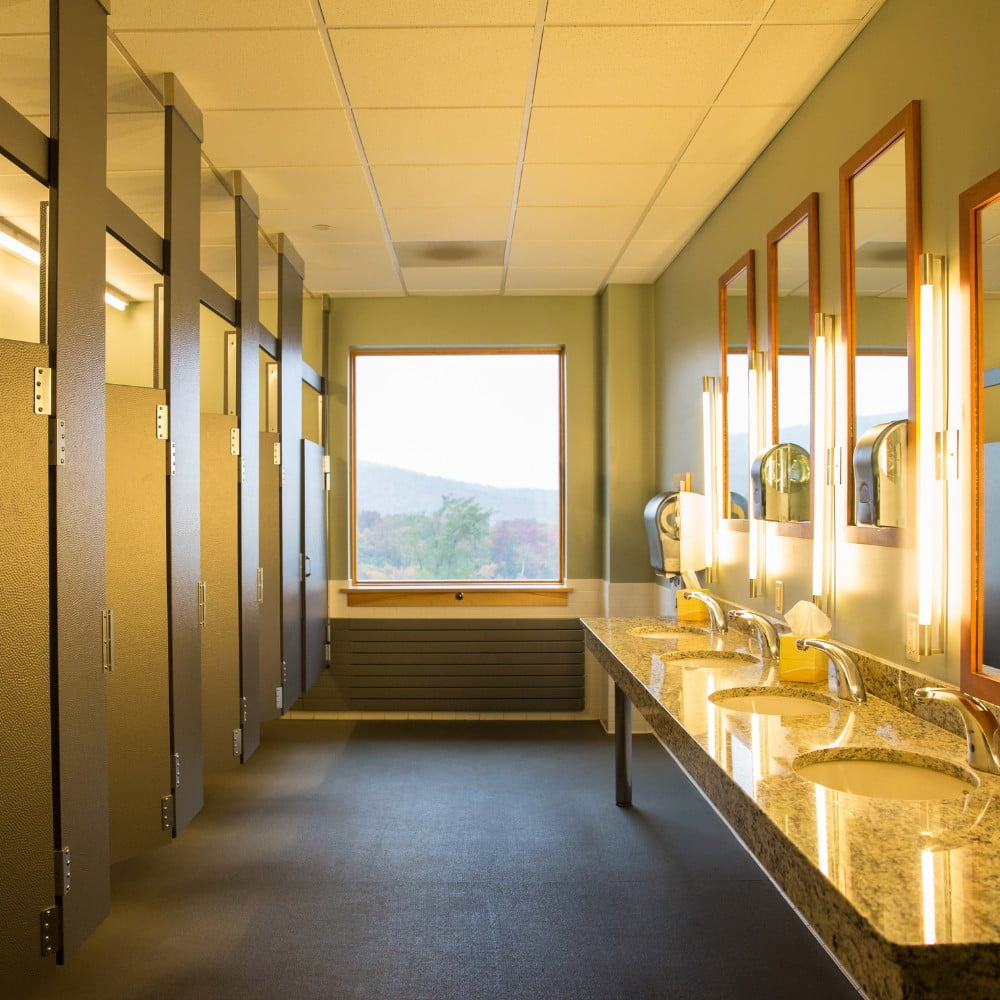
By following these guidelines, businesses can create an energy-efficient lighting control solution for restrooms that reduces energy waste, and lowers maintenance costs:
- Entrance Coverage: Install a wall occupancy sensor near the entrance to detect when someone enters the restroom. This sensor should be positioned high enough to avoid obstructions from the door and should not directly face the entrance to avoid false triggers from movement outside the restroom.
- Stall Coverage: Depending on customer preference for privacy, stalls can either be covered by a sensor or not. If stalls are not covered by a sensor, program a longer timeout (15 or 20 minutes) to prevent lights from turning off when someone is in the stall. If individual stall sensors are used, they should be installed in such a way that they do not detect movement outside the stall to avoid false triggers.
- Sink and Mirror Area: Install a ceiling occupancy sensor above the sink and mirror area. This sensor should be positioned to cover the entire area, ensuring that lights remain on when someone is using the sink or mirror.
- Avoidance of Air Vents: Do not mount sensors close to air vents, as the vibration and air flow can reduce the effectiveness of the sensor. PIR sensors should not be within 4ft of an air vent, and ultrasonic sensors should not be within 6ft of an air vent.
- Manual Control: Integrate manual control to turn ON/OFF all lighting with our occupancy/vacancy sensors. This allows for manual override of the lighting system if necessary.
Featured Products & Solutions
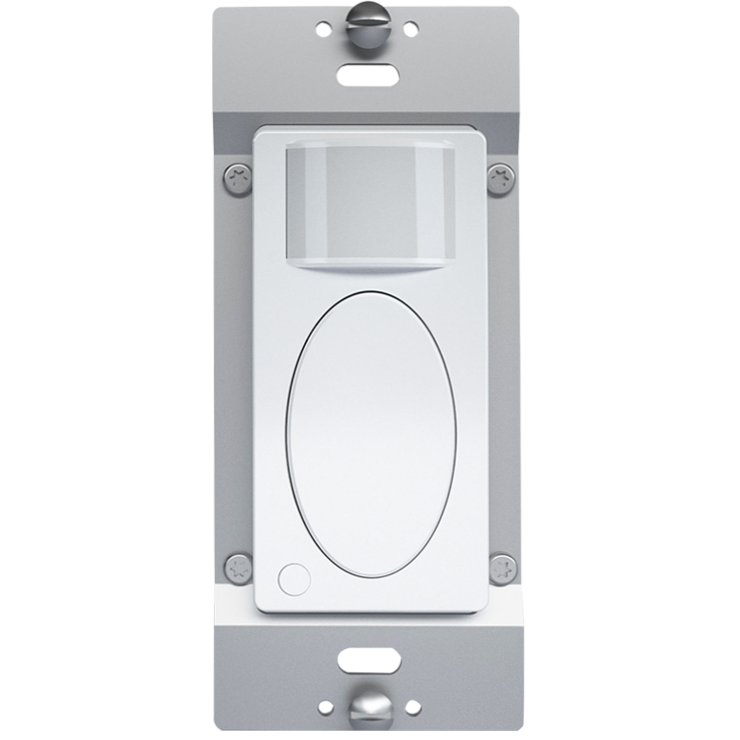
Wall Sensor Switches
RZ020/021 Motion Sensor Switches
- 2-wire, 3-wire, 4-wires wiring options
- Occupancy, Vacancy, Manual ON/OFF
- Adjustive time delay and ambient light control
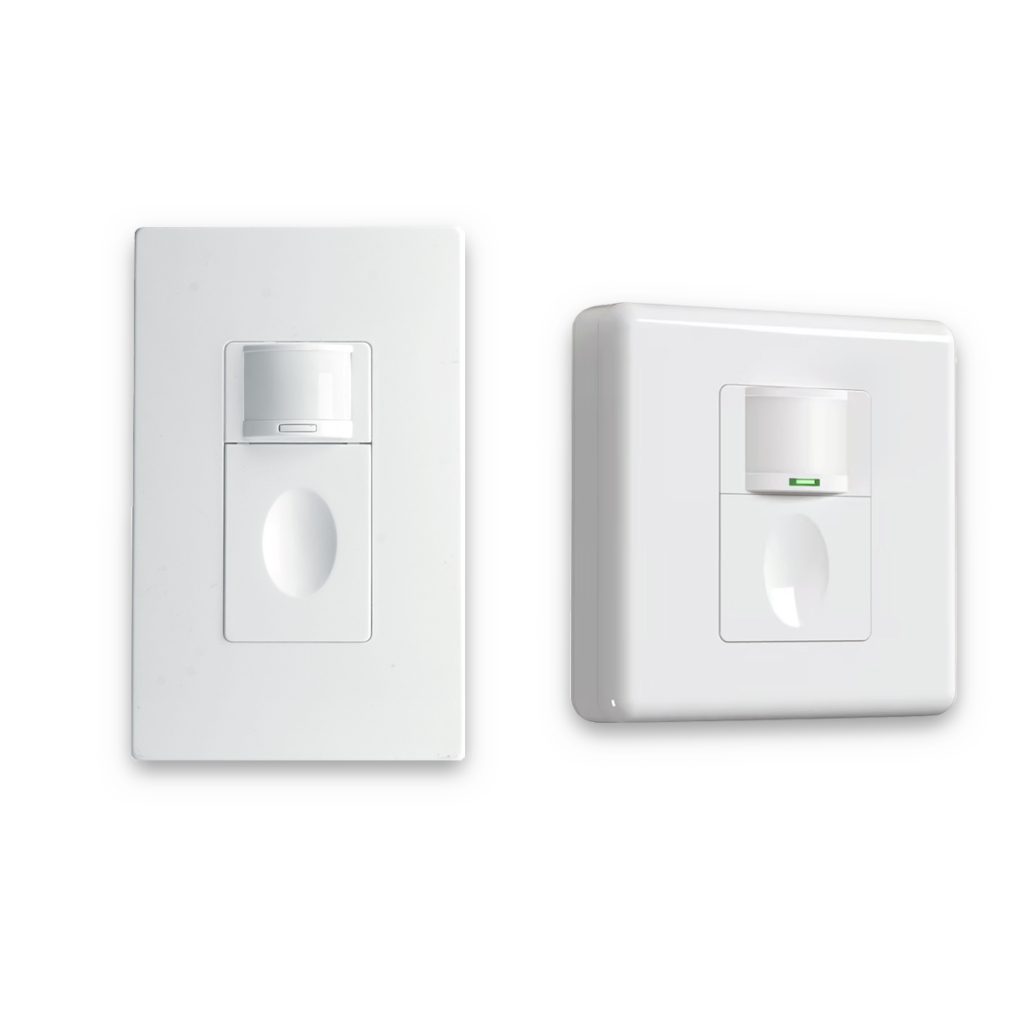
Multi-Location Wireless Wall Sensors
RZ020A/021A + RZ022W Kits
- Hardwired RZ021A/022A occupancy sensor switch
- Wireless companion switch (RZ022W) for multi-location control

Ceiling Occupancy Sensors
RZ036
- Hardwired occupancy sensors
- Auto ON, auto OFF
- Line voltage and Low voltage available
Core features included:
- Integrated manual ON/OFF control for all lighting
- Vacancy sensors (Manual ON only): Lights must be turned on manually only
- Adjustable time-delay, lighting is automatically turned full OFF after 15mins
- Additional: multi-location wireless kits to expand the control range without re-wring
- Additional: multiple wiring options available for both new constructions and retrofit projects.
Meets the Mandatory Provisions
IECC – 2011
C405.2.1 Occupant sensor controls
Occupant sensor controls shall be installed to control lights in the space.
C405.2.1.1 Occupant sensor control functions
- Manual on or partial on to no more than 50% power.
- Full off within 20 minutes after all occupants have left the space
- A manual control to turn off the lights.
**Full automatic-on controls with no manual control are permitted in restrooms where manual operation would endanger occupant safety or security.
ASHRAE 90.1 – 2022
Restrooms shall also be controlled by occupant sensors.
9.4.1.1 H Automatic full OFF control
All lighting in the space shall be automatically shut off within 20 minutes of all occupants leaving the space
Title 24 – 2022
130.1 (a) Manual area controls.
Each area enclosed by ceiling-height partitions shall provide lighting controls that allow the lighting in that area to be manually turned on and off.
** Restrooms having two or more stalls may use a manual control not accessible to unauthorized personnel.
130.1 (c) Shut-OFF Controls.
Lighting shall be controlled with occupant sensing controls to automatically shut OFF all of the lighting in 20 minutes or less after the control zone is unoccupied that shall function either as:
- A. Occupant sensing controls (if 130.1(b) not required to have multi-level lighting controls); or
- B. Partial-ON occupant sensing controls, or
- C. Vacancy sensing controls, where all lighting responds to a manual ON input only
Let us hear you.
Let Rayzeek help design and deliver a bespoke energy-saving lighting solution for you.