
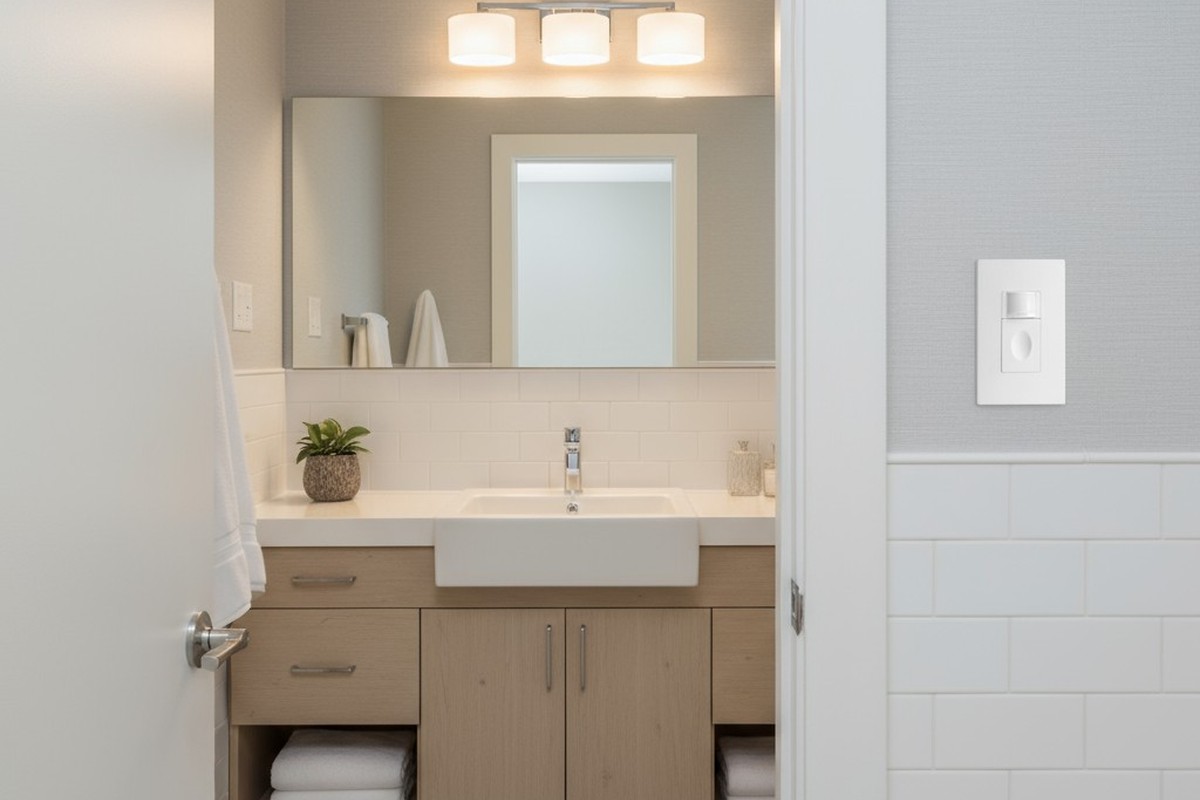
A bathroom fan with a humidity sensor seems like the perfect solution. It promises to activate precisely when you shower, run just long enough to clear the steam, and then shut itself off. The logic is airtight: showers create humidity, sensors detect it, and the fan removes it. It’s an elegant, automated loop.

Except it often doesn’t work. In the real world, humidity-based controls are surprisingly unreliable. Fans stay silent during odor-only bathroom visits. They fail to trigger after a hot shower in a dry climate. They shut off too quickly in a small powder room. The ideal of a perfectly calibrated, moisture-aware fan consistently fails the test of everyday life, forcing a reconsideration of what makes a ventilation system truly effective.
For most homes, a simpler approach is far more dependable: occupancy-based control with a post-run timer. This strategy trades the theoretical precision of a sensor for the practical certainty of human presence. When someone enters the bathroom, the fan runs. When they leave, a timer keeps it running for a set period. It’s predictable, climate-independent, and handles both moisture and odor without having to measure either. While humidity sensing has its niche, occupancy control is the superior default strategy.
How the Two Strategies Work
The two approaches operate on entirely different triggers and assumptions. One reacts to environmental change, while the other responds to human action.
Rayzeek人感センサーのポートフォリオを見る.
お探しの製品が見つかりませんか?ご安心ください。課題を解決する手段は常に複数存在します。当社の製品ポートフォリオのいずれかがお役に立つかもしれません。
Humidity Sensing: A Reactive Guess
A humidity sensor measures the relative humidity (RH) in the surrounding air—the amount of water vapor present compared to the maximum the air could hold at that temperature. The fan is triggered in one of two ways. Threshold triggering activates the fan when RH crosses a preset level, typically 50-70%. Delta triggering responds to a rapid rate of change, like a 10% RH increase in five minutes.
In either mode, the system is purely reactive. It waits for a significant moisture spike from a shower or bath, runs until the humidity drops back below the threshold, and then shuts off. It assumes that a measurable change in humidity is the only valid reason for ventilation.
Occupancy Control: An Event-Driven Certainty
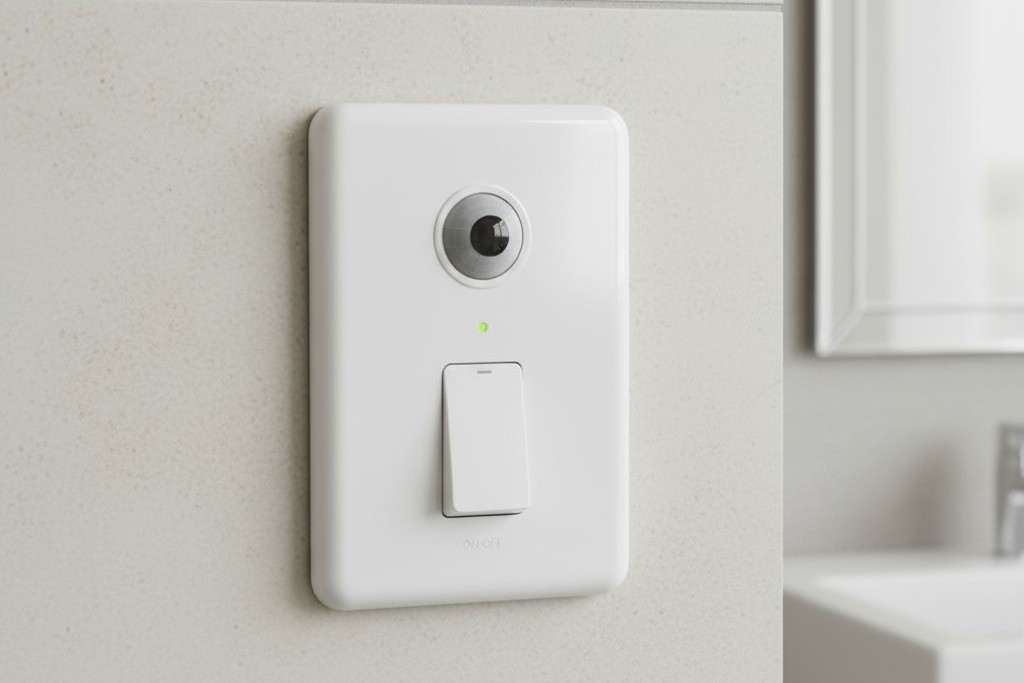
Occupancy control relies on a motion or presence sensor. When you enter the bathroom, the fan turns on immediately and runs as long as you’re there. The critical component is the post-occupancy timer. When you leave, the sensor detects your absence and starts a countdown, typically 10 to 20 minutes. The fan continues to run for this entire duration, ensuring a complete air exchange that removes both moisture and odor.
This behavior is deterministic. Presence guarantees activation; departure guarantees a thorough post-run. The system doesn’t interpret environmental data. It assumes every bathroom visit warrants ventilation and delivers it with mechanical consistency.
Where Humidity Sensing Breaks Down
The clean logic of humidity sensing conceals common failure modes. These aren’t rare malfunctions but predictable outcomes rooted in the physics of air and the patterns of daily life.
The Dry Climate Trap
Relative humidity is just that—relative. In an arid climate where baseline indoor humidity might be just 15%, a steamy shower can fog the mirror without ever pushing the RH past the sensor’s 50% trigger threshold. The bathroom might feel damp, but the absolute humidity change isn’t enough to register. Even a delta-based sensor might miss the event if the rise is too gradual. In climates where the ambient humidity rarely exceeds 40%, a standard humidity sensor becomes little more than a ceiling ornament.
The Small Bathroom Problem
In a small powder room, the limited air volume means moisture from handwashing or a quick shower can cause a rapid humidity spike. But that small volume also means the room equilibrates just as quickly. Air exchanges with the hallway under the door, and moisture diffuses into wall surfaces. The humidity spike can rise and fall before a sensor with conservative settings even registers it as an event worth addressing. The result is inconsistent performance, eroding any trust in the system.
Odor Is Not Moisture
The most fundamental flaw is categorical: a humidity sensor cannot detect odor. A bathroom visit that generates no steam produces no meaningful change in relative humidity. The sensor sees nothing, the fan stays off, and the odor lingers. Since odor control is a primary reason people want a bathroom fan, a system that is blind to this problem is fundamentally inadequate.
人感センサーを活用した省エネソリューションをお探しですか?
PIR人感センサー、人感センサー搭載省エネ製品、人感センサースイッチ、商業施設向けOccupancy/Vacancy(在室/不在)ソリューションについては、お気軽にお問い合わせください。
Why Occupancy Control Is More Reliable
Occupancy control sidesteps these issues by abandoning environmental measurement altogether. Its logic is simple and sound: if someone used the bathroom, ventilation is necessary.
This approach just works, everywhere. A home in Phoenix with 12% baseline humidity gets the same reliable fan operation as one in New Orleans with 65% humidity. The system is immune to climate because it responds only to a universal constant: human presence. It covers both moisture and odor comprehensively, because the post-run timer is set long enough to cycle the room’s air multiple times. A 15-minute run in a standard bathroom with an 80 CFM fan will exchange the entire volume of air three times over—more than enough to clear steam and smells.
The key is setting the timer correctly. A small powder room might only need 10 minutes, while a standard bathroom benefits from 15-20 minutes. Most occupancy controls have adjustable timers, allowing you to tune the run time to your specific needs.
Finally, the system is predictable. You know what it will do every time. It turns on when you enter and runs for a set time after you leave. There’s no mystery, no second-guessing if the conditions were “right.” This consistency builds trust and lets you forget about the fan entirely, because it behaves the same way every time.
When Humidity Sensing Still Makes Sense
Despite its flaws, humidity sensing excels in a few specific scenarios where its adaptive nature becomes an advantage.
Chronically Humid Climates

In coastal regions or areas with high annual rainfall, indoor humidity can consistently hover above 50-60%. Here, the low-baseline problem inverts. A shower will easily push the RH past a 70% threshold, making the sensor highly reliable. In this environment, a fixed 15-minute timer from an occupancy sensor might not be enough to bring the elevated humidity back to a safe level, increasing mold risk. A humidity sensor, however, will continue running until the job is done, providing a crucial adaptive response.
Shared or Commercial Bathrooms
In a multi-stall public restroom or a gym locker room, occupancy sensing is impractical. A motion sensor might never detect a true vacancy, causing the fan to run nonstop, or it might shut off while someone is in a stall outside its view. Here, humidity sensing or simple continuous ventilation is a better fit, as it can respond to the aggregate moisture load from multiple users.
Choosing the Right Strategy
For the vast majority of homes, the choice is clear.
For most residential bathrooms: Occupancy control with an adjustable 15-20 minute timer is the most reliable choice. It works consistently in any climate, handles both odor and moisture, and is completely predictable. This is especially true for homes in arid or moderate climates and for any small-to-medium-sized bathroom.
こちらの商品もおすすめです

- 電圧: 単4形乾電池 2本
- 昼/夜モード
- タイマー設定時間: 15分、30分、1時間(デフォルト)、2時間

- 無電圧接点リレー出力付き天井取り付け型PIR人感センサー
- 12/24VDCまたは12/24VAC低電圧電源
- EMS、HVAC、および建物制御入力用COM、NO、NC絶縁リレー接点

- 低電圧DC天井埋め込み型マイクロ波人感センサースイッチ
- 10~30 VDC範囲の12 VDC / 24 VDC入力
- 調整可能なタイムラグ、照度(Lux)閾値、感度を備えた最大動作電流10A仕様
- 高負荷対応型 埋込型天井取付けマイクロ波人感センサースイッチ
- 100-265 VAC 商用電源入力、10Aモデル
- 調整可能なタイムラグ、照度(Lux)閾値、感度を備えた5.8 GHzマイクロ波検知
- 埋込型天井取付けマイクロ波人感センサースイッチ
- 100-265 VAC商用電圧入力、5Aモデル
- 調整可能なタイムラグ、照度(Lux)閾値、感度を備えた5.8 GHzマイクロ波検知
- 220V電源対応 天井取付けRZ037 PIR(赤外線)人感センサー調光器
- 定格負荷660W、最大動作電流3A
- LUXボタンによる照度センサーのON/OFFおよびユーザー設定の調光明るさ制御
- 110V電源対応 天井取付けRZ037 PIR(赤外線)人感センサー調光器
- 定格負荷330W、最大動作電流3A
- LUXボタンによる照度センサーのON/OFFおよびユーザー設定の調光明るさ制御

- 低電圧DC対応 天井取付けマイクロ波人感センサースイッチ
- 10~30 VDC範囲の12 VDC / 24 VDC入力
- 調整可能なタイムラグ、照度(Lux)閾値、感度を備えた最大動作電流10A仕様
- 高負荷対応 天井取付型マイクロ波人感センサースイッチ
- 100-265 VAC 商用電源入力、10Aモデル
- 調整可能なタイムラグ、照度(Lux)閾値、感度を備えた5.8 GHzマイクロ波検知
- 天井取り付け型マイクロ波人感センサースイッチ
- 100-265 VAC商用電圧入力、5Aモデル
- 調整可能なタイムラグ、照度(Lux)閾値、感度を備えた5.8 GHzマイクロ波検知

- 低電圧DC埋込型天井PIR人感センサースイッチ
- 10~30 VDC範囲の12 VDC / 24 VDC入力
- 最大動作電流10A(調整可能なタイムラグ、照度閾値、感度設定付き)

- 高負荷対応 埋込型天井PIR人感センサースイッチ
- 100-265 VAC 商用電源入力、10Aモデル
- 360度検知(調整可能なタイムラグ、照度閾値、感度設定付き)
- 埋込型天井PIR人感センサースイッチ
- 100-265 VAC商用電圧入力、5Aモデル
- 360度検知(調整可能なタイムラグ、照度閾値、感度設定付き)

- 屋内用照明ON/OFF制御ワイヤレススイッチ&受信機キット
- 100-230VAC、50/60Hz、定格電流5A受信機
- 2.4GHz通信対応 CR2032電池駆動ワイヤレススイッチ
- Occupancy(自動点灯/自動消灯)
- 12–24V DC (10–30VDC)、最大10A
- 360°検知エリア、直径8–12m
- タイムラグ 15秒–30分
- 照度センサー オフ/15/25/35 Lux
- 高/低感度
- 自動点灯/自動消灯人感モード
- 100–265V AC, 10A(中性線必須)
- 360°検知範囲、検知直径8–12 m
- タイムデレイ15秒–30分、Lux OFF/15/25/35、感度 高/低
- 自動点灯/自動消灯人感モード
- 100–265V AC, 5A(中性線必須)
- 360°検知範囲、検知直径8–12 m
- タイムデレイ15秒–30分、Lux OFF/15/25/35、感度 高/低
For bathrooms in chronically humid climates: If your indoor RH is regularly above 50%, humidity sensing is a strong contender. The elevated baseline makes the sensor reliable, and its ability to run until the moisture is truly gone is a key advantage in preventing mold. A dual-mode system—triggering on occupancy but continuing to run based on humidity—offers the best of both worlds.
For large, complex bathrooms: A master bath over 100 square feet may benefit from a longer post-run timer (20-25 minutes) on an occupancy sensor, or a more sophisticated dual-mode controller.
The goal is to align the control strategy with the real-world conditions of the space. While humidity sensing offers a sophisticated, data-driven approach, it is a specialized tool that performs well only under specific conditions. Occupancy control is a general-purpose solution that sacrifices theoretical precision for practical reliability. In most bathrooms, reliability wins.







