
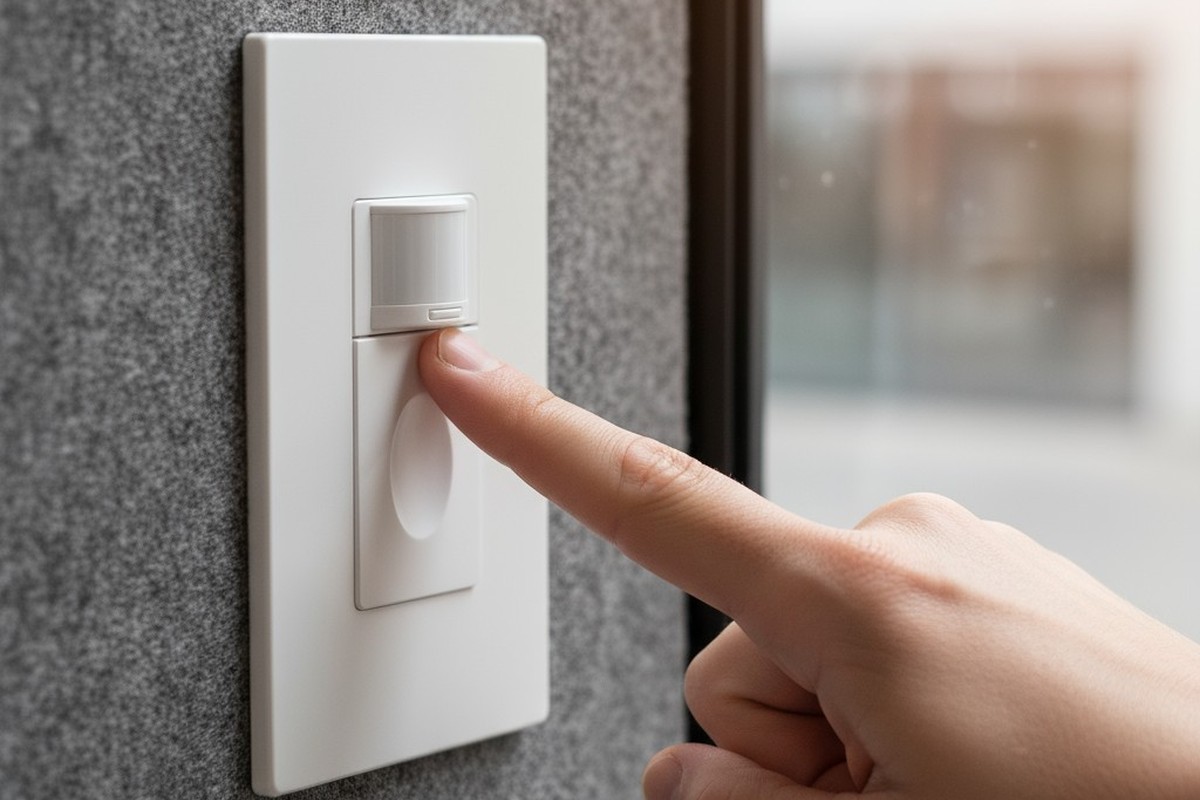
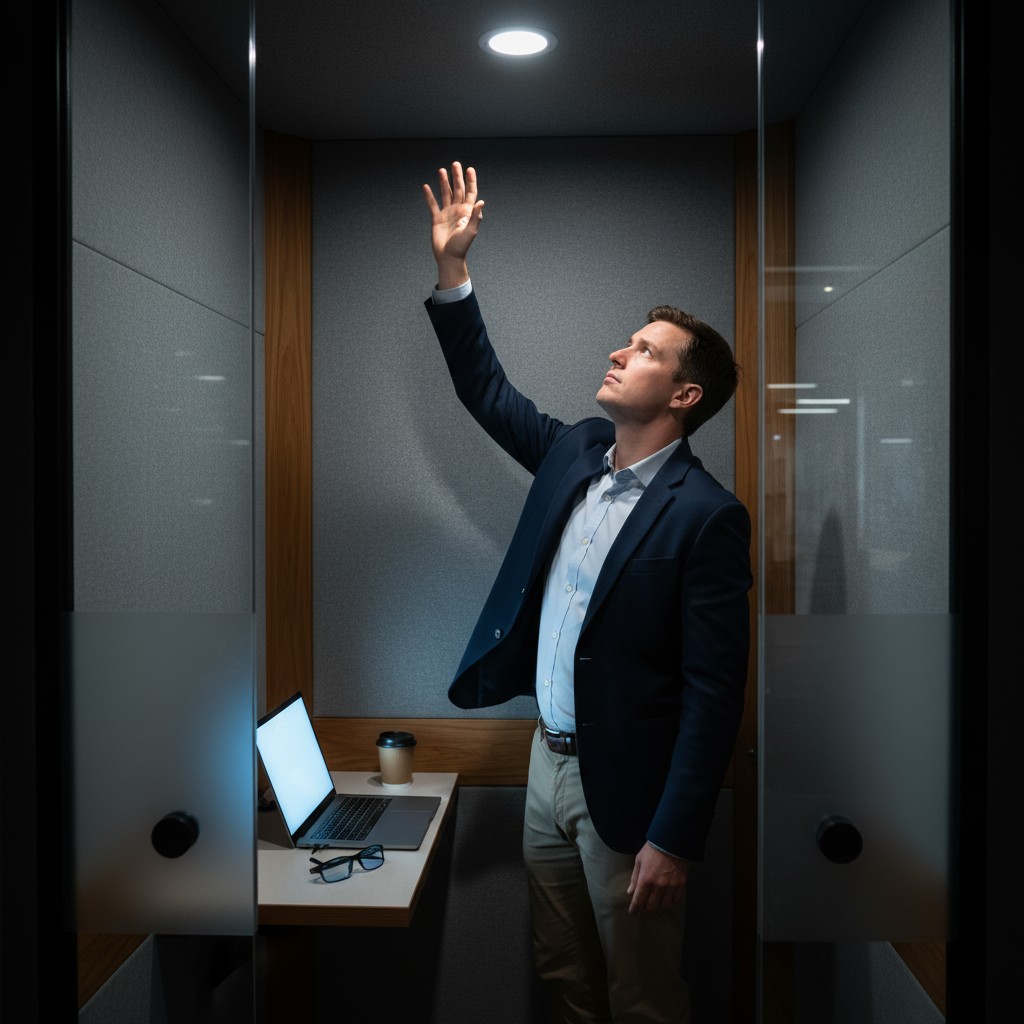
It’s a modern workplace cliché. You’re deep in a co-working phone booth, focused on a critical call, when the world suddenly goes black. A frantic wave of the arm restores the light, but the interruption is complete. Your flow is broken, and a low-grade anxiety sets in as you wait for the next plunge into darkness. This isn’t a random glitch. It’s a systemic design failure: technology intended for convenience actively undermining its user.
The failure stems from a basic misunderstanding of the space. A phone booth isn’t a transient hallway or a bustling restroom; it’s a space for focused, stationary work. Standard motion sensors, built for high traffic and big movements, are simply the wrong tool for the job. The answer isn’t a more complex sensor, but a more intelligent system. A properly designed system understands user behavior and uses smarter placement, better logic, and environmental awareness to create a seamless experience that never punishes someone for being quiet.
Diagnosing the Failure: The Limits of Overhead Passive Infrared Sensing
The culprit is almost always a device known as a Passive Infrared, or PIR, sensor. These sensors are the silent, low-cost gatekeepers of automated lighting in countless commercial spaces. In a phone booth, their failure isn’t a fault of the technology itself, but of its clumsy, conventional application.
How Standard PIR Sensors Detect Presence
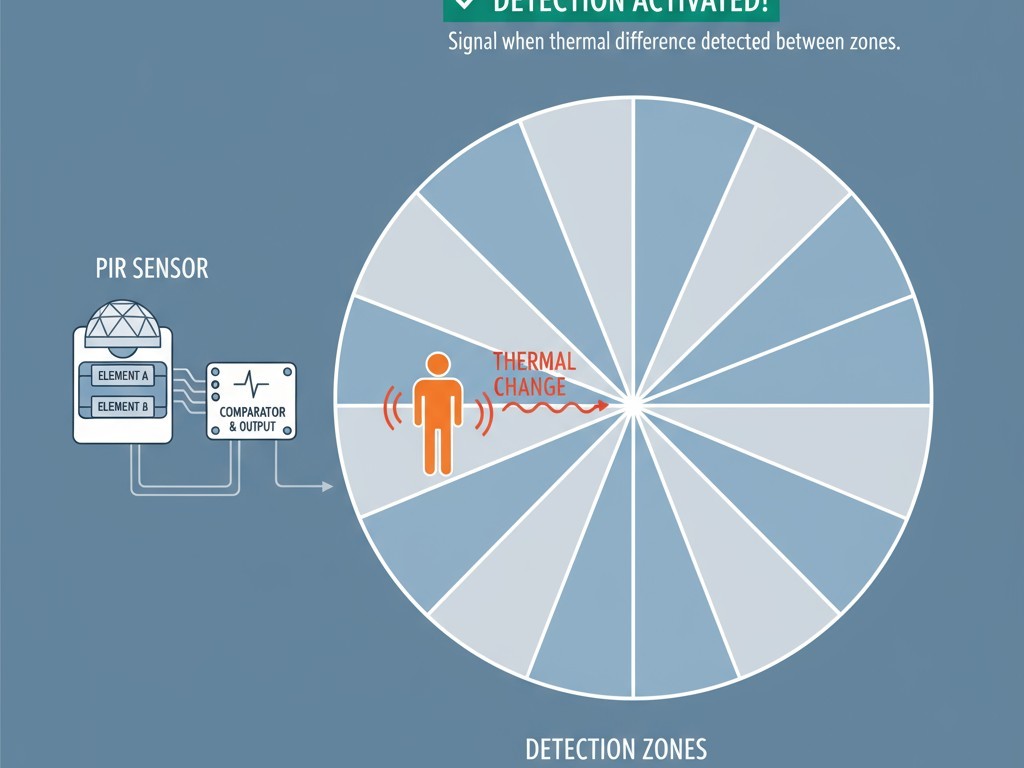
A PIR sensor doesn’t see people; it sees changes in thermal energy. Its lens divides the field of view into a grid of detection zones. When a warm body, like a person, moves from one zone to another, the sensor registers a differential in infrared radiation and triggers the light. The system is designed to detect motion, not static presence. If the thermal landscape remains unchanged for the sensor’s timeout period, the sensor assumes the room is empty and cuts the power.
Rayzeek人感センサーのポートフォリオを見る.
お探しの製品が見つかりませんか?ご安心ください。課題を解決する手段は常に複数存在します。当社の製品ポートフォリオのいずれかがお役に立つかもしれません。
The Challenge of the Still, Seated Occupant
The conventional placement for a PIR sensor is on the ceiling, looking down. While this provides excellent coverage in a large room, in a tiny phone booth it creates a critical blind spot. From an overhead perspective, a seated person is a very small and thermally uniform target. The head and shoulders don’t move much during a phone call. Minor shifts in posture, hand gestures, or turning the head often fail to create enough of a thermal differential to cross the sensor’s detection zones. To the overhead sensor, a quiet, focused person is indistinguishable from an empty room.
Rethinking Geometry: The Superiority of Sidewall Sensor Placement
The most direct solution to the detection problem is not to change the sensor, but to change its perspective. Moving the PIR sensor from the ceiling to a sidewall fundamentally alters the geometry of detection, making it far better suited to the phone booth environment.
Capturing the Seated Posture Profile
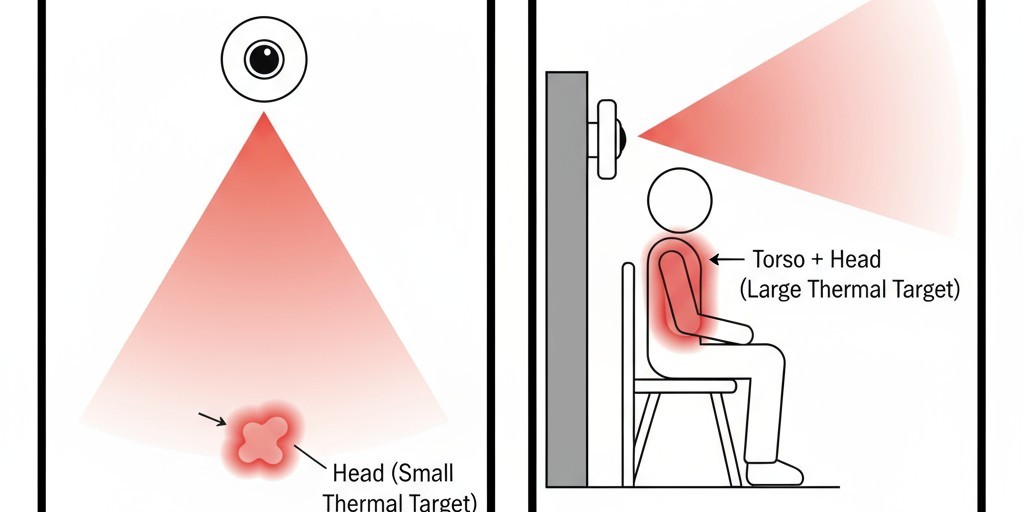
When placed on a sidewall at roughly the seated eye or shoulder level of an average user, the PIR sensor gets a completely different view. Instead of seeing a small circle representing the top of a head, it sees the entire thermal profile of the user’s torso, head, and arms. This larger thermal mass provides a much stronger signal. More importantly, small movements that are invisible from above become highly visible from the side. A slight lean, a hand gesture while talking, or turning to a notebook are all horizontal movements that will reliably cross the sensor’s detection zones.
Minimizing False Negatives Without Increasing False Positives
By aligning the sensor’s field of view with the occupant’s most likely axis of movement, sidewall placement dramatically reduces false negatives: the frustrating moments when the sensor fails to see a user who is still in the booth. This improvement doesn’t require cranking up the sensor’s sensitivity, which could cause false positives from vibrations or airflow. The solution is simply better-aligned data. The sensor is positioned to see the movements that actually happen, not forced to find a signal in the noise of a static overhead view.
Shifting the Default: From Occupancy Sensing to Intelligent Vacancy Mode
Solving the detection problem is only half the battle. The logic controlling the light also needs a rethink. The standard “occupancy” model, which automatically turns the light on and off, is fundamentally flawed for a space like a phone booth.
人感センサーを活用した省エネソリューションをお探しですか?
PIR人感センサー、人感センサー搭載省エネ製品、人感センサースイッチ、商業施設向けOccupancy/Vacancy(在室/不在)ソリューションについては、お気軽にお問い合わせください。
The Flaw in “Automatic On, Automatic Off” Logic
An automatic-on system assumes that anyone entering the booth needs the light. But a user might just be peeking inside to see if it’s free or grabbing a forgotten item. The auto-on light is a minor annoyance, but the automatic-off function is the real problem. It puts the user in a constant, low-level battle with the timer, setting the system’s logic directly at odds with the user’s need for focus.
Implementing a Manual-On System with Humane Timeouts
A far more robust and user-centric approach is a “vacancy” model. Here, the user manually turns the light on with a simple push-button, a single action that confirms their intent to occupy the space. The sensor’s role then shifts: its only job is to turn the light off after it has confirmed the space is vacant. The PIR sensor, now properly placed on the sidewall, works with a timer to determine when the occupant has left.
An essential detail is the humane timeout. Instead of an abrupt cutoff, a well-designed system provides a warning. For example, 30 seconds before the timeout expires, the light could dim to 50 percent. This subtle cue alerts the user, who can make a small movement to reset the timer without a jarring plunge into darkness. It transforms the interaction from adversarial to cooperative.
Solving the Blinding Entry: Integrating Photo-Thresholds for Adaptive Lighting
That cooperative spirit should extend to the very first moment a user enters the booth. Stepping out of a brightly lit corridor and into a dark phone booth, a person can be momentarily blinded if the light snaps on at full intensity. This is another small but significant point of friction that a thoughtful system can eliminate.
By incorporating a simple photocell, or photo-threshold sensor, the control system can become aware of its surroundings. The photocell measures the ambient light outside the booth. If it detects a bright environment, the controller can be programmed to turn the light on at a lower intensity, perhaps 30 or 40 percent, allowing the user’s eyes to adjust comfortably. The user can then choose to increase the brightness manually if needed. It’s a small detail that signals a high level of design thoughtfulness.
こちらの商品もおすすめです

- 電圧: 単4形乾電池 2本
- 昼/夜モード
- タイマー設定時間: 15分、30分、1時間(デフォルト)、2時間

- 無電圧接点リレー出力付き天井取り付け型PIR人感センサー
- 12/24VDCまたは12/24VAC低電圧電源
- EMS、HVAC、および建物制御入力用COM、NO、NC絶縁リレー接点

- 低電圧DC天井埋め込み型マイクロ波人感センサースイッチ
- 10~30 VDC範囲の12 VDC / 24 VDC入力
- 調整可能なタイムラグ、照度(Lux)閾値、感度を備えた最大動作電流10A仕様
- 高負荷対応型 埋込型天井取付けマイクロ波人感センサースイッチ
- 100-265 VAC 商用電源入力、10Aモデル
- 調整可能なタイムラグ、照度(Lux)閾値、感度を備えた5.8 GHzマイクロ波検知
- 埋込型天井取付けマイクロ波人感センサースイッチ
- 100-265 VAC商用電圧入力、5Aモデル
- 調整可能なタイムラグ、照度(Lux)閾値、感度を備えた5.8 GHzマイクロ波検知
- 220V電源対応 天井取付けRZ037 PIR(赤外線)人感センサー調光器
- 定格負荷660W、最大動作電流3A
- LUXボタンによる照度センサーのON/OFFおよびユーザー設定の調光明るさ制御
- 110V電源対応 天井取付けRZ037 PIR(赤外線)人感センサー調光器
- 定格負荷330W、最大動作電流3A
- LUXボタンによる照度センサーのON/OFFおよびユーザー設定の調光明るさ制御

- 低電圧DC対応 天井取付けマイクロ波人感センサースイッチ
- 10~30 VDC範囲の12 VDC / 24 VDC入力
- 調整可能なタイムラグ、照度(Lux)閾値、感度を備えた最大動作電流10A仕様
- 高負荷対応 天井取付型マイクロ波人感センサースイッチ
- 100-265 VAC 商用電源入力、10Aモデル
- 調整可能なタイムラグ、照度(Lux)閾値、感度を備えた5.8 GHzマイクロ波検知
- 天井取り付け型マイクロ波人感センサースイッチ
- 100-265 VAC商用電圧入力、5Aモデル
- 調整可能なタイムラグ、照度(Lux)閾値、感度を備えた5.8 GHzマイクロ波検知

- 低電圧DC埋込型天井PIR人感センサースイッチ
- 10~30 VDC範囲の12 VDC / 24 VDC入力
- 最大動作電流10A(調整可能なタイムラグ、照度閾値、感度設定付き)

- 高負荷対応 埋込型天井PIR人感センサースイッチ
- 100-265 VAC 商用電源入力、10Aモデル
- 360度検知(調整可能なタイムラグ、照度閾値、感度設定付き)
- 埋込型天井PIR人感センサースイッチ
- 100-265 VAC商用電圧入力、5Aモデル
- 360度検知(調整可能なタイムラグ、照度閾値、感度設定付き)

- 屋内用照明ON/OFF制御ワイヤレススイッチ&受信機キット
- 100-230VAC、50/60Hz、定格電流5A受信機
- 2.4GHz通信対応 CR2032電池駆動ワイヤレススイッチ
- Occupancy(自動点灯/自動消灯)
- 12–24V DC (10–30VDC)、最大10A
- 360°検知エリア、直径8–12m
- タイムラグ 15秒–30分
- 照度センサー オフ/15/25/35 Lux
- 高/低感度
- 自動点灯/自動消灯人感モード
- 100–265V AC, 10A(中性線必須)
- 360°検知範囲、検知直径8–12 m
- タイムデレイ15秒–30分、Lux OFF/15/25/35、感度 高/低
- 自動点灯/自動消灯人感モード
- 100–265V AC, 5A(中性線必須)
- 360°検知範囲、検知直径8–12 m
- タイムデレイ15秒–30分、Lux OFF/15/25/35、感度 高/低
The Case for Simplicity: Why Tuned PIR Outperforms Ultrasonic Complexity
When faced with the limits of a standard PIR setup, some are tempted to reach for more complex technology like ultrasonic sensors. While these devices work by bouncing sound waves off objects and can detect very fine motion, for a phone booth they are often an over-engineered and inferior solution. Ultrasonic sensors are more expensive and can be triggered by non-human factors, like the vibration from a ventilation fan or fluttering papers. They solve the “still user” problem but can introduce a new set of reliability issues.
This brings us to a core principle of intelligent design: the goal isn’t to use the most powerful technology, but the most appropriate one. A simple, reliable PIR sensor, when implemented with thoughtful design—correct sidewall placement, vacancy-based logic, and adaptive photo-thresholds—creates a system that is robust, cost-effective, and perfectly tuned to its purpose. It simply works, disappearing into the background so the user can focus on theirs.







