
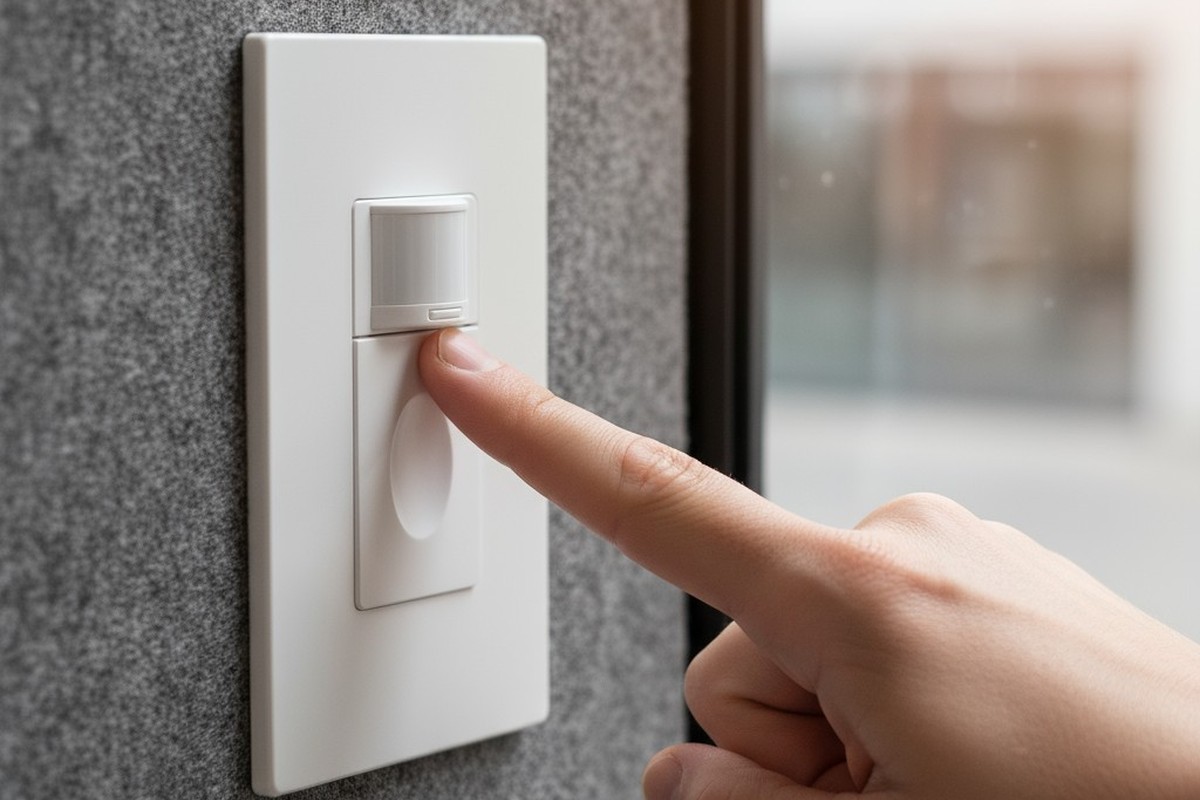
It’s a modern workplace cliché. You’re deep in a co-working phone booth, focused on a critical call, when the world suddenly goes black. A frantic wave of the arm restores the light, but the interruption is complete. Your flow is broken, and a low-grade anxiety sets in as you wait for the next plunge into darkness. This isn’t a random glitch. It’s a systemic design failure: technology intended for convenience actively undermining its user.
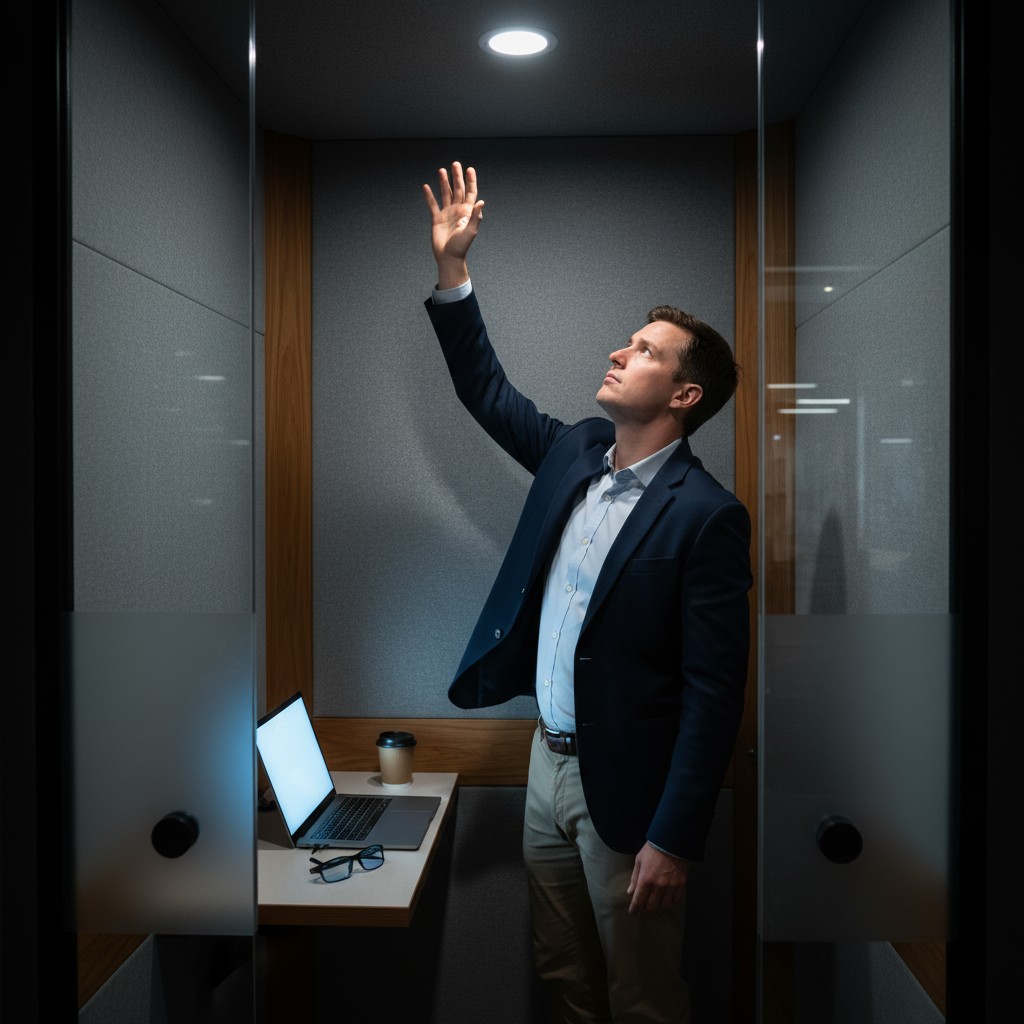
The failure stems from a basic misunderstanding of the space. A phone booth isn’t a transient hallway or a bustling restroom; it’s a space for focused, stationary work. Standard motion sensors, built for high traffic and big movements, are simply the wrong tool for the job. The answer isn’t a more complex sensor, but a more intelligent system. A properly designed system understands user behavior and uses smarter placement, better logic, and environmental awareness to create a seamless experience that never punishes someone for being quiet.
Diagnosing the Failure: The Limits of Overhead Passive Infrared Sensing
The culprit is almost always a device known as a Passive Infrared, or PIR, sensor. These sensors are the silent, low-cost gatekeepers of automated lighting in countless commercial spaces. In a phone booth, their failure isn’t a fault of the technology itself, but of its clumsy, conventional application.
How Standard PIR Sensors Detect Presence
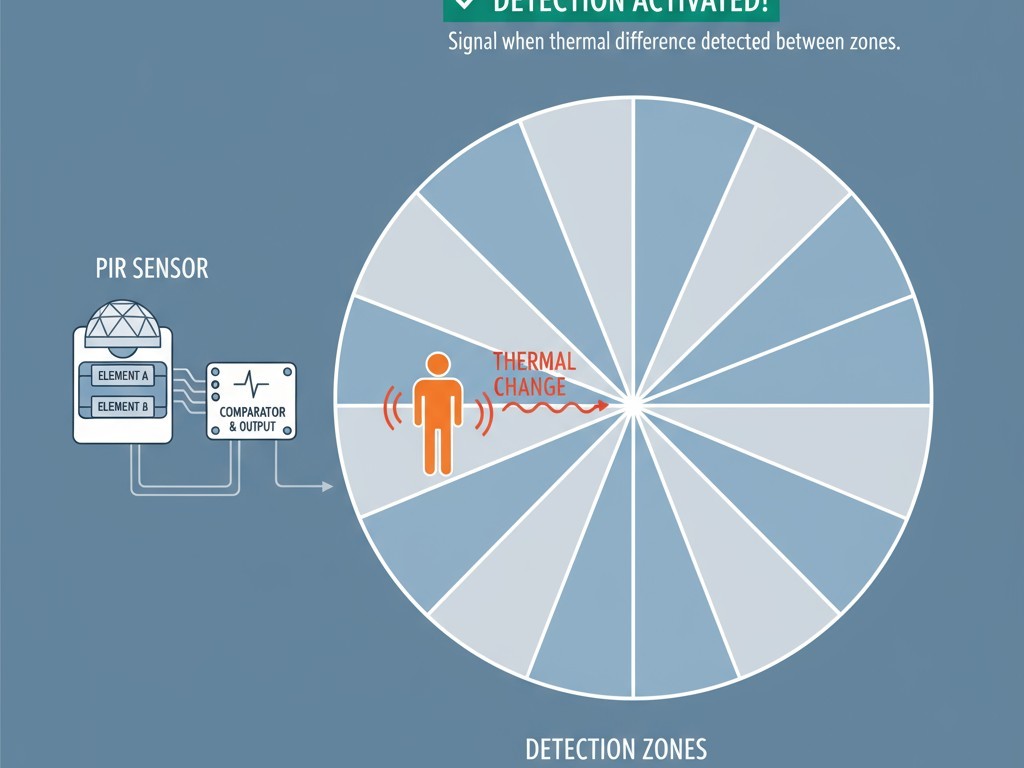
A PIR sensor doesn’t see people; it sees changes in thermal energy. Its lens divides the field of view into a grid of detection zones. When a warm body, like a person, moves from one zone to another, the sensor registers a differential in infrared radiation and triggers the light. The system is designed to detect motion, not static presence. If the thermal landscape remains unchanged for the sensor’s timeout period, the sensor assumes the room is empty and cuts the power.
Inspirujte se portfoliem snímačů pohybu Rayzeek.
Nenašli jste, co hledáte? Nemějte obavy. K vyřešení vašich požadavků existují vždy alternativní cesty. Možná vám pomůže některé z našich portfolií.
The Challenge of the Still, Seated Occupant
The conventional placement for a PIR sensor is on the ceiling, looking down. While this provides excellent coverage in a large room, in a tiny phone booth it creates a critical blind spot. From an overhead perspective, a seated person is a very small and thermally uniform target. The head and shoulders don’t move much during a phone call. Minor shifts in posture, hand gestures, or turning the head often fail to create enough of a thermal differential to cross the sensor’s detection zones. To the overhead sensor, a quiet, focused person is indistinguishable from an empty room.
Rethinking Geometry: The Superiority of Sidewall Sensor Placement
The most direct solution to the detection problem is not to change the sensor, but to change its perspective. Moving the PIR sensor from the ceiling to a sidewall fundamentally alters the geometry of detection, making it far better suited to the phone booth environment.
Capturing the Seated Posture Profile
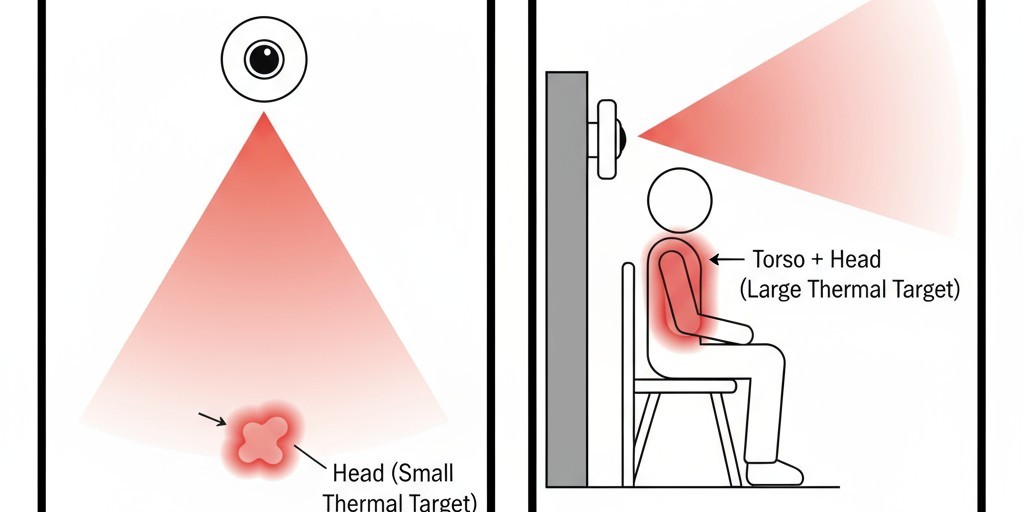
When placed on a sidewall at roughly the seated eye or shoulder level of an average user, the PIR sensor gets a completely different view. Instead of seeing a small circle representing the top of a head, it sees the entire thermal profile of the user’s torso, head, and arms. This larger thermal mass provides a much stronger signal. More importantly, small movements that are invisible from above become highly visible from the side. A slight lean, a hand gesture while talking, or turning to a notebook are all horizontal movements that will reliably cross the sensor’s detection zones.
Minimizing False Negatives Without Increasing False Positives
By aligning the sensor’s field of view with the occupant’s most likely axis of movement, sidewall placement dramatically reduces false negatives: the frustrating moments when the sensor fails to see a user who is still in the booth. This improvement doesn’t require cranking up the sensor’s sensitivity, which could cause false positives from vibrations or airflow. The solution is simply better-aligned data. The sensor is positioned to see the movements that actually happen, not forced to find a signal in the noise of a static overhead view.
Shifting the Default: From Occupancy Sensing to Intelligent Vacancy Mode
Solving the detection problem is only half the battle. The logic controlling the light also needs a rethink. The standard “occupancy” model, which automatically turns the light on and off, is fundamentally flawed for a space like a phone booth.
Hledáte úsporná řešení aktivovaná pohybem?
Kontaktujte nás pro kompletní PIR snímače pohybu, úsporné produkty aktivované pohybem, spínače s pohybovým senzorem a komerční řešení pro detekci přítomnosti či nepřítomnosti osob.
The Flaw in “Automatic On, Automatic Off” Logic
An automatic-on system assumes that anyone entering the booth needs the light. But a user might just be peeking inside to see if it’s free or grabbing a forgotten item. The auto-on light is a minor annoyance, but the automatic-off function is the real problem. It puts the user in a constant, low-level battle with the timer, setting the system’s logic directly at odds with the user’s need for focus.
Implementing a Manual-On System with Humane Timeouts
A far more robust and user-centric approach is a “vacancy” model. Here, the user manually turns the light on with a simple push-button, a single action that confirms their intent to occupy the space. The sensor’s role then shifts: its only job is to turn the light off after it has confirmed the space is vacant. The PIR sensor, now properly placed on the sidewall, works with a timer to determine when the occupant has left.
An essential detail is the humane timeout. Instead of an abrupt cutoff, a well-designed system provides a warning. For example, 30 seconds before the timeout expires, the light could dim to 50 percent. This subtle cue alerts the user, who can make a small movement to reset the timer without a jarring plunge into darkness. It transforms the interaction from adversarial to cooperative.
Solving the Blinding Entry: Integrating Photo-Thresholds for Adaptive Lighting
That cooperative spirit should extend to the very first moment a user enters the booth. Stepping out of a brightly lit corridor and into a dark phone booth, a person can be momentarily blinded if the light snaps on at full intensity. This is another small but significant point of friction that a thoughtful system can eliminate.
By incorporating a simple photocell, or photo-threshold sensor, the control system can become aware of its surroundings. The photocell measures the ambient light outside the booth. If it detects a bright environment, the controller can be programmed to turn the light on at a lower intensity, perhaps 30 or 40 percent, allowing the user’s eyes to adjust comfortably. The user can then choose to increase the brightness manually if needed. It’s a small detail that signals a high level of design thoughtfulness.
Mohlo by vás také zajímat

- Napětí: 2 baterie AAA
- Režim Den/Noc
- Časové zpoždění: 15 min, 30 min, 1 h (výchozí), 2 h

- Stropní PIR snímač přítomnosti s výstupem relé s beznapěťovým kontaktem
- Nízkonapěťové napájení 12/24VDC nebo 12/24VAC
- Isolované kontakty relé COM, NO a NC pro vstupy systémů EMS, HVAC a řízení budov

- Nízkonapěťový stejnosměrný vestavný stropní mikrovlnný spínač snímače pohybu
- Vstup 12 VDC / 24 VDC s rozsahem 10–30 VDC
- Maximální pracovní proud 10 A s nastavitelným časovým zpožděním, prahem Lux a citlivostí
- Vestavný stropní mikrovlnný spínač snímače pohybu pro vyšší zátěž
- Síťové vstupní napětí 100–265 VAC, model 10A
- Mikrovlnné snímání 5.8 GHz s nastavitelnou časovou prodlevou, prahem Lux a citlivostí
- Vestavný stropní mikrovlnný spínač senzoru pohybu
- Síťové vstupní napětí 100–265 VAC, model 5A
- Mikrovlnné snímání 5.8 GHz s nastavitelnou časovou prodlevou, prahem Lux a citlivostí
- Stropní RZ037 PIR senzor přítomnosti se stmívačem pro napájení 220V
- Maximální pracovní proud 3A s jmenovitým zatížením 660W
- Tlačítko LUX ovládá zapnutí/vypnutí světelného senzoru a uživatelsky nastavený jas stmívání
- Stropní RZ037 PIR senzor přítomnosti se stmívačem pro napájení 110V
- Maximální pracovní proud 3A s jmenovitým zatížením 330W
- Tlačítko LUX ovládá zapnutí/vypnutí světelného senzoru a uživatelsky nastavený jas stmívání

- Nízkonapěťový stejnosměrný stropní mikrovlnný spínač senzoru pohybu
- Vstup 12 VDC / 24 VDC s rozsahem 10–30 VDC
- Maximální pracovní proud 10 A s nastavitelným časovým zpožděním, prahem Lux a citlivostí
- Stropní mikrovlnný spínač senzoru pohybu pro vyšší zatížení
- Síťové vstupní napětí 100–265 VAC, model 10A
- Mikrovlnné snímání 5.8 GHz s nastavitelnou časovou prodlevou, prahem Lux a citlivostí
- Stropní mikrovlnný spínač s pohybovým senzorem
- Síťové vstupní napětí 100–265 VAC, model 5A
- Mikrovlnné snímání 5.8 GHz s nastavitelnou časovou prodlevou, prahem Lux a citlivostí

- Nízkonapěťový stejnosměrný vestavný stropní spínač s PIR pohybovým senzorem
- Vstup 12 VDC / 24 VDC s rozsahem 10–30 VDC
- Maximální pracovní proud 10A s nastavitelným časovým zpožděním, prahem Lux a citlivostí

- Vestavný stropní spínač s PIR pohybovým senzorem pro vyšší zátěž
- Síťové vstupní napětí 100–265 VAC, model 10A
- 360stupňová detekce s nastavitelným časovým zpožděním, prahem Lux a citlivostí
- Vestavný stropní spínač s PIR pohybovým senzorem
- Síťové vstupní napětí 100–265 VAC, model 5A
- 360stupňová detekce s nastavitelným časovým zpožděním, prahem Lux a citlivostí

- Sada bezdrátového spínače a přijímače pro vnitřní řízení osvětlení ZAP/VYP
- Přijímač 100-230VAC, 50/60Hz s jmenovitým proudem 5A
- Bezdrátový spínač napájený baterií CR2032 s komunikací 2,4GHz
- Detekce přítomnosti (Automatické ZAP/Automatické VYP)
- 12–24V DC (10–30VDC), až 10A
- Pokrytí 360°, průměr 8–12 m
- Časové zpoždění 15 s–30 min
- Snímač jasu Vypnuto / 15 / 25 / 35 Lux
- Vysoká/nízká citlivost
- Režim detekce přítomnosti s automatickým zapnutím/vypnutím
- 100–265V AC, 10A (vyžaduje nulový vodič)
- 360° pokrytí; průměr detekce 8–12 m
- Časové zpoždění 15 s – 30 min; Lux VYPNUTO / 15 / 25 / 35; citlivost vysoká/nízká
- Režim detekce přítomnosti s automatickým zapnutím/vypnutím
- 100–265V AC, 5A (vyžaduje nulový vodič)
- 360° pokrytí; průměr detekce 8–12 m
- Časové zpoždění 15 s – 30 min; Lux VYPNUTO / 15 / 25 / 35; citlivost vysoká/nízká
The Case for Simplicity: Why Tuned PIR Outperforms Ultrasonic Complexity
When faced with the limits of a standard PIR setup, some are tempted to reach for more complex technology like ultrasonic sensors. While these devices work by bouncing sound waves off objects and can detect very fine motion, for a phone booth they are often an over-engineered and inferior solution. Ultrasonic sensors are more expensive and can be triggered by non-human factors, like the vibration from a ventilation fan or fluttering papers. They solve the “still user” problem but can introduce a new set of reliability issues.
This brings us to a core principle of intelligent design: the goal isn’t to use the most powerful technology, but the most appropriate one. A simple, reliable PIR sensor, when implemented with thoughtful design—correct sidewall placement, vacancy-based logic, and adaptive photo-thresholds—creates a system that is robust, cost-effective, and perfectly tuned to its purpose. It simply works, disappearing into the background so the user can focus on theirs.







