
Open Offices
Scopri la potenza del controllo automatico dell'illuminazione per migliorare l'efficienza e ridurre gli sprechi energetici. Scopri come ottimizzare il controllo dell'illuminazione per garantire efficienza e comfort nel tuo ambiente di lavoro.

Revolutionize Your Open Office Lighting with Smart Occupancy Sensors
Open offices, characterized by their large areas and cubicle partitions, are a common sight in many modern workplaces. These spaces are typically bustling with activity, filled with employees working, collaborating, and moving around. The expansive area requires ample illumination, often provided by high-intensity light fixtures. These lights, left on throughout the workday, consume a substantial amount of energy. Moreover, even when the office is vacant, during off-hours or lunch breaks, the lights often remain on, leading to unnecessary energy consumption.
The high energy consumption of lighting in open offices is a concern for both environmental and economic reasons. With the increasing emphasis on energy efficiency and sustainability, businesses are seeking ways to reduce their energy footprint. Moreover, energy costs can account for a significant portion of a company’s operating expenses, making energy-saving measures a smart financial decision as well.
To address this, the integration of occupancy sensors in open offices presents a compelling solution. Occupancy sensors can automatically control lighting based on the presence of individuals in the space, significantly reducing unnecessary energy consumption. When the office is vacant, the sensors can automatically switch off or dim the lights, thereby conserving energy. With our sensors seamlessly integrated into your open office layout, you can transform your open office into an energy-efficient workspace that meets the stringent requirements of US Energy Codes.
Rispettare i codici energetici

L'International Energy Conservation Code (IECC) è un modello di codice sviluppato dall'International Code Council (ICC) per stabilire i requisiti minimi di progettazione e costruzione volti all'efficienza energetica degli edifici. L'IECC viene aggiornato ogni tre anni per integrare le più recenti prassi e tecnologie nel campo del risparmio energetico.
IECC: perché è importante
L'IECC è ampiamente adottato da stati e comuni negli Stati Uniti. Copre vari aspetti dell'uso dell'energia, tra cui l'involucro edilizio (pareti, tetti e finestre), gli impianti di riscaldamento e raffrescamento e i sistemi di illuminazione.
L'IECC impone controlli dell'illuminazione specifici, come i sensori di presenza, per ridurre al minimo lo spreco di energia negli spazi non occupati in diverse aree.

Lo standard ANSI/ASHRAE/IES 90.1, Energy Standard for Sites and Buildings Except Low-Rise Residential Buildings, è uno standard energetico ampiamente riconosciuto e pubblicato dall'American Society of Heating, Refrigerating and Air-Conditioning Engineers (ASHRAE).
ASHRAE 90.1: perché è importante
Lo standard ASHRAE 90.1 viene utilizzato come punto di riferimento per i codici energetici degli edifici in tutti gli Stati Uniti e funge da percorso di conformità all'interno dell'IECC; definisce i requisiti minimi per le prestazioni di efficienza energetica dei componenti degli edifici commerciali, inclusi involucri edilizi, sistemi HVAC, sistemi di riscaldamento dell'acqua e impianti di illuminazione.
Lo standard ASHRAE 90.1 specifica le densità di potenza massima consentite per l'illuminazione e i requisiti minimi di controllo dell'illuminazione, compreso l'uso di sensori di presenza in aree specifiche.

Il Title 24, parte 6 del California Building Standards Code, ufficialmente noto come Building Energy Efficiency Standards for Residential and Nonresidential Buildings, è amministrato dalla California Energy Commission e viene aggiornato periodicamente per riflettere le nuove tecnologie e metodologie di efficienza energetica.
Title 24: perché è importante
Il Title 24 è noto per i suoi requisiti rigorosi, spesso considerati più severi rispetto a quelli di molti altri codici energetici negli Stati Uniti. Il Title 24 impone severi standard di prestazione energetica per tutti gli aspetti della costruzione di un edificio, tra cui riscaldamento, ventilazione, aria condizionata (HVAC), riscaldamento dell'acqua e illuminazione.
Il Title 24 richiede l'installazione di sensori di presenza che regolino l'illuminazione in base all'occupazione della stanza in specifiche aree degli edifici commerciali, in modo da evitare sprechi di energia.
Adozione dei codici energetici per stato
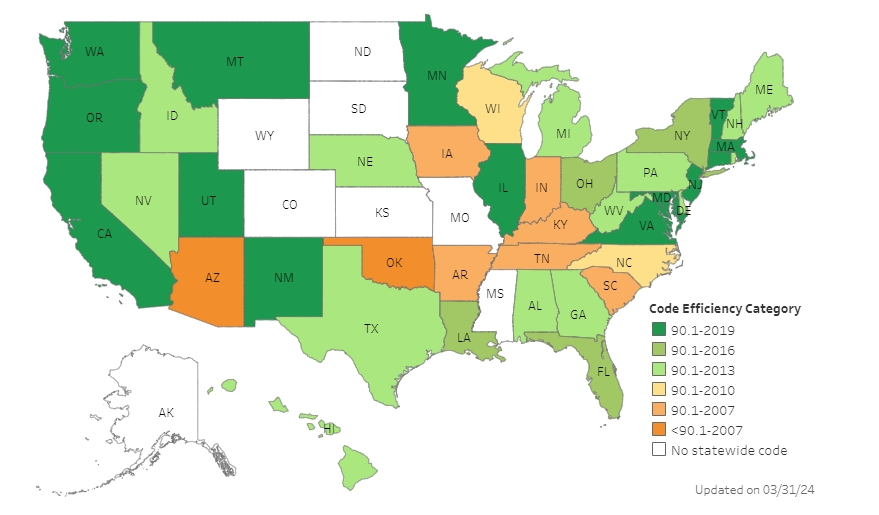
Espandere per visualizzare la tabella dettagliata ↓
| Stato | Codice commerciale attuale | Categoria di efficienza del codice commerciale |
|---|---|---|
| Alabama | 90.1-2013 | 90.1-2013 |
| Alaska | Nessuno a livello statale | Nessun codice a livello statale |
| Arizona | Autonomia locale | <90.1-2007 |
| Arkansas | 2009 IECC e 90.1-2007 | 90.1-2007 |
| California | 2022 Building Energy Efficiency Standards | 90.1-2019 |
| Colorado | Autonomia locale | Nessun codice a livello statale |
| Connecticut | 2021 IECC and 90.1-2019 | 90.1-2019 |
| Delaware | 2018 IECC and 90.1-2016 | 90.1-2013 |
| District of Columbia | 90.1-2013^ | 90.1-2019 |
| Florida | 2021 IECC and 90.1-2019^ | 90.1-2016 |
| Georgia | 2015 IECC and 90.1-2013^ | 90.1-2013 |
| Hawaii | Autonomia locale | 90.1-2013 |
| Idaho | 2018 IECC and 90.1-2016 | 90.1-2013 |
| Illinois | 2021 IECC and 90.1-2019 | 90.1-2019 |
| Indiana | 90.1-2007 | 90.1-2007 |
| Iowa | 2012 IECC e 90.1-2010 | 90.1-2007 |
| Kansas | Autonomia locale | Nessun codice a livello statale |
| Kentucky | 2012 IECC e 90.1-2010 | 90.1-2007 |
| Louisiana | 2021 IECC and 90.1-2019^ | 90.1-2016 |
| Maine | 2015 IECC e 90.1-2013 | 90.1-2013 |
| Maryland | 2021 IECC and 90.1-2019^ | 90.1-2019 |
| Massachusetts | 2018 IECC e 90.1-2016^ | 90.1-2019 |
| Michigan | 2015 IECC and 90.1-2013^ | 90.1-2013 |
| Minnesota | 90.1-2019^ | 90.1-2019 |
| Mississippi | Nessuno a livello statale | Nessun codice a livello statale |
| Missouri | Autonomia locale | Nessun codice a livello statale |
| Montana | 2021 IECC and 90.1-2019 | 90.1-2019 |
| Nebraska | 2018 IECC and 90.1-2016 | 90.1-2013 |
| Nevada | 2018 IECC and 90.1-2016 | 90.1-2013 |
| New Hampshire | 2018 IECC e 90.1-2016^ | 90.1-2013 |
| New Jersey | 90.1-2019 | 90.1-2019 |
| New Mexico | 2021 IECC and 90.1-2019^ | 90.1-2019 |
| New York | 2018 IECC e 90.1-2016^ | 90.1-2016 |
| North Carolina | 2015 IECC and 90.1-2013^ | 90.1-2010 |
| North Dakota | Autonomia locale | Nessun codice a livello statale |
| Ohio | 2021 IECC and 90.1-2019^ | 90.1-2016 |
| Oklahoma | 2006 IECC e 90.1-2004 | <90.1-2007 |
| Oregon | 90.1-2019 | 90.1-2019 |
| Pennsylvania | 2018 IECC and 90.1-2016 | 90.1-2013 |
| Rhode Island | 2018 IECC e 90.1-2016^ | 90.1-2013 |
| South Carolina | 2009 IECC e 90.1-2007 | 90.1-2007 |
| South Dakota | Autonomia locale | Nessun codice a livello statale |
| Tennessee | 2021 IECC e 90.1-2013 | 90.1-2007 |
| Texas | 2015 IECC e 90.1-2013 | 90.1-2013 |
| Utah | 2021 IECC and 90.1-2019^ | 90.1-2019 |
| Vermont | 2021 IECC and 90.1-2019^ | 90.1-2019 |
| Virginia | 2021 IECC and 90.1-2019^ | 90.1-2019 |
| Washington | Codice energetico dello Stato di Washington 2018 | 90.1-2019 |
| Tennessee | 2012 IECC e 90.1-2010 | 90.1-2007 |
| Texas | 2015 IECC e 90.1-2013 | 90.1-2013 |
| Utah | 2021 IECC and 90.1-2019^ | 90.1-2019 |
| Vermont | 2018 IECC e 90.1-2016^ | 90.1-2019 |
| Virginia | 2021 IECC and 90.1-2019^ | 90.1-2019 |
| Washington | Codice energetico dello Stato di Washington 2018 | 90.1-2019 |
| West Virginia | 90.1-2013 | 90.1-2013 |
| Wisconsin | 2015 IECC and 90.1-2013^ | 90.1-2010 |
| Wyoming | Autonomia locale | Nessun codice a livello statale |
- ^ Quando una modifica che influisce sull'efficienza energetica può essere quantificata utilizzando i modelli di edificio prototipo del DOE, questa è stata inclusa nell'analisi.
- Per gli Stati che adottano sia l'IECC che la norma 90.1, il codice IECC viene solitamente analizzato come codice statale vigente in questo studio, ad eccezione degli Stati con modifiche estese all'IECC.
Design Guide Key Concepts for Open Offices
Designing an energy-efficient lighting control solution for open offices involves strategic placement of occupancy sensors to ensure comprehensive coverage of the space.

In an open office setting, the primary areas to consider for sensor placement are the main walkways and areas with high foot traffic. These areas are crucial for sensor placement as they are the main areas of human traffic:
- Cover Main Walkways: The main walkways in an open office are the areas with the highest foot traffic. Therefore, these should be the primary focus when placing sensors. Ceiling-mounted sensors are ideal for these areas as they provide a wide coverage area and are strategically placed to cover the entire length.
- Overlap Coverage on Walkways: To avoid blind spots, ensure that the coverage patterns of the sensors overlap along the walkways. This ensures continuous detection as people move through the space, preventing any gaps in sensor coverage.
- Use a Long Timeout: Given the size and activity level in open offices, use a longer timeout setting (15 or 20 minutes) on the sensors. This prevents the lights from turning off too soon when there’s no movement detected for a brief period.
- Consider Wall-Mounted Sensors: If the cubicle walls are short, consider using wall-mounted sensors in addition to ceiling-mounted ones. These can provide additional coverage and ensure that all areas of the office are monitored.
- Avoid Air Vents: Don’t place sensors near air vents. The vibration and airflow can reduce the effectiveness of the sensors. PIR sensors should not be within 4ft of an air vent, and ultrasonic sensors should not be within 6ft of an air vent.
- Controllo manuale: Incorporate manual controls that are integrated with the occupancy sensors. This allows for manual override to turn ON/OFF all lighting when necessary.
Featured Products & Solutions
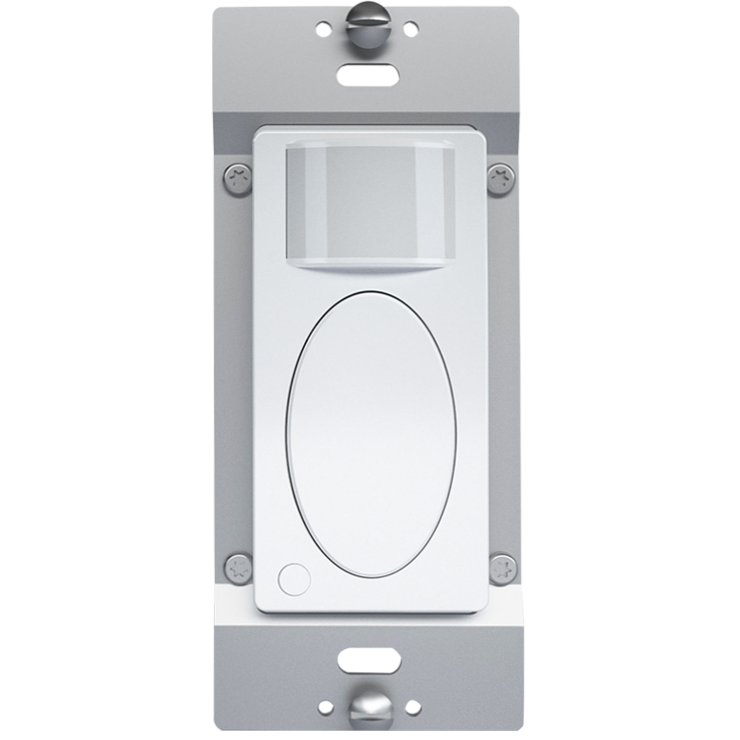
Wall Sensor Switches
RZ020/021 Motion Sensor Switches
- 2-wire, 3-wire, 4-wires wiring options
- Occupancy, Vacancy, Manual ON/OFF
- Adjustive time delay and ambient light control
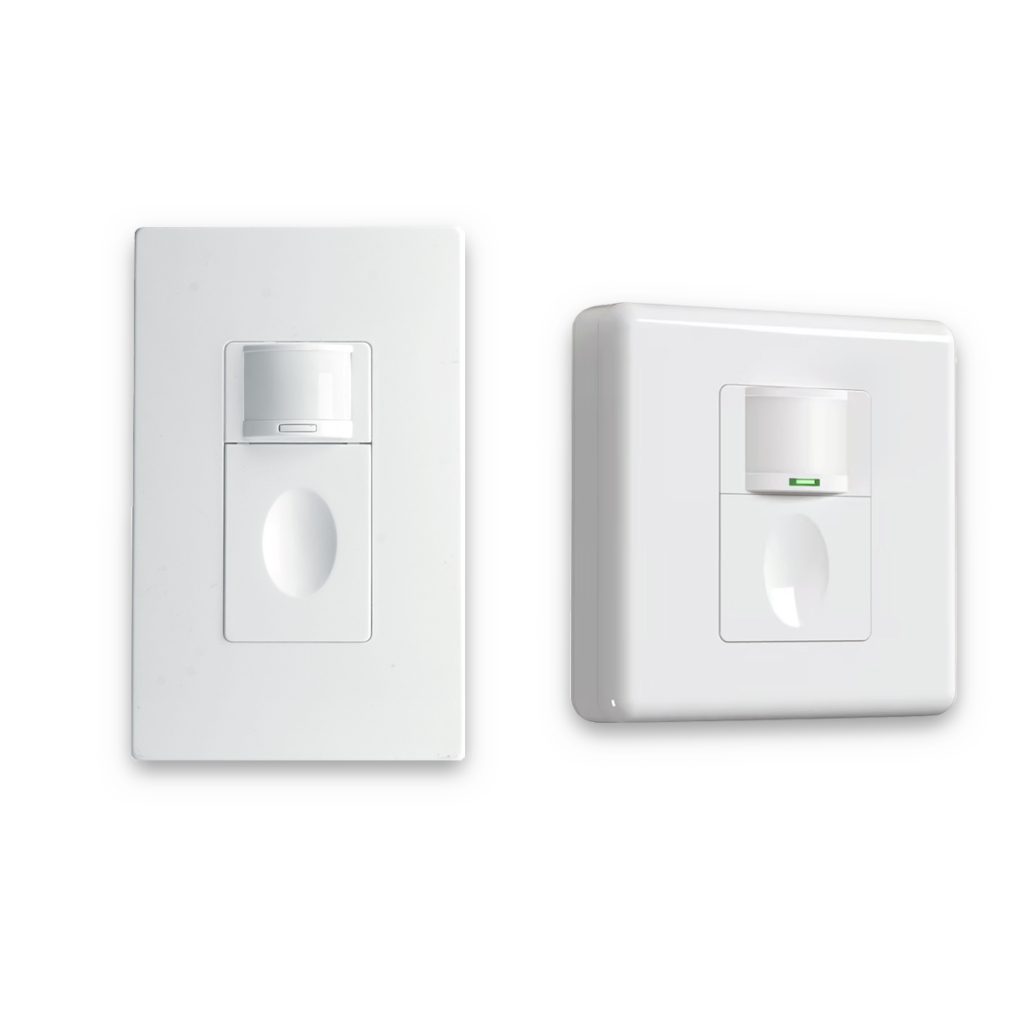
Multi-Location Wireless Wall Sensors
RZ020A/021A + RZ022W Kits
- Hardwired RZ021A/022A occupancy sensor switch
- Wireless companion switch (RZ022W) for multi-location control

Ceiling Occupancy Sensors
RZ036
- Hardwired occupancy sensors
- Auto ON, auto OFF
- Line voltage and Low voltage available
Core features included:
- Integrated manual ON/OFF control for all lighting
- Vacancy sensors (Manual ON only): Lights must be turned on manually only
- Adjustable time-delay, lighting is automatically turned full OFF after 15mins
- Additional: multi-location wireless kits to expand the control range without re-wring
- Additional: multiple wiring options available for both new constructions and retrofit projects.

Meets the Mandatory Provisions
IECC – 2011
C405.2.1 Occupant sensor controls
Occupant sensor controls shall be installed to control lights in the space.
For open offices < 300 sq. ft:
C405.2.1.1 Occupant sensor control functions
- Manual on or partial on to no more than 50% power.
- Full off within 20 minutes after all occupants have left the space
- A manual control to turn off the lights.
For open offices > 300 sq. ft:
- The general lighting shall be controlled separately in control zones with floor areas not greater than 600 sq. ft within the open plan office space.
- In each control zone, the general lighting shall be permitted to automatically turn on within the control zone. In other unoccupied zones, the general lighting shall be permitted to turn on to < 20% full power(or unaffected).
- Automatically turn off general lighting in all control zones within 20 minutes after all occupants have left the space.
- In each control zone, the general lighting shall turn off or uniformly reduce lighting power to an unoccupied setpoint of < 20% full power within 20 minutes after all occupants have left.
ASHRAE 90.1 – 2022
For open offices in any sizes:
9.4.1.1 a Local control
There shall be one or more manual lighting control device that provides ON and OFF control
of all lighting in the space.
9.4.1.1 b Restricted to manual ON
None of the lighting shall be automatically turned on
9.4.1.1 c Restricted to partial automatic ON
No more than 50% of the lighting power for the general lighting shall be allowed to be automatically turned on
** NOTE: At least one 9.4.1.1 b or 9.4.1.1 c shall be implemented.
9.4.1.1 H Automatic full OFF control
All lighting in the space shall be automatically shut off within 20 minutes of all occupants leaving the space
Additionally, for open offices > 300 sq. ft:
9.4.1.1 g Automatic reduction control
The general lighting power in the space shall be automatically reduced by at least 50% within 15 minutes of all occupants leaving the space.
Title 24 – 2022
For open offices in any sizes:
130.1 (a) Manual area controls.
Each area enclosed by ceiling-height partitions shall provide lighting controls that allow the lighting in that area to be manually turned on and off.
130.1 (c) Shut-OFF Controls.
Additionally, for open offices <250 sq. ft:
130.1 (c) 5. Occupant sensing controls are required for specified offices.
Lighting shall be controlled with occupant sensing controls to automatically shut OFF all of the lighting in 20 minutes or less after the control zone is unoccupied that shall function either as:
- A. Occupant sensing controls (if 130.1(b) not required to have multi-level lighting controls); or
- B. Partial-ON occupant sensing controls, or
- C. Vacancy sensing controls, where all lighting responds to a manual ON input only
Additionally, for open offices > 250 sq. ft:
130.1 (c) 6. Full or partial-OFF occupant sensing controls are required for offices greater than 250 square feet.
In office spaces greater than 250 square feet, general lighting shall be controlled with occupant sensing controls that meet all of the following:
- Lighting shall be controlled separately in control zones not greater than 600 square feet. For luminaires with an embedded occupant sensor that are capable of reducing power independently from other luminaires, each luminaire can be considered its own control zone
- The occupant sensing controls shall uniformly reduce lighting power in the control zone by at least 80% full power(or off) in 20 minutes or less after the control zone is unoccupied.
- The occupant sensing controls shall automatically turn off lighting in ALL control zones in 20 minutes or less after the entire office space is unoccupied
- When occupancy is detected:
- in each control zone, lighting shall be allowed to automatically turn on to any level up to full power.
- in other control zones that are unoccupied, lighting shall operate at no more than 20% full power.
Let us hear you.
Let Rayzeek help design and deliver a bespoke energy-saving lighting solution for you.