
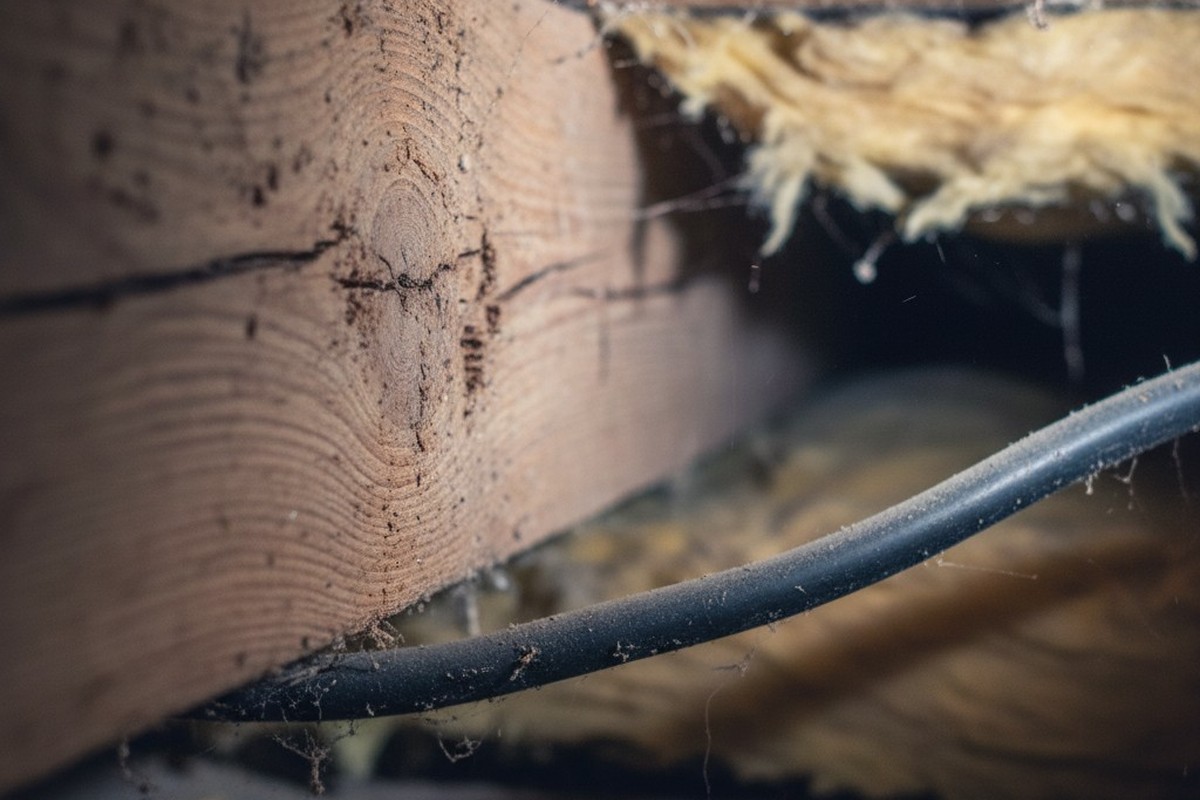
A crawl space isn’t a room. It is a biological zone that actively wants to degrade building materials. When you unlatch that access hatch, you are typically met with the smell of wet earth, the visual chaos of hanging insulation, and—if you are unlucky—absolute darkness.
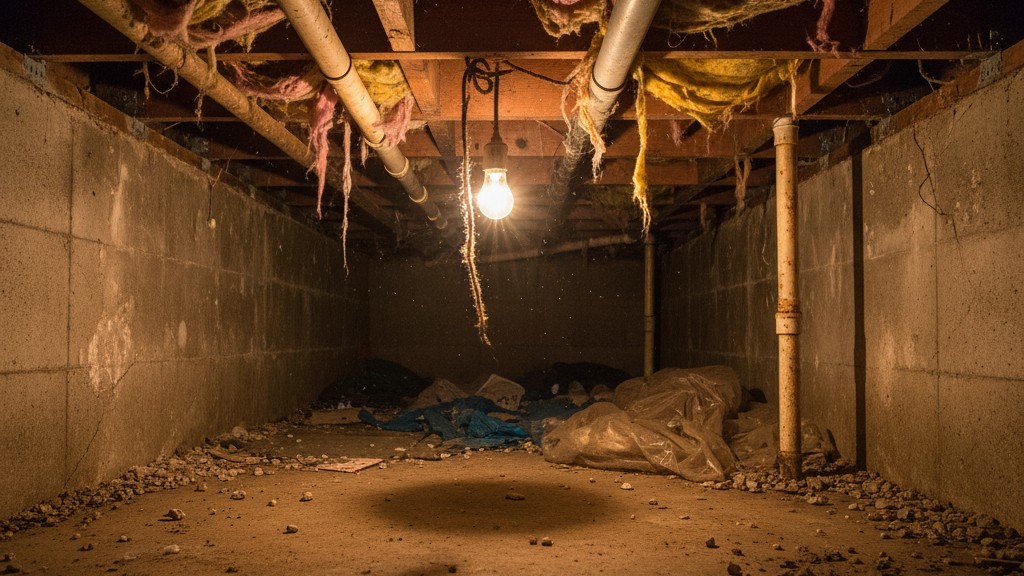
There is a specific, dangerous failure mode in these spaces. It isn’t structural collapse or flooding. It’s human memory. A standard toggle switch, mounted in a dark corner or inside a closet, relies entirely on the discipline of the person leaving the crawl space to flip it off. History shows that people fail at this. We have seen 100W incandescent bulbs left burning for years in Portland basements, slowly turning the fir joist above them into charcoal. Conversely, we see plumbing inspectors refuse to enter a space because the bulb burned out three years ago and nobody noticed until the leak started.
The solution isn’t a better checklist. It’s removing the human element entirely. For the damp, neglected environment of a Pacific Northwest crawl space, the Rayzeek RZ021 motion sensor switch has emerged as the pragmatic standard for retrofits. It isn’t the prettiest device on the market, but it solves the “Callback Calculus” better than high-end alternatives.
The Hardware Reality: Why “Dumb” Sensors Win
In a conditioned hallway, you can use a Lutron Maestro or a fancy Wi-Fi-enabled dimmer. Those devices are calibrated for stable temperatures and clean power. In a crawl space, you are dealing with high humidity, temperature swings from freezing to sweltering, and often “dirty” power loads.
您可能也會感興趣

- 電壓:2 粒 AAA 電池
- 日/夜模式
- 延遲時間:15 分鐘、30 分鐘、1 小時(預設)、2 小時

- 吸頂式 PIR 人體感應器,配備乾觸點繼電器輸出
- 12/24VDC 或 12/24VAC 低電壓供電
- 用於 EMS、HVAC 和建築控制輸入的 COM、NO 和 NC 隔離繼電器觸點

- 低壓直流嵌入式天花安裝微波人體感應開關
- 12 VDC / 24 VDC 輸入,支援 10-30 VDC 範圍
- 最大工作電流 10A,配備可調節延時、光感閾值及靈敏度
- 高負載嵌入式天花安裝微波人體感應開關
- 100-265 VAC 市電輸入,10A 型號
- 5.8 GHz 微波感應,配備可調節延時、光感閾值及靈敏度
- 嵌入式天花安裝微波人體感應開關
- 100-265 VAC 市電輸入,5A 型號
- 5.8 GHz 微波感應,配備可調節延時、光感閾值及靈敏度
- 適用於 220V 電源的天花安裝 RZ037 PIR 被動式紅外線佔空感應調光開關
- 最大工作電流 3A,額定負載 660W
- LUX 按鈕控制光線感應器開關及用戶設定之調光亮度
- 適用於 110V 電源的天花安裝 RZ037 PIR 被動式紅外線佔空感應調光開關
- 最大工作電流 3A,額定負載 330W
- LUX 按鈕控制光線感應器開關及用戶設定之調光亮度

- 低壓直流天花安裝微波人體感應開關
- 12 VDC / 24 VDC 輸入,支援 10-30 VDC 範圍
- 最大工作電流 10A,配備可調節延時、光感閾值及靈敏度
- 高負載吸頂式微波動態感應器開關
- 100-265 VAC 市電輸入,10A 型號
- 5.8 GHz 微波感應,配備可調節延時、光感閾值及靈敏度
- 吸頂式微波動態感應器開關
- 100-265 VAC 市電輸入,5A 型號
- 5.8 GHz 微波感應,配備可調節延時、光感閾值及靈敏度

- 低壓直流嵌頂式 PIR 動態感應器開關
- 12 VDC / 24 VDC 輸入,支援 10-30 VDC 範圍
- 最大工作電流 10A,具備可調式時間延遲、光照度閾值及靈敏度

- 高負載嵌頂式 PIR 動態感應器開關
- 100-265 VAC 市電輸入,10A 型號
- 360度偵測,具備可調式時間延遲、光照度閾值及靈敏度
- 嵌頂式 PIR 動態感應器開關
- 100-265 VAC 市電輸入,5A 型號
- 360度偵測,具備可調式時間延遲、光照度閾值及靈敏度

- 用於室內開關照明控制的無線開關及接收器套裝
- 100-230VAC,50/60Hz 接收器,額定電流 5A
- CR2032 電池供電無線開關,採用 2.4GHz 通訊
- 佔用感應(自動開啟/自動關閉)
- 12–24V DC (10–30VDC),最高 10A
- 360° 覆蓋,直徑 8–12 米
- 延遲時間 15 秒至 30 分鐘
- 光感應器 關閉/15/25/35 Lux
- 高/低靈敏度
- 自動開啟/自動關閉佔用模式
- 100–265V AC,10A(需接零線)
- 360° 全方位覆蓋;8–12 米偵測直徑
- 延遲時間 15 秒至 30 分鐘;Lux 關閉/15/25/35;靈敏度 高/低
- 自動開啟/自動關閉佔用模式
- 100–265V AC,5A(需接零線)
- 360° 全方位覆蓋;8–12 米偵測直徑
- 延遲時間 15 秒至 30 分鐘;Lux 關閉/15/25/35;靈敏度 高/低
The Rayzeek RZ021 stands out because it is remarkably load agnostic. Crawl spaces are often lit by a mishmash of fixtures—an old porcelain keyless fixture here, a cheap LED shop light there, maybe a fluorescent strip left over from 1990. Many modern sensors flicker or buzz when faced with inductive loads like old ballasts or cheap LED drivers. In bench tests and field retrofits, the Rayzeek tends to handle this electrical soup without the “ghost switching” that plagues more sensitive units.
Then there’s the “Pilot Light” switch—the ones with the little red neon glow when the light is on. Old-school sparkies love these. The theory is that the red light warns you the crawl space lights are burning. The reality? Homeowners ignore red lights just as easily as they ignore toggle switches. A motion sensor (PIR) does not ask for permission or attention. It simply detects heat signatures and shuts down when they leave.
The “Door Swing” Placement Strategy
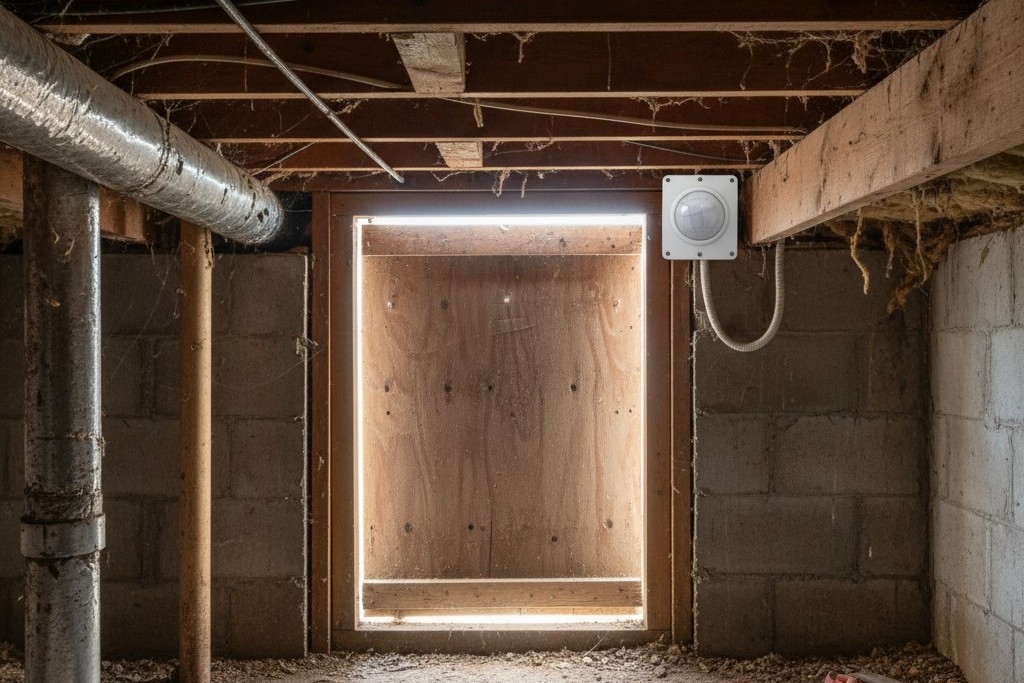
A motion sensor is only as good as its line of sight. Passive Infrared (PIR) technology works by detecting the temperature differential between a moving body and the background. If the sensor is mounted behind a stack of R-30 insulation or a foil-wrapped HVAC duct, it doesn’t exist.
The placement rule for crawl spaces is strict: The sensor must see the hatch open.
When you are crawling on your belly through mud, holding a channel lock in one hand and a flashlight in the other, you do not have a free hand to fumble for a switch. The light must trigger the moment the access door cracks open. This usually means mounting the switch box high on the rim joist, facing the opening directly.
If the crawl space is an L-shape or has massive obstructions like a furnace unit in the center, a single sensor at the door may not cover the back corners. In those cases, the sensor acts as the “entry/exit” safety, ensuring you can at least get in and out without relying on a battery-powered stick light.
Installation: The Neutral Wire Non-Negotiable
Before anyone strips a wire, the breaker must be off. That is the baseline. But the real hurdle in retrofitting a Rayzeek—or any modern occupancy sensor—is the wiring architecture.
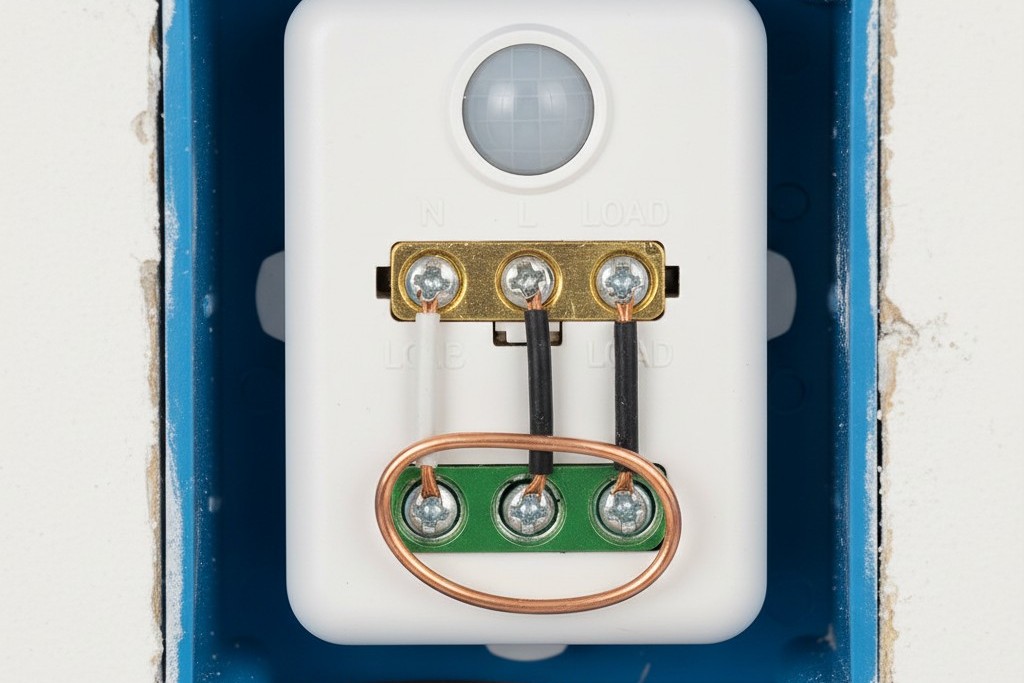
The RZ021 requires a Neutral wire (usually white). This is non-negotiable. The sensor is a small computer that needs a complete circuit to power its internal brain, even when the light is off.
In many homes built before the 1980s, electricians ran what is known as a “switch loop.” They sent power to the light fixture first, then dropped a single cable down to the switch. That cable has a hot and a switched leg, but no neutral. If you open your existing switch box and see only two wires (plus a bare copper ground), you cannot install this sensor without pulling new wire.
Do not try to cheat by tying the neutral screw to the ground wire. That creates a safety hazard and violates NEC 210.70 and about a dozen other code articles. If the neutral isn’t there, you are pulling new Romex.
We also see a lot of confusion regarding “Smart Home” integration here. People want to use a Philips Hue bulb or a Wi-Fi switch so they can check the status on their phone. This is a mistake. Wi-Fi signals struggle to penetrate subfloors, hardwood, and foil vapor barriers. You will end up with a “Device Offline” notification and a dark crawl space. The Rayzeek is “dumb”—it has no app, no Wi-Fi, and no firmware updates. That is exactly what you want in a dirt hole.
正在尋找動態感應節能解決方案?
歡迎聯絡我們以獲取完整的 PIR 動態感應器、動態感應節能產品、動態感應器開關以及人體感應/無人感應商業解決方案。
Configuration: The 15-Minute Rule
Out of the box, these sensors are often set to “Test” mode (5–15 seconds) or a very short duration. This is a trap.
Imagine you are a plumber repairing a cracked ABS stack in the back corner. You are lying still, gluing a fitting. You are not moving enough to trigger the PIR sensor. If the timer is set to 1 minute, the lights go out. Now you are in pitch blackness, surrounded by spiders and pipe glue, waving your arms to trigger the sensor 20 feet away.
Set the time delay dial to 30 minutes.
從 Rayzeek 動態感測器產品組合中獲得靈感。
找不到您想要的產品?別擔心。總有其他方法可以解決您的問題。也許我們的其中一個產品組合可以幫到您。
There is a small dial under the faceplate cover, usually adjustable with a precision flathead driver. Crank it up. You aren’t installing this device to save twelve cents of electricity while you are working; you’re doing it to ensure the lights turn off after you leave. If the light stays on for 29 minutes after you exit, that is acceptable. If it turns off while you are inspecting a foundation crack, that is a safety failure.
A Note on “Easy” Alternatives
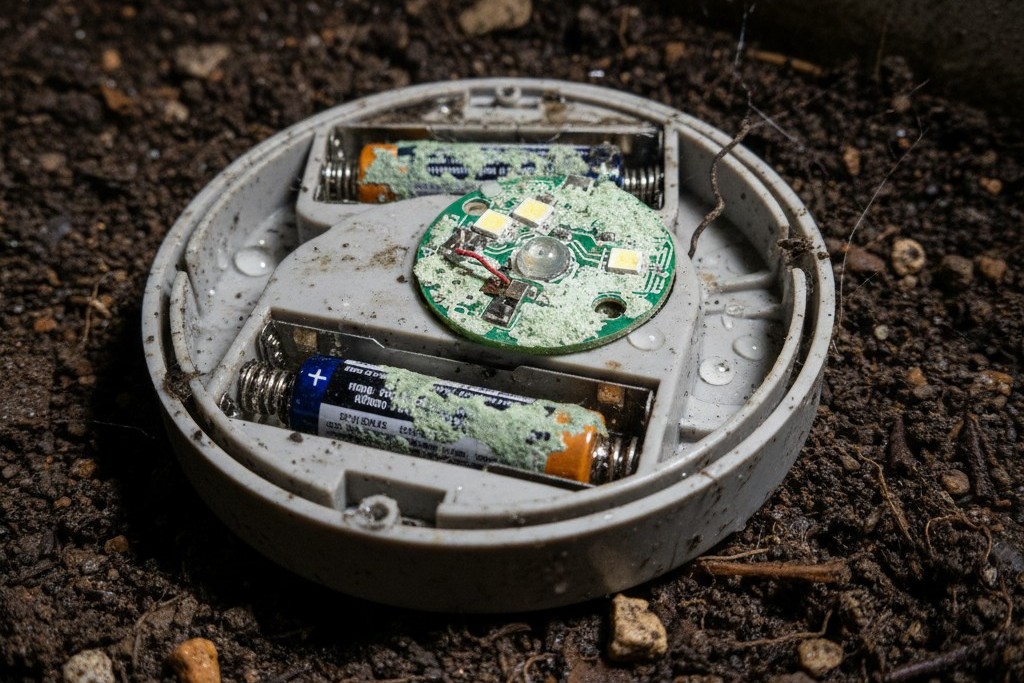
There is always a temptation to bypass wiring altogether. We see it constantly: homeowners sticking battery-powered “puck lights” or solar garden lights into the crawl space.
This is false economy. Batteries in a crawl space are subjected to damp, cold conditions that drain them rapidly. Alkaline batteries leak; lithium batteries die in the freeze. When you actually need to go down there—usually during a crisis like a leak or a freeze—the batteries will be dead. You will be left relying on a portable flashlight, which limits your peripheral vision and makes navigating over sewage pipes dangerous.
A hardwired fixture with a Rayzeek sensor uses the house’s power. It does not sleep, it does not corrode like a AA battery contact, and it does not care if it’s 20 degrees Fahrenheit. It is a permanent infrastructure upgrade, not a temporary patch.
The crawl space is a part of the house that demands respect. It doesn’t need to be pretty, but it must work. By removing the manual switch and replacing it with a properly placed, load-agnostic sensor, you remove the human error that leads to wasted energy and fire risks. You ensure that the next time someone has to crawl into the dark, the house is ready for them.







