
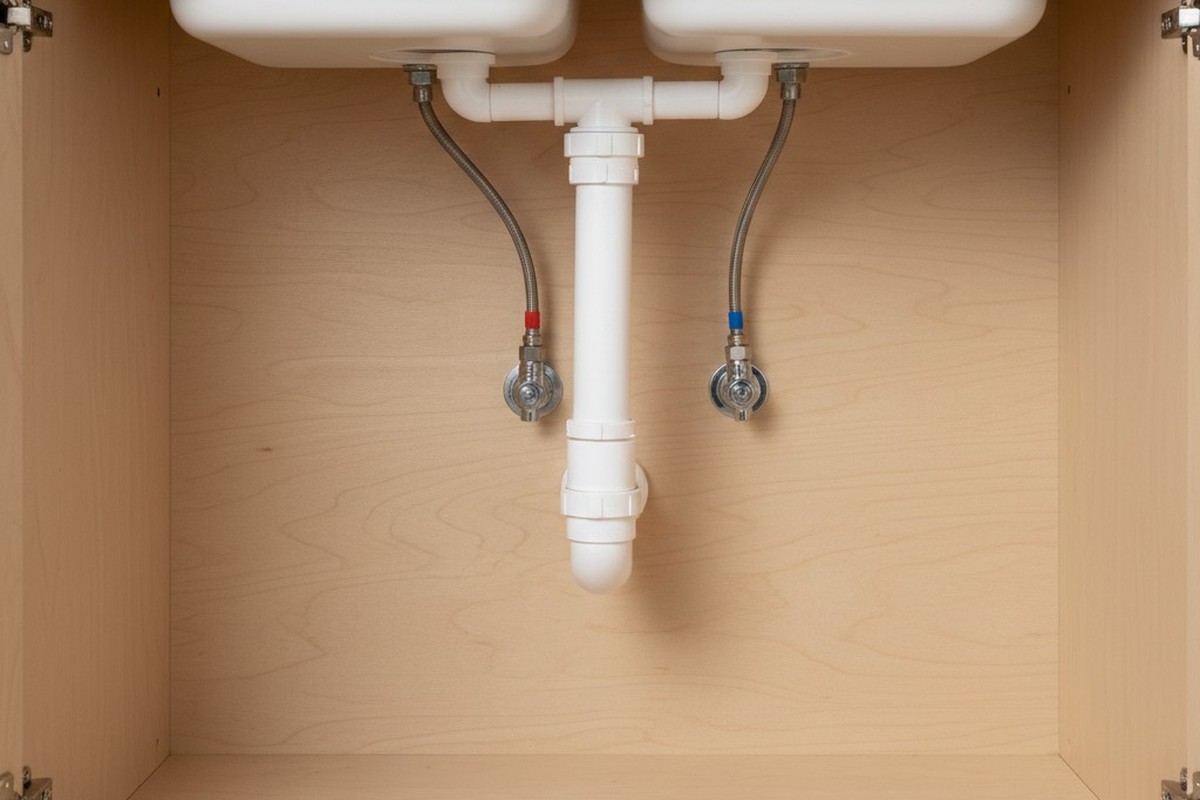
The most expensive component of a Reverse Osmosis (RO) system isn’t the membrane, the tank, or the remineralization cartridge. It’s the friction required to service it.
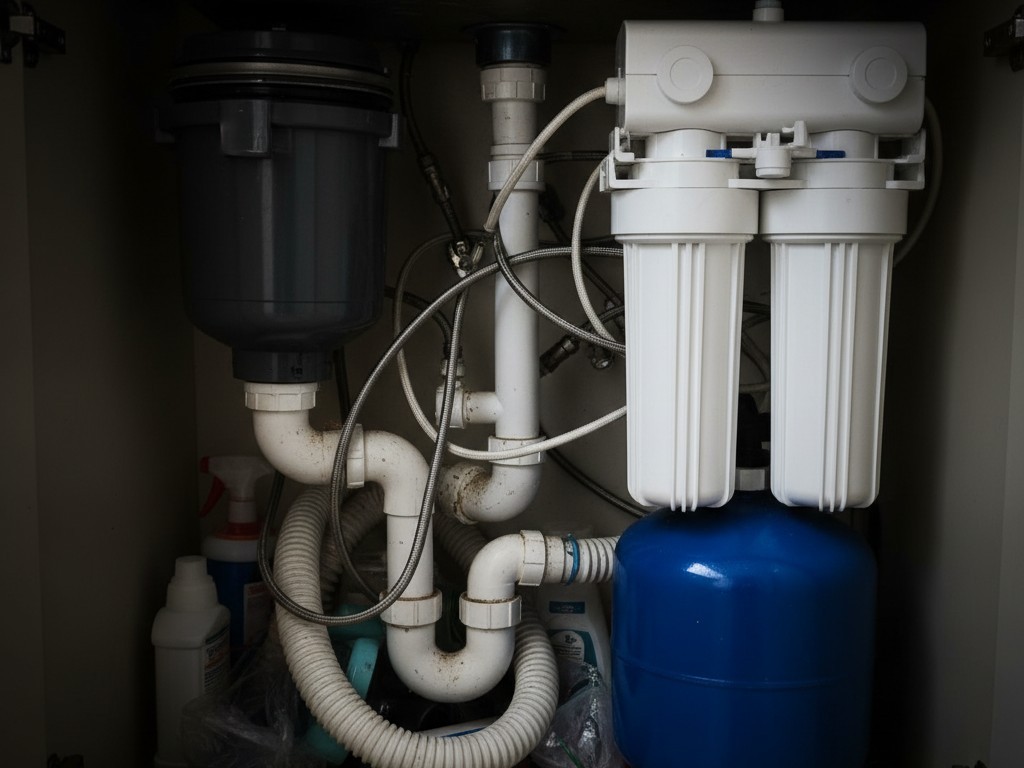
Consider the contortions required to change a sediment filter: knees on a hard tile floor, torso twisted into a pretzel, head jammed between a garbage disposal and a P-trap. Now add darkness. In that pitch-black cavity, a simple five-minute filter swap transforms into a trial of endurance. You’re holding a flashlight in your teeth (likely a Maglite Solitaire or a cheap phone torch), drooling slightly, while trying to wrestle a filter wrench with one hand and stabilize the housing with the other.
The physical indignity is bad enough, but the inevitable neglect is worse. When a maintenance task requires a headlamp and a chiropractor, homeowners subconsciously defer it. An iSpring RCC7 membrane designed to last two years dies in eight months because the pre-filters weren’t changed, simply because the owner couldn’t face the “black hole” under the sink.
Even worse, darkness hides the early warning signs of catastrophic failure. A slow drip from a loose compression fitting on an APEC system can rot a particle board cabinet floor for weeks before it ever spills out onto the kitchen tiles. If you can’t see the plumbing, you can’t trust the plumbing.
The Hardware Fix: Automating Visibility
A brighter flashlight isn’t the answer. The fix is removing the friction entirely by making the cabinet illuminate itself. This requires a hardwired sensor approach, specifically leveraging technology like the Rayzeek RZ021. But before drilling holes, you have to distinguish between the two primary sensor architectures available: the Door Contact (Reed Switch) and the Motion Sensor (PIR).
Novices often gravitate toward Door Contact sensors—the RZ022 style—where a magnet on the door triggers a switch on the frame. In theory, this is sound. In practice, under-sink cabinets are hostile environments for precision alignment. Cabinet doors sag over time. Hinges loosen. If the magnet drifts just three millimeters out of alignment, the light stays on forever, cooking the LED strip and the driver. Or it never turns on at all. For a retrofit scenario where you want “set and forget” reliability, the mechanical dependency of a reed switch is a liability.
S-ar putea să vă intereseze și

- Tensiune: 2 baterii AAA
- Mod Zi/Noapte
- Temporizare: 15min, 30min, 1h (implicit), 2h

- Senzor de prezență PIR cu montaj pe tavan și ieșire de releu cu contact uscat
- Alimentare de joasă tensiune de 12/24VDC sau 12/24VAC
- Contacte de releu izolate COM, NO și NC pentru intrări de control al sistemelor EMS, HVAC și al clădirilor

- Întrerupător cu senzor de mișcare cu microunde încastrat în tavan, de joasă tensiune DC
- Intrare de 12 VDC / 24 VDC cu un interval cuprins între 10-30 VDC
- Curent de lucru maxim de 10A cu temporizare reglabilă, prag Lux și sensibilitate ajustabile
- Întrerupător cu senzor de mișcare cu microunde încastrat în tavan, pentru sarcini mai mari
- Intrare la tensiunea rețelei de 100-265 VAC, model de 10A
- Detectare cu microunde de 5.8 GHz cu temporizare reglabilă, prag Lux și sensibilitate ajustabile
- Întrerupător încastrat pentru plafon cu senzor de mișcare cu microunde
- Tensiune de intrare 100-265 VAC, model de 5A
- Detectare cu microunde de 5.8 GHz cu temporizare reglabilă, prag Lux și sensibilitate ajustabile
- Variator cu senzor de prezență PIR RZ037 pentru plafon, pentru alimentare la 220V
- Curent maxim de lucru de 3A cu sarcină nominală de 660W
- Butonul LUX controlează funcția ON/OFF a senzorului de lumină și luminozitatea setată de utilizator
- Variator cu senzor de prezență PIR RZ037 pentru plafon, pentru alimentare la 110V
- Curent maxim de lucru de 3A cu sarcină nominală de 330W
- Butonul LUX controlează funcția ON/OFF a senzorului de lumină și luminozitatea setată de utilizator

- Întrerupător cu senzor de mișcare cu microunde pentru plafon, de joasă tensiune C.C.
- Intrare de 12 VDC / 24 VDC cu un interval cuprins între 10-30 VDC
- Curent de lucru maxim de 10A cu temporizare reglabilă, prag Lux și sensibilitate ajustabile
- Întrerupător cu senzor de mișcare cu microunde pentru plafon, pentru sarcini mai mari
- Intrare la tensiunea rețelei de 100-265 VAC, model de 10A
- Detectare cu microunde de 5.8 GHz cu temporizare reglabilă, prag Lux și sensibilitate ajustabile
- Întrerupător cu senzor de mișcare cu microunde pentru plafon
- Tensiune de intrare 100-265 VAC, model de 5A
- Detectare cu microunde de 5.8 GHz cu temporizare reglabilă, prag Lux și sensibilitate ajustabile

- Întrerupător cu senzor de mișcare PIR încastrat în tavan, CC de joasă tensiune
- Intrare de 12 VDC / 24 VDC cu un interval cuprins între 10-30 VDC
- Curent maxim de lucru 10A cu temporizare reglabilă, prag Lux și sensibilitate

- Întrerupător cu senzor de mișcare PIR încastrat în tavan pentru sarcini mai mari
- Intrare la tensiunea rețelei de 100-265 VAC, model de 10A
- Detecție la 360 de grade cu temporizare reglabilă, prag Lux și sensibilitate
- Întrerupător cu senzor de mișcare PIR încastrat în tavan
- Tensiune de intrare 100-265 VAC, model de 5A
- Detecție la 360 de grade cu temporizare reglabilă, prag Lux și sensibilitate

- Kit de întrerupător și receptor wireless pentru controlul iluminatului de interior PORNIT/OPRIT
- Receptor 100-230VAC, 50/60Hz cu curent nominal de 5A
- Întrerupător wireless alimentat cu baterie CR2032 cu comunicare la 2.4GHz
- Prezență (PORNIRE automată/OPRIRE automată)
- 12–24V CC (10–30VCC), până la 10A
- Acoperire 360°, diametru 8–12 m
- Temporizare 15 s–30 min
- Senzor de lumină Oprit/15/25/35 Lux
- Sensibilitate ridicată/scăzută
- Mod de prezență Auto-ON/Auto-OFF
- 100–265V AC, 10A (necesită nul)
- Acoperire 360°; diametru de detecție 8–12 m
- Temporizare 15 s–30 min; Lux OFF/15/25/35; Sensibilitate ridicată/scăzută
- Mod de prezență Auto-ON/Auto-OFF
- 100–265V AC, 5A (necesită nul)
- Acoperire 360°; diametru de detecție 8–12 m
- Temporizare 15 s–30 min; Lux OFF/15/25/35; Sensibilitate ridicată/scăzută
The superior approach for the under-sink domain is the Passive Infrared (PIR) Motion Sensor. These units detect the heat signature of your hand or face entering the cabinet space. The advantage here is the elimination of moving parts. You open the door, the infrared signature changes, and the cabinet floods with 4000K light.
When you are wrestling a 10-inch filter housing and your elbow bumps the door partially closed, the light stays on because it sees you, not the door position. It turns the cabinet into a responsive workspace rather than a closet. We can skip the physics of Fresnel lenses, but know this: these sensors need a direct line of sight. They cannot be buried behind a dense thicket of RO tubing.
The Power Architecture Trap
The single most common failure point in these retrofits has nothing to do with the light itself. It’s about where you steal the power.
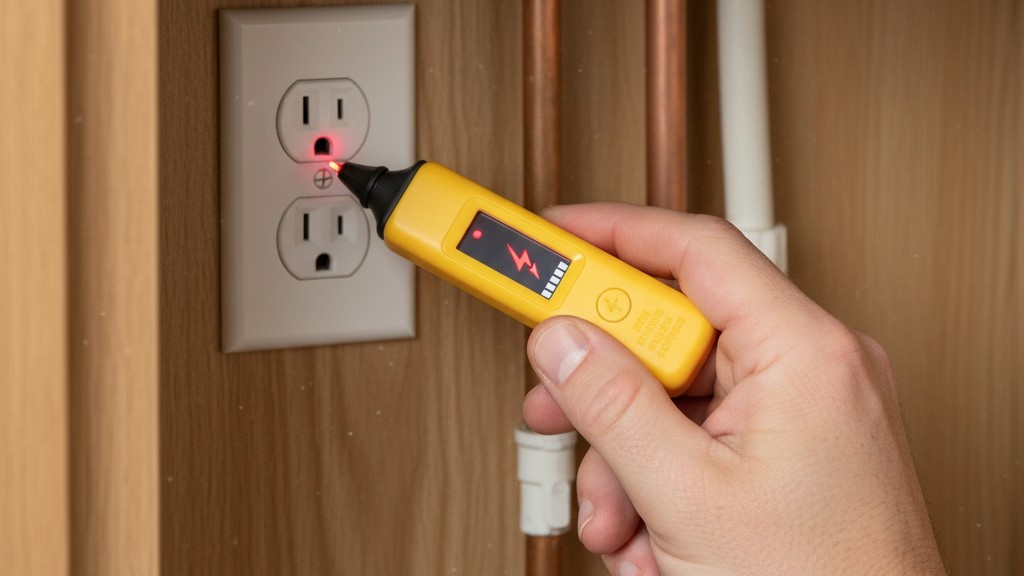
In 90% of modern kitchens, the outlet under the sink is dedicated to the garbage disposal. This is a “switched” outlet. If you plug your LED driver into this, your fancy new lighting system will only work when the garbage disposal is grinding chicken bones. Obviously, this is useless. Before purchasing any components, grab a non-contact voltage tester or a multimeter. Check both receptacles on the outlet. Often, electricians will split the outlet—top half hot, bottom half switched—but you cannot assume this without verification.
If you find yourself with only switched power, the project scope changes. You are now looking at tapping into the dishwasher circuit (often hardwired nearby) or pulling a new line, which escalates this from a “Saturday morning tweak” to actual electrical work.
However, if you have a constant hot source, the rest is low-voltage assembly. The goal is to convert that 120V AC down to 12V or 24V DC immediately. Do not run 120V lines around the cabinet interior. Using a compact driver plugged into the constant hot, you can run low-voltage wire to the Rayzeek sensor and then to the LED strips.
Căutați soluții de economisire a energiei activate de mișcare?
Contactați-ne pentru senzori de mișcare PIR compleți, produse de economisire a energiei cu activare la mișcare, întrerupătoare cu senzor de mișcare și soluții comerciale de prezență/vacanță.
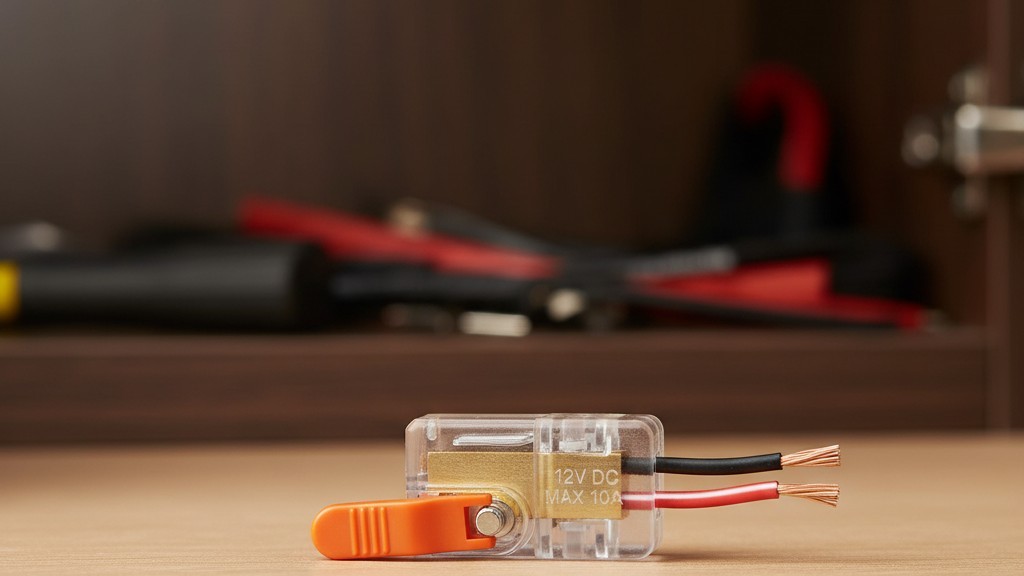
Now, let’s handle the connections. Under-sink environments are technically “damp locations” by code in many jurisdictions, and certainly by common sense. Standard wire nuts are bulky and prone to loosening if snagged by a stray bleach bottle. The standard for this work should be Wago lever nuts. They clamp down on stranded low-voltage wire securely and offer a lower profile. While checking your local regulations regarding low-voltage penetrations is on you, the universal rule is simple: keep high-voltage connections inside a junction box and only expose the 12V side to the cabinet interior.
Installation for Longevity
Mounting the sensor is a game of strategic avoidance. The under-sink area is a chaotic ecosystem of drain pipes, P-traps, disposal bodies, and supply lines. If you mount the Rayzeek sensor on the floor or low on the wall, it will eventually get wet. A filter change will spill water. A drain will eventually weep.
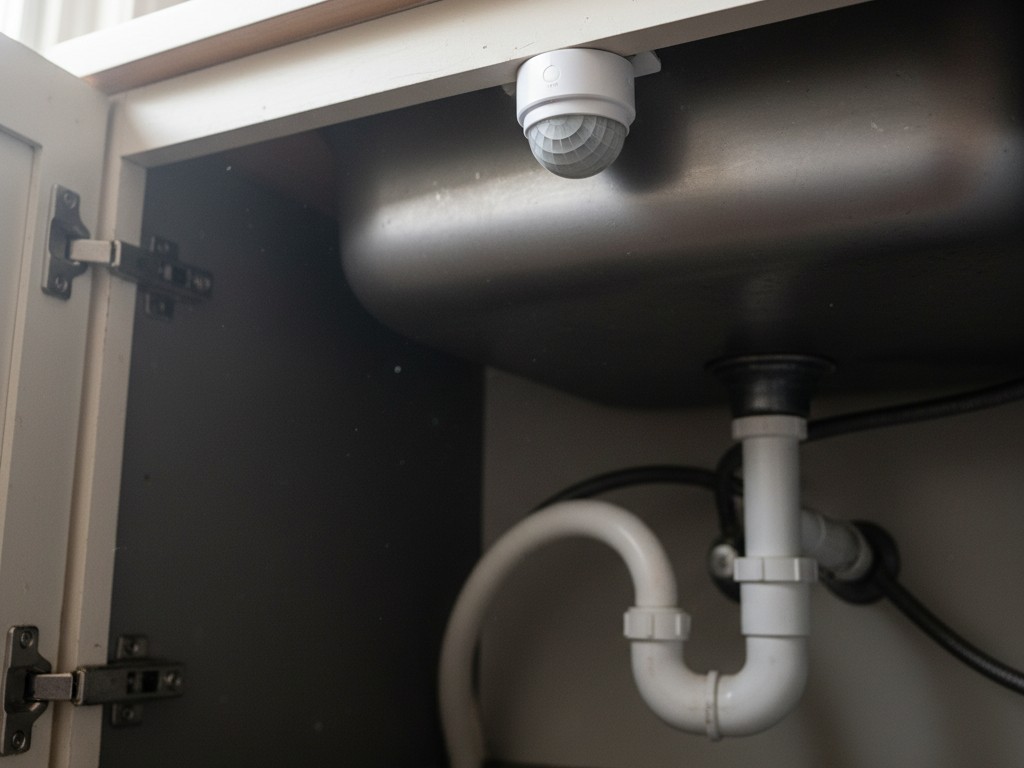
The sensor must be mounted high, ideally on the upper face frame or the ceiling of the cabinet, looking down. This protects the electronics from gravity-fed water damage and ensures the “eye” of the sensor has the widest possible field of view.
Cable management here is a safety requirement, not an aesthetic choice. An RO system has roughly five to seven tubes running between the manifold, the tank, and the faucet. Adding loose electrical wires to this spaghetti is a recipe for disaster. When you pull the filter housing wrench, you do not want to snag the power wire for the lights. Use adhesive clips or screw-down zip ties to route every inch of wire tight against the cabinet carcass. The system should be invisible until it turns on. If you can snag it with a bottle of dishwasher detergent, it is installed wrong.
The Battery Delusion
There is always a temptation to bypass the wiring work and buy a three-pack of stick-on battery puck lights. They are cheap, available at every checkout counter, and install in seconds.
Don’t do it. Battery lights are the “fast food” of home maintenance—satisfying for ten minutes, regrettable for the long haul. The batteries will die. They always die. And they will die exactly when you have a leak at 11 PM on a Tuesday.
Lăsați-vă inspirat de portofoliile de senzori de mișcare Rayzeek.
Nu găsiți ceea ce căutați? Nu vă faceți griji. Există întotdeauna modalități alternative de a vă rezolva problemele. Poate vă poate ajuta unul dintre portofoliile noastre.
When the batteries die, you won’t replace them immediately. You will throw the dead puck in a junk drawer, intending to buy AAAs later. The cabinet returns to darkness. The friction returns. The leak goes unnoticed. The filter change gets deferred.
The entire purpose of the upgrade is reliability—making the visibility of your plumbing systems automatic and inevitable. A hardwired sensor draws a negligible amount of “vampire power”—pennies a year—which is a rounding error compared to the cost of replacing a water-damaged subfloor. Treat the light as a utility, same as the water flowing through the pipes. It should just be there, waiting for you to open the door.







