

Most boutique hotels notice split-AC waste in small, annoying ways. Housekeeping opens a room after checkout and finds the AC still running. A guest leaves for dinner with the balcony door cracked open. The owner sees the summer electricity bill and knows the rooms are part of the problem, but nobody at the front desk can police every remote control.
The hard part is that guest-room AC control has two jobs that pull against each other. It should stop the obvious waste, but it cannot make the room feel managed by a machine. A setting that saves power and creates a hot-room complaint at 10 p.m. has not solved the problem. It has moved the problem from the utility bill to the review page.
For boutique hotels, guesthouses, serviced apartments, and short-term rentals using ductless split AC units, the useful question is not “Can we automate this?” It is “Which room behavior are we trying to control, and how quietly can we do it?”
The Waste Pattern Is Not Just “Empty Room”
An empty room with the AC left on is the easy case to understand. Real rooms are messier. A guest may leave for breakfast and expect the room to recover quickly when they return. Housekeeping may enter for five minutes and accidentally make the room look active again. Someone may nap with almost no movement. A balcony room may be occupied, comfortable, and still wasting energy because the door is open while the split AC keeps cooling.
That is why a simple timer is often too crude for hotel rooms. A timer only knows how long it has been running. It does not know whether the guest is asleep, whether the room has an open thermal boundary, or whether the AC should be turned off completely instead of shifted to a less aggressive command. Good guest-room control starts with the failure pattern, not with the device.
Start With the Room Failure, Then Choose the Rayzeek Controller
If the main problem is guests leaving split AC units running after they leave the room, the Rayzeek RZ050-DP Dual Power Air Conditioner Motion Sensor is the direct fit. It detects occupancy and sends learned commands from the existing AC remote after the configured delay. For many sealed-window rooms, that is the problem worth solving first.
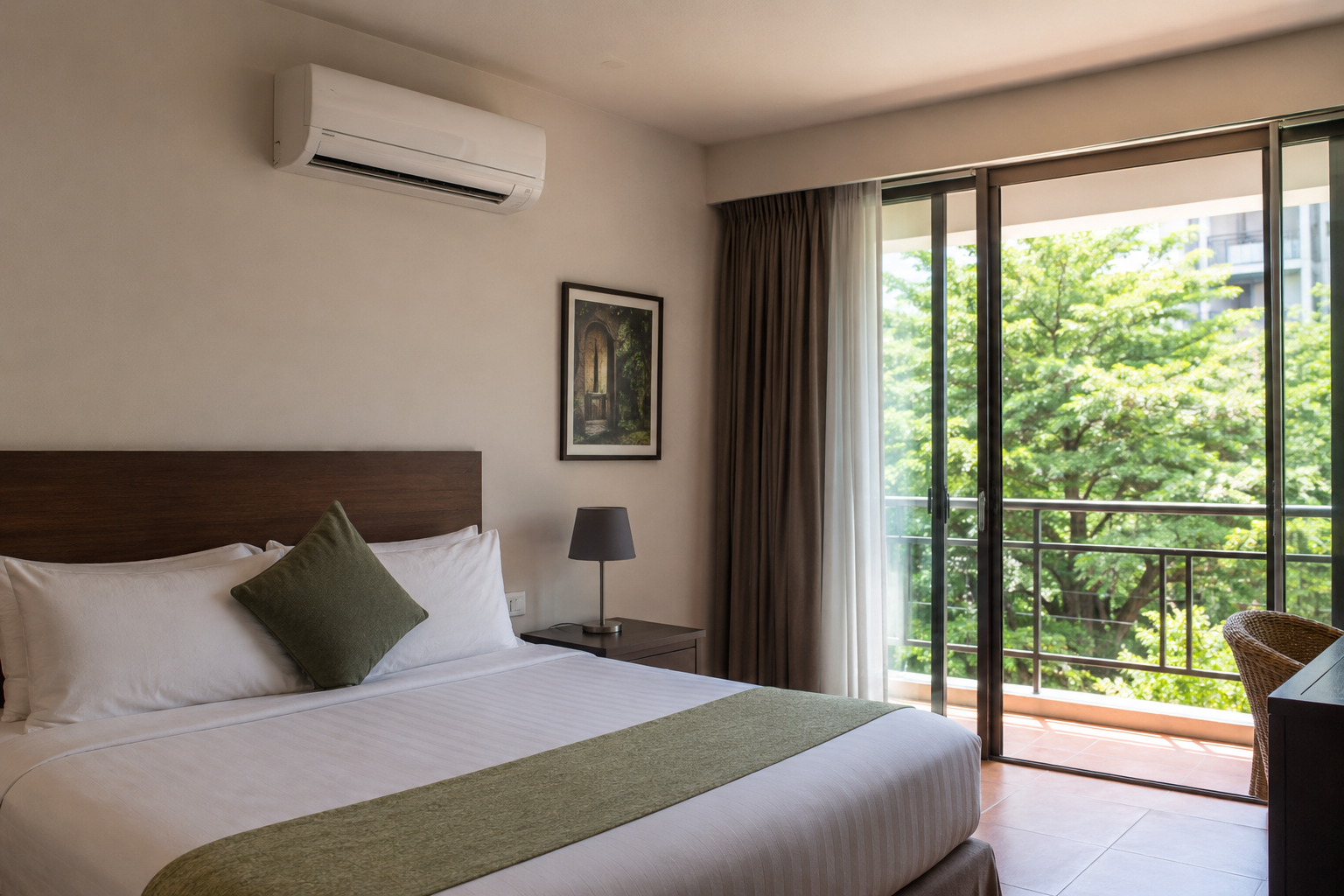
If the room has a balcony door, patio door, terrace door, or operable window, vacancy is only part of the story. The room can be occupied and still be wasting power because the AC is fighting outdoor air. For those rooms, the Rayzeek RZ050-DS kit with two RZ001 door/window sensors is the better application match. The controller still handles occupancy, while the door/window sensors add a signal that motion alone cannot see.
Căutați soluții de economisire a energiei activate de mișcare?
Contactați-ne pentru senzori de mișcare PIR compleți, produse de economisire a energiei cu activare la mișcare, întrerupătoare cu senzor de mișcare și soluții comerciale de prezență/vacanță.
A quick room audit usually makes the choice clear. Interior room with sealed windows and guests leaving the AC on: start with the RZ050-DP. Balcony or garden room where the door is often open while cooling: use the RZ050-DS kit with RZ001 sensors. Mixed property: do not force one answer across every room. Standardize by room type, not by the cheapest hardware line.
The RZ050-DP Case: Flexible Power and Learned Commands
The RZ050-DP is most useful when the installation needs to stay simple and the room envelope is mostly closed. Think interior rooms, sealed-window rooms, serviced apartments without balcony doors, or retrofits where replacing the AC system is not on the table. Because it can be powered by battery or USB, placement can follow the room’s motion pattern instead of the nearest convenient outlet.
That placement matters. A controller pointed only at the entrance may miss the guest reading in bed or working at the desk. Before installing across a property, test the intended mounting position from the bed, desk, luggage area, and path to the bathroom. Also confirm that the learned IR command reliably reaches the split AC receiver from that same position. A setup that works in your hand but fails from the wall is not commissioned.
S-ar putea să vă intereseze și

- Tensiune: 2 baterii AAA
- Mod Zi/Noapte
- Temporizare: 15min, 30min, 1h (implicit), 2h

- Senzor de prezență PIR cu montaj pe tavan și ieșire de releu cu contact uscat
- Alimentare de joasă tensiune de 12/24VDC sau 12/24VAC
- Contacte de releu izolate COM, NO și NC pentru intrări de control al sistemelor EMS, HVAC și al clădirilor

- Întrerupător cu senzor de mișcare cu microunde încastrat în tavan, de joasă tensiune DC
- Intrare de 12 VDC / 24 VDC cu un interval cuprins între 10-30 VDC
- Curent de lucru maxim de 10A cu temporizare reglabilă, prag Lux și sensibilitate ajustabile
- Întrerupător cu senzor de mișcare cu microunde încastrat în tavan, pentru sarcini mai mari
- Intrare la tensiunea rețelei de 100-265 VAC, model de 10A
- Detectare cu microunde de 5.8 GHz cu temporizare reglabilă, prag Lux și sensibilitate ajustabile
- Întrerupător încastrat pentru plafon cu senzor de mișcare cu microunde
- Tensiune de intrare 100-265 VAC, model de 5A
- Detectare cu microunde de 5.8 GHz cu temporizare reglabilă, prag Lux și sensibilitate ajustabile
- Variator cu senzor de prezență PIR RZ037 pentru plafon, pentru alimentare la 220V
- Curent maxim de lucru de 3A cu sarcină nominală de 660W
- Butonul LUX controlează funcția ON/OFF a senzorului de lumină și luminozitatea setată de utilizator
- Variator cu senzor de prezență PIR RZ037 pentru plafon, pentru alimentare la 110V
- Curent maxim de lucru de 3A cu sarcină nominală de 330W
- Butonul LUX controlează funcția ON/OFF a senzorului de lumină și luminozitatea setată de utilizator

- Întrerupător cu senzor de mișcare cu microunde pentru plafon, de joasă tensiune C.C.
- Intrare de 12 VDC / 24 VDC cu un interval cuprins între 10-30 VDC
- Curent de lucru maxim de 10A cu temporizare reglabilă, prag Lux și sensibilitate ajustabile
- Întrerupător cu senzor de mișcare cu microunde pentru plafon, pentru sarcini mai mari
- Intrare la tensiunea rețelei de 100-265 VAC, model de 10A
- Detectare cu microunde de 5.8 GHz cu temporizare reglabilă, prag Lux și sensibilitate ajustabile
- Întrerupător cu senzor de mișcare cu microunde pentru plafon
- Tensiune de intrare 100-265 VAC, model de 5A
- Detectare cu microunde de 5.8 GHz cu temporizare reglabilă, prag Lux și sensibilitate ajustabile

- Întrerupător cu senzor de mișcare PIR încastrat în tavan, CC de joasă tensiune
- Intrare de 12 VDC / 24 VDC cu un interval cuprins între 10-30 VDC
- Curent maxim de lucru 10A cu temporizare reglabilă, prag Lux și sensibilitate

- Întrerupător cu senzor de mișcare PIR încastrat în tavan pentru sarcini mai mari
- Intrare la tensiunea rețelei de 100-265 VAC, model de 10A
- Detecție la 360 de grade cu temporizare reglabilă, prag Lux și sensibilitate
- Întrerupător cu senzor de mișcare PIR încastrat în tavan
- Tensiune de intrare 100-265 VAC, model de 5A
- Detecție la 360 de grade cu temporizare reglabilă, prag Lux și sensibilitate

- Kit de întrerupător și receptor wireless pentru controlul iluminatului de interior PORNIT/OPRIT
- Receptor 100-230VAC, 50/60Hz cu curent nominal de 5A
- Întrerupător wireless alimentat cu baterie CR2032 cu comunicare la 2.4GHz
- Prezență (PORNIRE automată/OPRIRE automată)
- 12–24V CC (10–30VCC), până la 10A
- Acoperire 360°, diametru 8–12 m
- Temporizare 15 s–30 min
- Senzor de lumină Oprit/15/25/35 Lux
- Sensibilitate ridicată/scăzută
- Mod de prezență Auto-ON/Auto-OFF
- 100–265V AC, 10A (necesită nul)
- Acoperire 360°; diametru de detecție 8–12 m
- Temporizare 15 s–30 min; Lux OFF/15/25/35; Sensibilitate ridicată/scăzută
- Mod de prezență Auto-ON/Auto-OFF
- 100–265V AC, 5A (necesită nul)
- Acoperire 360°; diametru de detecție 8–12 m
- Temporizare 15 s–30 min; Lux OFF/15/25/35; Sensibilitate ridicată/scăzută
The learned-command approach gives operators a practical choice: full off, or a gentler command such as a higher set temperature, depending on the room. Full off may be fine in mild weather or in rooms that recover quickly. In humid climates, premium rooms, or slow-cooling spaces, a softer away command can reduce waste without making the guest return to a stale room. The tradeoff is simple: shorter delays and stronger commands save more energy, but they need more careful testing against comfort.
The Door/Window Sensor Case: Stop Cooling the Outside
Open-window and open-balcony waste is a different problem because the room may still be occupied. A guest can sit inside with the balcony door open and the AC running. To a motion-only controller, that still looks like a valid occupied room. To the electricity bill, it looks like hours of cooling with no closed boundary.
The RZ001 door/window sensors are useful because they respond to the opening itself. In a room with one balcony door and one operable window, the two-sensor kit covers the likely leak points without asking staff to inspect the room manually. It is not about stopping guests from using the balcony. It is about preventing the AC from running as if the door were closed.
This option does add commissioning work. The sensor and magnet need to align after the door or window is opened and closed the way guests actually use it, not just during a quick test with the door barely moving. The response delay also matters. Too fast, and the room feels fussy. Too slow, and the AC spends too long cooling outdoor air. For balcony rooms, that extra setup is usually worth it because occupancy sensing cannot solve this failure on its own.
Do Not Commission Guest Rooms Like Storage Rooms
Guest rooms have long periods of low movement. A guest may be asleep, watching TV, reading, or working quietly. If the vacancy delay is too aggressive, the controller can do exactly what it was told and still create a bad stay. Start with conservative timing, then tighten only after testing the real room patterns.
Lăsați-vă inspirat de portofoliile de senzori de mișcare Rayzeek.
Nu găsiți ceea ce căutați? Nu vă faceți griji. Există întotdeauna modalități alternative de a vă rezolva problemele. Poate vă poate ajuta unul dintre portofoliile noastre.
A practical pilot should include more than one room type. Test a sealed-window room, a balcony room, and any room that usually attracts comfort complaints. For each room, document the chosen away command, the vacancy delay, the controller location, and whether door/window sensors are installed. Then test the normal guest paths: entering, leaving for a short time, lying in bed, working at the desk, using the bathroom at night, and opening the balcony door long enough to match real behavior.
The goal is a boring result. The guest leaves and the AC stops wasting energy after a sensible delay. The guest sleeps and the room does not surprise them. The balcony door stays open and the AC control responds to the open boundary. Staff have fewer rooms to chase manually, and managers can explain the policy without apologizing for it.
A Simple Selection Rule
Use the RZ050-DP when the main goal is occupancy-based split AC control in rooms without a serious open-door or open-window problem. Use the RZ050-DS kit with RZ001 door/window sensors when the room can be open to outdoor air while occupied.
If you are unsure, do not start with the whole property. Pick a few rooms that represent the real mix: one sealed room, one balcony room, and one room with a history of comfort complaints. Commission those properly, watch where the tradeoffs show up, then roll out by room type. The product choice should follow the failure you actually need to stop, not the other way around.






