

The room’s soft glow is perfect. A dozen people are settled on their mats, breathing in unison, finding a rare moment of collective quiet. Then, with an audible click, the room plunges into darkness.
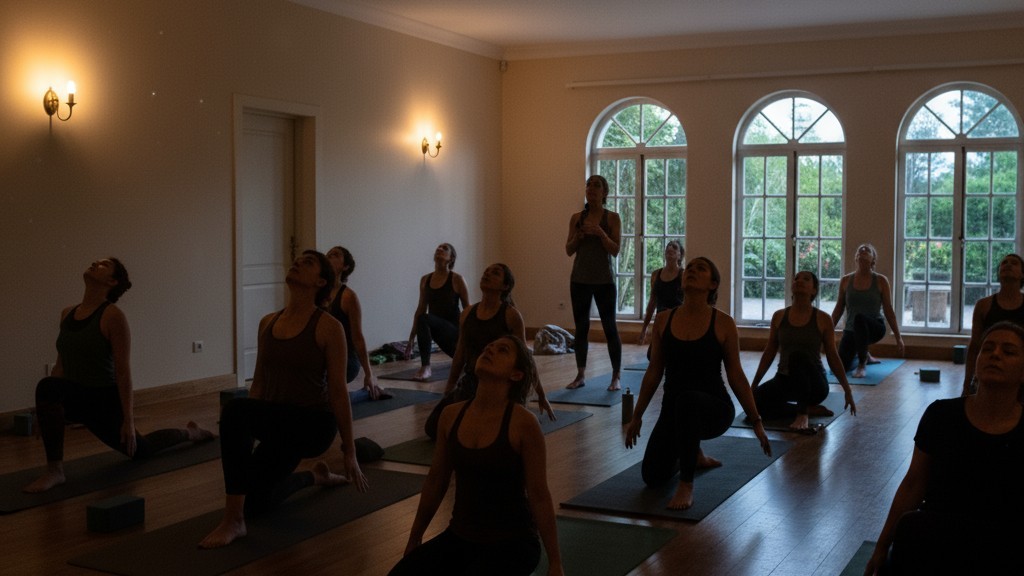
The spell is broken. The disruption is total, a jarring reminder of the outside world in a space designed for inner focus. This isn’t a malfunction. It’s a failure of context—a well-intentioned technology, built for the bustle of offices and hallways, applied to a space defined by stillness.
The solution requires a new philosophy, not just a new product. It means moving from a reactive system that punishes stillness to an intentional one that supports it. With the right strategy—vacancy detection, longer timeouts, and intelligent placement—lighting can become a silent partner in tranquility, not a source of disruption.
The Paradox of Stillness: Why Standard Occupancy Sensors Fail
When the lights go out in a quiet room, the sensor isn’t broken; it’s working exactly as designed. The problem is a fundamental mismatch between its logic and the room’s purpose. Most common occupancy sensors are not designed to detect presence; they are designed to detect change.
A Passive Infrared (PIR) sensor, the most common type, doesn’t actually see people. It sees heat. The sensor divides its field of view into zones and monitors the ambient thermal energy in each. When your body heat moves from one zone to another, it creates a differential that the sensor reads as motion. For the sensor, motion equals occupancy. This logic works reliably in an office or a corridor where people are constantly moving.
In a yoga or meditation room, this logic collapses. A student holding a pose or a group in seated meditation produces very little change in the thermal landscape. The slow, deliberate breathing or a minor shift in posture is often too subtle to cross the sensor’s detection threshold. After a set period of this perceived inactivity, the sensor concludes the room is empty and dutifully turns off the lights, prioritizing a flawed idea of energy efficiency over the room’s primary function.
Redefining Presence: The Critical Shift from Occupancy to Vacancy Mode
The most effective solution is a simple change to the sensor’s core operational mode. Most commercial-grade sensors can be configured for either occupancy or vacancy detection. While the names sound similar, their logic is profoundly different, and choosing the right one is the key to creating a tranquil space.
Occupancy Mode: The Automated but Disruptive Default
Occupancy mode is fully automated. The sensor turns lights on automatically when it detects motion and turns them off automatically after a period of perceived vacancy. This is the default for hands-free energy savings and is ideal for transient spaces like restrooms or storage closets. In a meditation room, however, the auto-on feature can be just as disruptive as the auto-off, flooding a room with light when it was meant to remain dark.
Vacancy Mode: Intentional Control for Uninterrupted Calm
Vacancy mode, or manual-on/auto-off, puts control back in the user’s hands. The lights must be turned on manually with a wall switch. The sensor’s only job is to turn them off automatically after it has confirmed the room is truly empty.
This simple shift in logic solves the core problem. The instructor or first person in makes a conscious decision to turn the lights on, initiating the session. From that point, the sensor’s countdown timer is active, but there is no risk of the lights failing to turn on or switching on unexpectedly. The system delivers the energy savings of an auto-off feature without sacrificing control over the environment during the session.
Căutați soluții de economisire a energiei activate de mișcare?
Contactați-ne pentru senzori de mișcare PIR compleți, produse de economisire a energiei cu activare la mișcare, întrerupătoare cu senzor de mișcare și soluții comerciale de prezență/vacanță.
Calibrating for Calm: The Art of the Extended Time Delay
With the sensor in vacancy mode, the next step is to calibrate its time delay. This setting determines how long the sensor waits after the last detected motion before turning off the lights. In a standard office, a 15-minute delay is common. For a space dedicated to stillness, this is far too short.
A short time delay creates a state of “countdown anxiety,” where any prolonged period of quiet risks a blackout. The solution is to align the technology with the activity.
Guideline: Match the Timeout to the Session Length. For a room used for hour-long yoga classes or 30-minute meditations, the time delay should be set accordingly. A timeout of 30 to 60 minutes is a sensible starting point. This ensures that even if no motion is detected for most of the session, the lights will remain on. This preserves energy savings when the room is empty for hours, a far more effective and less intrusive approach to efficiency.
The Geometry of Awareness: Strategic Sensor Placement
Sensor placement is just as critical as its settings. A perfectly calibrated sensor is useless if a blind spot prevents it from seeing movement. The key is to map the sensor’s coverage pattern to the room’s usage, focusing on areas of likely, not constant, movement.
Monitor the Path of Movement, Not the Zone of Stillness
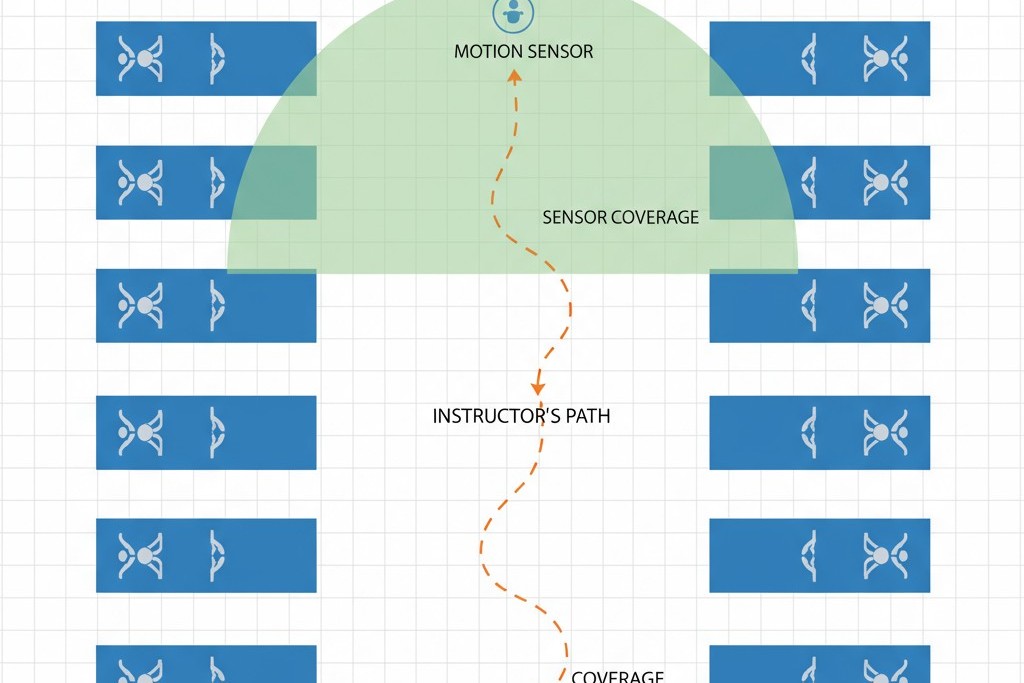
In a typical yoga class, students remain relatively stationary on their mats, while the instructor often moves around the room to demonstrate poses and provide adjustments. This creates a predictable path of movement. The sensor should be positioned with a clear, unobstructed view of this path. By focusing on the instructor’s area, the sensor is far more likely to get the periodic triggers needed to reset its timer, without needing to detect the subtle movements of twenty stationary people.
Lăsați-vă inspirat de portofoliile de senzori de mișcare Rayzeek.
Nu găsiți ceea ce căutați? Nu vă faceți griji. Există întotdeauna modalități alternative de a vă rezolva problemele. Poate vă poate ajuta unul dintre portofoliile noastre.
Wall Mount vs. Ceiling Mount
The choice between a wall-mounted or ceiling-mounted sensor depends on the room’s layout. A ceiling-mounted sensor provides a conical, 360-degree coverage pattern, making it excellent for monitoring the center of a large, open room where an instructor might roam. A wall-mounted sensor provides a fan-shaped pattern, better for smaller rooms where it can be aimed precisely at the instructor’s primary area or the main pathways. The goal is to ensure the most consistently active areas are the primary focus of the sensor’s view.
Selecting the Right Sensing Technology
While PIR is the most common, other technologies offer the increased sensitivity that can make all the difference in a challenging space.
Infraroșu pasiv (PIR) sensors, as we’ve covered, detect motion via changes in heat. They are excellent for detecting major movements and are immune to false triggers from things like air vents, but they can be challenged by the minor motions in a quiet room.
Ultrasonic (US) sensors emit high-frequency sound waves and detect motion by sensing a shift in the returning waves. They are extremely sensitive to minor movements and can even “see” around corners. This sensitivity, however, makes them prone to false triggers from vibrations or airflow from HVAC systems.
Dual-Technology (Dual-Tech) sensors are the gold standard for these spaces. They combine both PIR and Ultrasonic technologies in a single unit, requiring both to agree the room is occupied. This dual-validation approach offers the high sensitivity of an ultrasonic sensor while using the PIR to guard against the false triggers that can plague it alone. For a yoga studio, reliability is paramount, making a dual-tech sensor the superior choice.
Harmonizing the Space: Advanced Scenarios
For spaces with multiple uses, lighting controls can offer more nuance than a simple on/off command.
Handling Dual-Use Spaces
If a room hosts quiet meditation in the morning and high-energy aerobics in the afternoon, a dual-tech sensor with adjustable sensitivity is ideal. The settings can be optimized to provide high sensitivity for the yoga class while remaining robust enough for more active periods. The core strategy of vacancy mode and a long time delay remains effective for both scenarios.
S-ar putea să vă intereseze și

- Tensiune: 2 baterii AAA
- Mod Zi/Noapte
- Temporizare: 15min, 30min, 1h (implicit), 2h

- Senzor de prezență PIR cu montaj pe tavan și ieșire de releu cu contact uscat
- Alimentare de joasă tensiune de 12/24VDC sau 12/24VAC
- Contacte de releu izolate COM, NO și NC pentru intrări de control al sistemelor EMS, HVAC și al clădirilor

- Întrerupător cu senzor de mișcare cu microunde încastrat în tavan, de joasă tensiune DC
- Intrare de 12 VDC / 24 VDC cu un interval cuprins între 10-30 VDC
- Curent de lucru maxim de 10A cu temporizare reglabilă, prag Lux și sensibilitate ajustabile
- Întrerupător cu senzor de mișcare cu microunde încastrat în tavan, pentru sarcini mai mari
- Intrare la tensiunea rețelei de 100-265 VAC, model de 10A
- Detectare cu microunde de 5.8 GHz cu temporizare reglabilă, prag Lux și sensibilitate ajustabile
- Întrerupător încastrat pentru plafon cu senzor de mișcare cu microunde
- Tensiune de intrare 100-265 VAC, model de 5A
- Detectare cu microunde de 5.8 GHz cu temporizare reglabilă, prag Lux și sensibilitate ajustabile
- Variator cu senzor de prezență PIR RZ037 pentru plafon, pentru alimentare la 220V
- Curent maxim de lucru de 3A cu sarcină nominală de 660W
- Butonul LUX controlează funcția ON/OFF a senzorului de lumină și luminozitatea setată de utilizator
- Variator cu senzor de prezență PIR RZ037 pentru plafon, pentru alimentare la 110V
- Curent maxim de lucru de 3A cu sarcină nominală de 330W
- Butonul LUX controlează funcția ON/OFF a senzorului de lumină și luminozitatea setată de utilizator

- Întrerupător cu senzor de mișcare cu microunde pentru plafon, de joasă tensiune C.C.
- Intrare de 12 VDC / 24 VDC cu un interval cuprins între 10-30 VDC
- Curent de lucru maxim de 10A cu temporizare reglabilă, prag Lux și sensibilitate ajustabile
- Întrerupător cu senzor de mișcare cu microunde pentru plafon, pentru sarcini mai mari
- Intrare la tensiunea rețelei de 100-265 VAC, model de 10A
- Detectare cu microunde de 5.8 GHz cu temporizare reglabilă, prag Lux și sensibilitate ajustabile
- Întrerupător cu senzor de mișcare cu microunde pentru plafon
- Tensiune de intrare 100-265 VAC, model de 5A
- Detectare cu microunde de 5.8 GHz cu temporizare reglabilă, prag Lux și sensibilitate ajustabile

- Întrerupător cu senzor de mișcare PIR încastrat în tavan, CC de joasă tensiune
- Intrare de 12 VDC / 24 VDC cu un interval cuprins între 10-30 VDC
- Curent maxim de lucru 10A cu temporizare reglabilă, prag Lux și sensibilitate

- Întrerupător cu senzor de mișcare PIR încastrat în tavan pentru sarcini mai mari
- Intrare la tensiunea rețelei de 100-265 VAC, model de 10A
- Detecție la 360 de grade cu temporizare reglabilă, prag Lux și sensibilitate
- Întrerupător cu senzor de mișcare PIR încastrat în tavan
- Tensiune de intrare 100-265 VAC, model de 5A
- Detecție la 360 de grade cu temporizare reglabilă, prag Lux și sensibilitate

- Kit de întrerupător și receptor wireless pentru controlul iluminatului de interior PORNIT/OPRIT
- Receptor 100-230VAC, 50/60Hz cu curent nominal de 5A
- Întrerupător wireless alimentat cu baterie CR2032 cu comunicare la 2.4GHz
- Prezență (PORNIRE automată/OPRIRE automată)
- 12–24V CC (10–30VCC), până la 10A
- Acoperire 360°, diametru 8–12 m
- Temporizare 15 s–30 min
- Senzor de lumină Oprit/15/25/35 Lux
- Sensibilitate ridicată/scăzută
- Mod de prezență Auto-ON/Auto-OFF
- 100–265V AC, 10A (necesită nul)
- Acoperire 360°; diametru de detecție 8–12 m
- Temporizare 15 s–30 min; Lux OFF/15/25/35; Sensibilitate ridicată/scăzută
- Mod de prezență Auto-ON/Auto-OFF
- 100–265V AC, 5A (necesită nul)
- Acoperire 360°; diametru de detecție 8–12 m
- Temporizare 15 s–30 min; Lux OFF/15/25/35; Sensibilitate ridicată/scăzută
Beyond On/Off: The Role of Integrated Dimming
For an even more refined experience, sensors can be integrated with dimming controls. This allows for a “fade-to-off” transition instead of an abrupt shutoff. A slow, 60-second fade provides a gentle visual cue that the lights are about to go out, giving someone still in the room ample time to make a small movement and reset the timer. This simple feature transforms the system from a blunt switch into a graceful, communicative part of the environment.







