
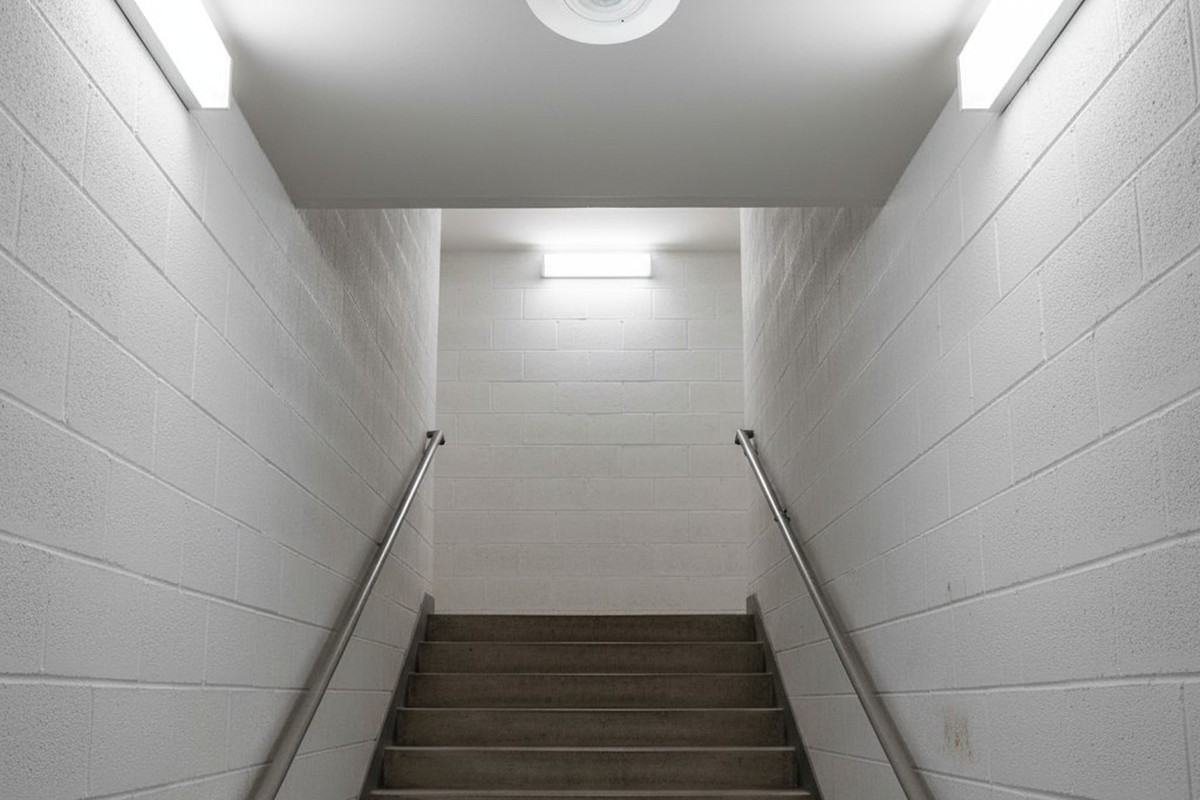
Motion-activated stairwell lighting promises energy savings by turning lights off in empty spaces. But when standard settings are applied to vertical environments, this efficiency feature can become a safety hazard. Many installations cycle lights on and off rapidly as people move between floors, creating a dangerous strobe effect. A light extinguishes mid-descent, vision struggles to adjust to the sudden darkness, and a missed step becomes a fall.
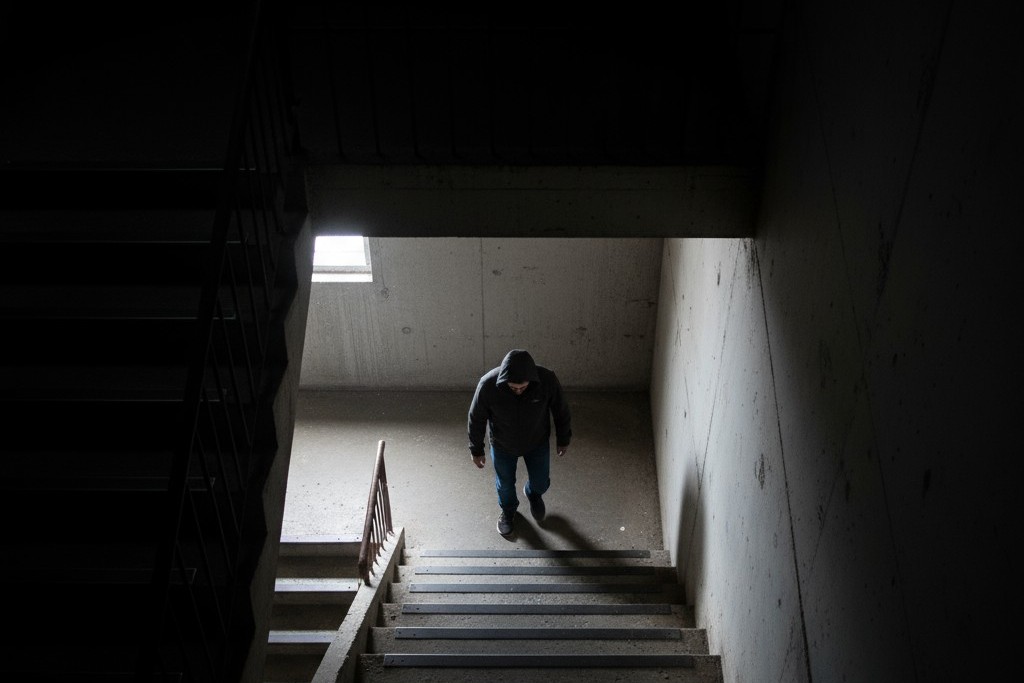
This strobing isn’t a sensor malfunction. It’s the predictable result of applying timeout settings calibrated for hallways to the unique demands of stairwells. Stairs require longer transit times. Sensors positioned for room coverage leave detection gaps when monitoring multi-level movement. The aggressive pursuit of minimal “on” time produces a system that is technically functional but practically dangerous.
The problem is entirely preventable. With the right timeout duration, retrigger behavior, and sensor placement, you can eliminate strobing while preserving real energy savings. These settings aren’t complex, but they require a deliberate rejection of the default, one-size-fits-all approach in favor of one that guarantees continuous coverage.
The Strobing Hazard: Darkness Mid-Transit
Strobing is the repeated on-off cycling of lights as a person moves through a stairwell. It’s more than a single activation; it’s a disruptive pattern. Lights turn on with motion, extinguish when a short timeout expires, then immediately reactivate as the person enters a new detection zone. In a multi-story stairwell, this can happen three or four times during a single trip.
While strobing in a hallway is an annoyance, in a stairwell it’s a fall risk. Human vision needs time to adapt between light and dark. When a staircase suddenly goes black, this critical adjustment period coincides with the exact moment a person is navigating changes in depth and elevation. In an environment where a misstep has consequences, spatial awareness depends on consistent visual input. The on-off pattern creates the perfect conditions for an accident: intermittent darkness during continuous movement on an uneven surface.
The disorientation is worse in enclosed stairwells without natural light. When a sensor times out, the space doesn’t dim—it plunges into darkness. Handrails and step edges vanish. The instinctive reaction is to freeze or slow down, which ironically worsens the problem by reducing motion below the sensor’s detection threshold.
人感センサーを活用した省エネソリューションをお探しですか?
PIR人感センサー、人感センサー搭載省エネ製品、人感センサースイッチ、商業施設向けOccupancy/Vacancy(在室/不在)ソリューションについては、お気軽にお問い合わせください。
This isn’t a failure of technology, but of configuration. The solution isn’t to replace the equipment; it’s to adjust three key parameters: timeout duration, retrigger responsiveness, and detection zone coverage.
Why Stairwell Lights Strobe: The Timeout-Transit Mismatch
Motion sensors operate on a countdown timer. When movement is detected, the light activates and a timeout period begins. If the timer expires without detecting new motion, the light turns off. In a conference room or a hallway, this logic works perfectly. Occupants produce enough periodic motion to keep resetting the timer, and the lights go off only after the space is truly empty.
Stairwells violate this core assumption. A person moving through a stairwell is in continuous motion, but that motion is spread across multiple sensor zones. If each sensor has a 30-second timeout and a five-floor descent takes 90 seconds, the person will trigger the first sensor, leave its detection zone, and the timeout will expire long before they reach the next sensor. The first light goes out while they are still on the stairs. The pattern repeats all the way down: the floor above goes dark as the floor ahead lights up.
The mismatch is both temporal and spatial. A single, well-placed sensor can cover an entire hallway, keeping a person in continuous detection from end to end. A stairwell’s verticality makes this impossible with one sensor. It requires multiple sensors, each operating on its own independent countdown. Unless their settings create an overlap in both time and space, gaps are inevitable.
The Detection Dead Zone
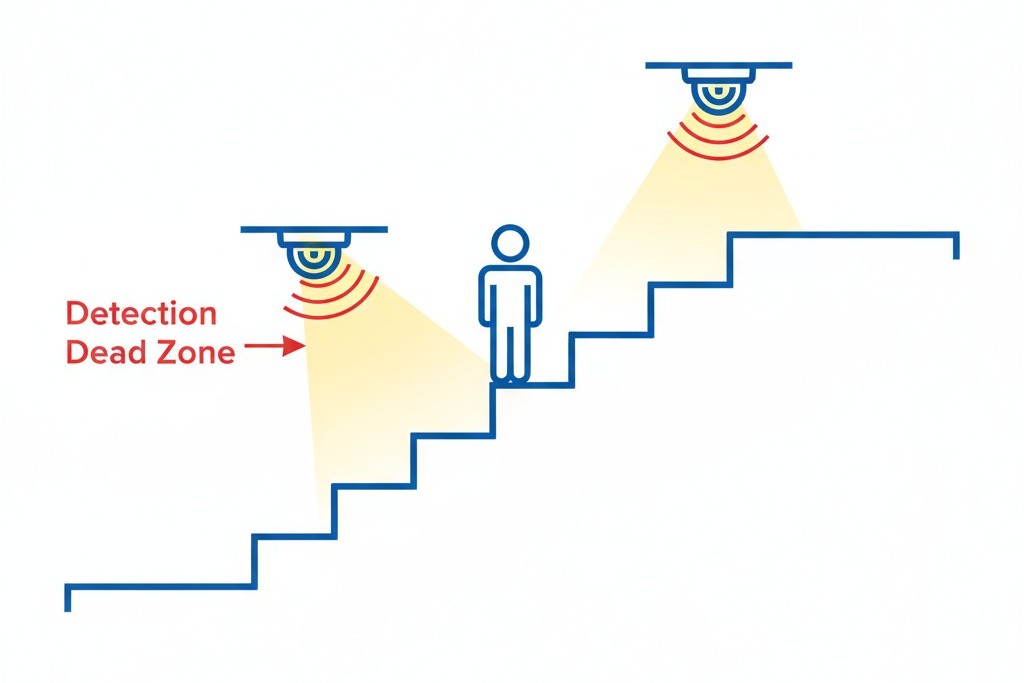
These gaps—detection dead zones—are a product of vertical movement. A person walking across a 20-foot room at a normal pace takes about five to seven seconds, easily covered by a minimal 15-second timeout. But descending a single flight of stairs takes an average adult 15 to 20 seconds. A three-story descent can take a minute; a five-story descent, more than 90 seconds.
Sensor geometry compounds the problem. Motion sensors detect changes in infrared radiation. Horizontal movement across a sensor’s field of view creates a strong, clear signal. Vertical movement, especially directly toward or away from a sensor, produces a much weaker signal. As someone descends, their movement is partially along the sensor’s line of sight, not across it. This shrinks the effective coverage area well below the manufacturer’s rated range.
These two factors create dead zones between floors. A person exits the upper sensor’s range a few seconds before entering the lower one’s. That’s all it takes for a short timeout to expire, plunging the landing into darkness.
Timeout Duration: The Primary Defense
The most effective way to stop strobing is to extend the timeout duration so it exceeds the total transit time through the stairwell. If a person can get from the first sensor they trigger to their final exit before the timer runs out, the lights will stay on for the entire journey.
For most stairwells, a minimum timeout of 60 seconds is recommended. This covers a two- to three-story trip at a normal pace.
- Stairwells serving more than three floors should use a 90-second baseline.
- Buildings with five or more floors benefit from 120-second settings.
These durations aren’t arbitrary. They are based on the measured time for typical transit, plus a safety margin for slower users. To calculate the right timeout for a specific building, estimate the longest reasonable path and add a 30-40% buffer. Consider users with mobility limitations, children, or people carrying heavy loads, who may take twice as long. A timeout calibrated for the average user will fail the most vulnerable ones.
Rayzeek人感センサーのポートフォリオを見る.
お探しの製品が見つかりませんか?ご安心ください。課題を解決する手段は常に複数存在します。当社の製品ポートフォリオのいずれかがお役に立つかもしれません。
The common objection is that longer timeouts waste energy. This concern is overstated. The energy difference between a 30-second and a 90-second timeout is negligible. For an LED-lit stairwell activated 20 times a day, extending the timeout adds about 20 minutes of total “on” time. This translates to a trivial cost—often less than a dollar per year. The safety benefit of eliminating mid-transit darkness far outweighs this marginal expense.
Retrigger Settings and Continuous Presence
A long timeout prevents strobing for a single user, but what about continuous traffic? If a second person enters the stairwell just as the first person’s timeout is about to expire, the lights could still flicker off briefly.
Retriggering solves this by resetting the countdown whenever new motion is detected. Instead of running uninterrupted, the timer restarts to its full duration with each new trigger. As long as people are moving through the space, the lights stay on. Only after the last person leaves and the stairwell is truly vacant does the full countdown complete and the lights turn off.
This behavior is critical for creating a stable lighting environment during active periods. Not all sensors support effective retriggering; some basic models ignore any motion after the initial activation. When selecting or configuring sensors, verify they offer continuous monitoring to ensure the lights remain on seamlessly for consecutive users. A long timeout and effective retriggering work together to create a system that feels responsive: on when needed, off when truly empty.
Sensor Placement for Overlapping Zones
Timeout and retrigger settings solve the time problem; sensor placement solves the space problem. Even with long timeouts, strobing will persist if there are gaps between detection zones.
Effective placement requires creating overlapping fields of coverage. An occupant must always be within range of at least one sensor. This doesn’t mean blanketing the entire stairwell, but ensuring the transition points between zones are redundant. Where one sensor’s range ends, the next one’s should have already begun. As a rule of thumb, aim for at least 20-30% overlap.
Single-Flight Stairwells: A sensor at the top landing and another at the bottom can provide full coverage if their detection zones meet in the middle. The easiest way to test this is to walk the stairs; if the lights flicker off mid-flight, the sensors are too far apart.
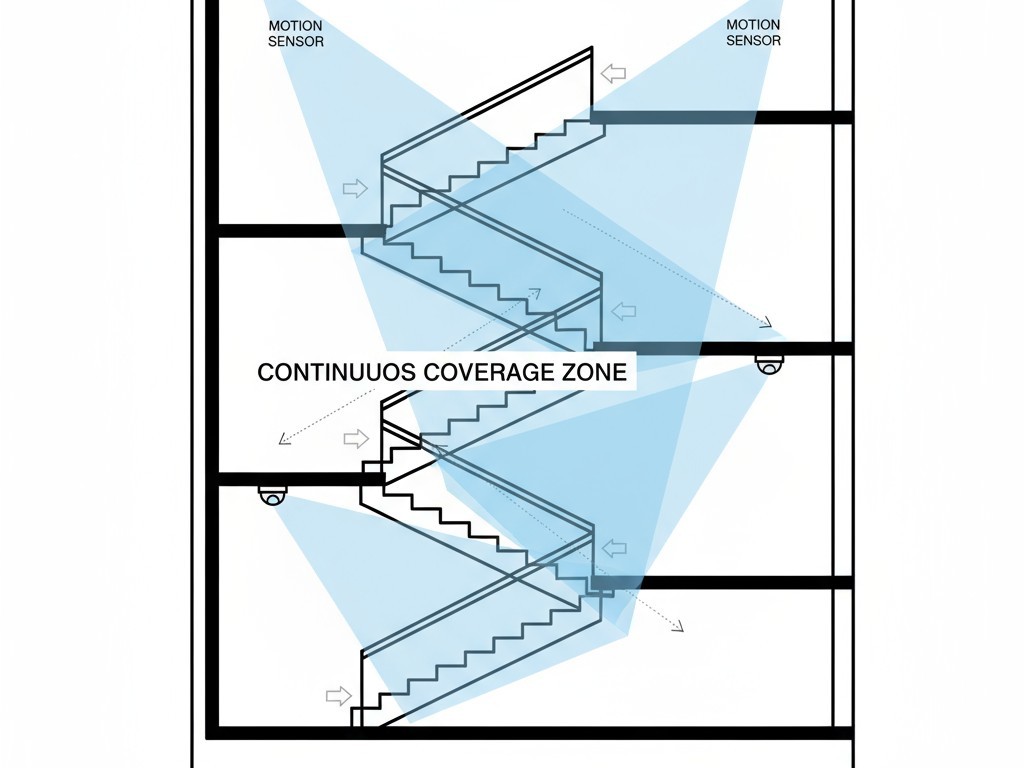
Multi-Story Staggering: For taller stairwells, each landing needs a sensor positioned to create a cascade of overlapping zones. The fifth-floor sensor should cover the fifth-floor landing and partway down the flight to the fourth. The fourth-floor sensor should cover partway up to the fifth, across its own landing, and partway down to the third. This ensures a seamless handoff. As a person descends, they are detected by the next sensor before they leave the range of the previous one. This may require angling or tilting sensors to extend their vertical reach down the flight of stairs.
The False Economy of Aggressive Timeouts
The push for shorter timeouts comes from a flawed belief that they produce proportional energy savings. The actual savings from cutting a stairwell timeout from 90 to 30 seconds are minuscule compared to total building energy use.
Consider a stairwell with four 20-watt LED fixtures. At 20 activations per day, a 90-second timeout consumes about 0.04 kWh. A 30-second timeout consumes 0.013 kWh. The difference is 0.027 kWh per day. At a commercial rate of $0.12/kWh, the daily savings amount to one-third of a cent. The annual savings is about a dollar.
こちらの商品もおすすめです

- 電圧: 単4形乾電池 2本
- 昼/夜モード
- タイマー設定時間: 15分、30分、1時間(デフォルト)、2時間

- 無電圧接点リレー出力付き天井取り付け型PIR人感センサー
- 12/24VDCまたは12/24VAC低電圧電源
- EMS、HVAC、および建物制御入力用COM、NO、NC絶縁リレー接点

- 低電圧DC天井埋め込み型マイクロ波人感センサースイッチ
- 10~30 VDC範囲の12 VDC / 24 VDC入力
- 調整可能なタイムラグ、照度(Lux)閾値、感度を備えた最大動作電流10A仕様
- 高負荷対応型 埋込型天井取付けマイクロ波人感センサースイッチ
- 100-265 VAC 商用電源入力、10Aモデル
- 調整可能なタイムラグ、照度(Lux)閾値、感度を備えた5.8 GHzマイクロ波検知
- 埋込型天井取付けマイクロ波人感センサースイッチ
- 100-265 VAC商用電圧入力、5Aモデル
- 調整可能なタイムラグ、照度(Lux)閾値、感度を備えた5.8 GHzマイクロ波検知
- 220V電源対応 天井取付けRZ037 PIR(赤外線)人感センサー調光器
- 定格負荷660W、最大動作電流3A
- LUXボタンによる照度センサーのON/OFFおよびユーザー設定の調光明るさ制御
- 110V電源対応 天井取付けRZ037 PIR(赤外線)人感センサー調光器
- 定格負荷330W、最大動作電流3A
- LUXボタンによる照度センサーのON/OFFおよびユーザー設定の調光明るさ制御

- 低電圧DC対応 天井取付けマイクロ波人感センサースイッチ
- 10~30 VDC範囲の12 VDC / 24 VDC入力
- 調整可能なタイムラグ、照度(Lux)閾値、感度を備えた最大動作電流10A仕様
- 高負荷対応 天井取付型マイクロ波人感センサースイッチ
- 100-265 VAC 商用電源入力、10Aモデル
- 調整可能なタイムラグ、照度(Lux)閾値、感度を備えた5.8 GHzマイクロ波検知
- 天井取り付け型マイクロ波人感センサースイッチ
- 100-265 VAC商用電圧入力、5Aモデル
- 調整可能なタイムラグ、照度(Lux)閾値、感度を備えた5.8 GHzマイクロ波検知

- 低電圧DC埋込型天井PIR人感センサースイッチ
- 10~30 VDC範囲の12 VDC / 24 VDC入力
- 最大動作電流10A(調整可能なタイムラグ、照度閾値、感度設定付き)

- 高負荷対応 埋込型天井PIR人感センサースイッチ
- 100-265 VAC 商用電源入力、10Aモデル
- 360度検知(調整可能なタイムラグ、照度閾値、感度設定付き)
- 埋込型天井PIR人感センサースイッチ
- 100-265 VAC商用電圧入力、5Aモデル
- 360度検知(調整可能なタイムラグ、照度閾値、感度設定付き)

- 屋内用照明ON/OFF制御ワイヤレススイッチ&受信機キット
- 100-230VAC、50/60Hz、定格電流5A受信機
- 2.4GHz通信対応 CR2032電池駆動ワイヤレススイッチ
- Occupancy(自動点灯/自動消灯)
- 12–24V DC (10–30VDC)、最大10A
- 360°検知エリア、直径8–12m
- タイムラグ 15秒–30分
- 照度センサー オフ/15/25/35 Lux
- 高/低感度
- 自動点灯/自動消灯人感モード
- 100–265V AC, 10A(中性線必須)
- 360°検知範囲、検知直径8–12 m
- タイムデレイ15秒–30分、Lux OFF/15/25/35、感度 高/低
- 自動点灯/自動消灯人感モード
- 100–265V AC, 5A(中性線必須)
- 360°検知範囲、検知直径8–12 m
- タイムデレイ15秒–30分、Lux OFF/15/25/35、感度 高/低
This calculation ignores the real-world consequences. It assumes strobing doesn’t cause people to prop doors open for light, negating the savings. More importantly, it ignores the immense cost of a single fall caused by inadequate lighting, which would dwarf the marginal energy savings by orders of magnitude.
Safety must override micro-optimization. The relevant comparison isn’t between a 30-second and a 90-second timeout; it’s between a properly configured motion-activated system and the alternatives of leaving lights on 24/7. Even a 120-second timeout is a massive efficiency gain. Energy savings that compromise safety aren’t savings at all—they are deferred costs that will reappear as insurance claims and liability risks.
Verifying Strobing-Free Operation
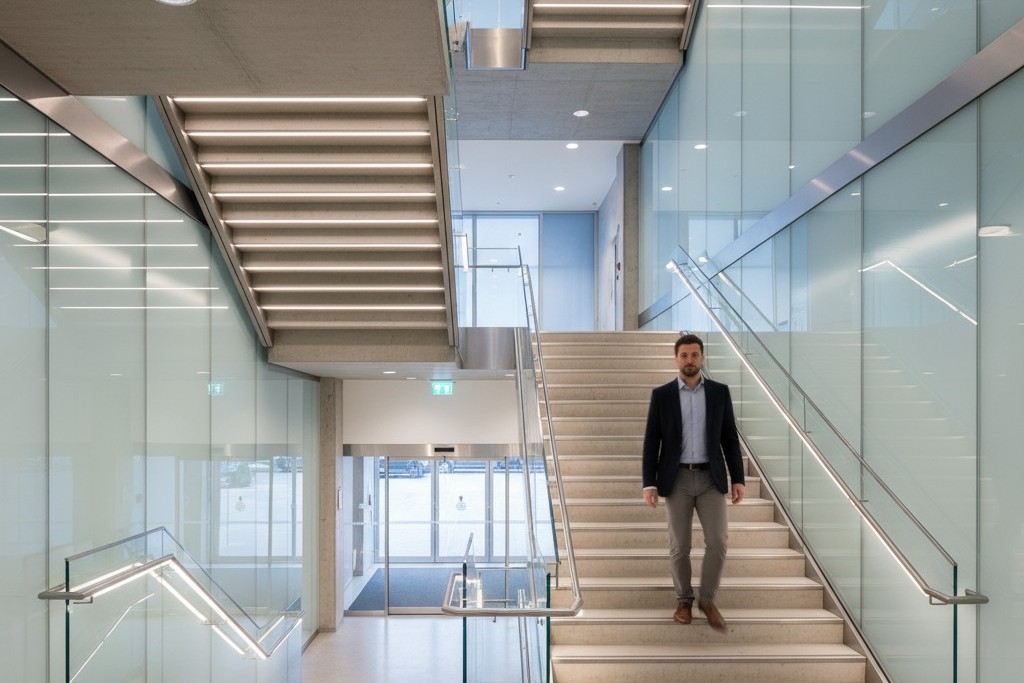
Configuration on paper is no guarantee of performance. The only way to confirm the settings work is to test them in the real world.
- Full-Transit Walk-Through: Walk from the highest floor to the lowest at a normal pace, then back up. The lights should activate once and remain on for the entire trip. Any flicker indicates a gap in coverage or an insufficient timeout.
- Timeout Test: Trigger a sensor, leave the area, and time how long the light stays on. It should match the configured setting.
- Multi-User Test: Have a second person enter the stairwell 10-15 seconds after the first. The lights should remain on without interruption, confirming the retrigger setting is working.
Properly configured stairwell lighting is stable and predictable. It activates promptly, stays on continuously during transit, and turns off only after a true period of vacancy. This isn’t a compromise between safety and efficiency; it is the correct application of technology to a unique space. The result is a system that delivers on the promise of energy savings without introducing unnecessary risk.







