
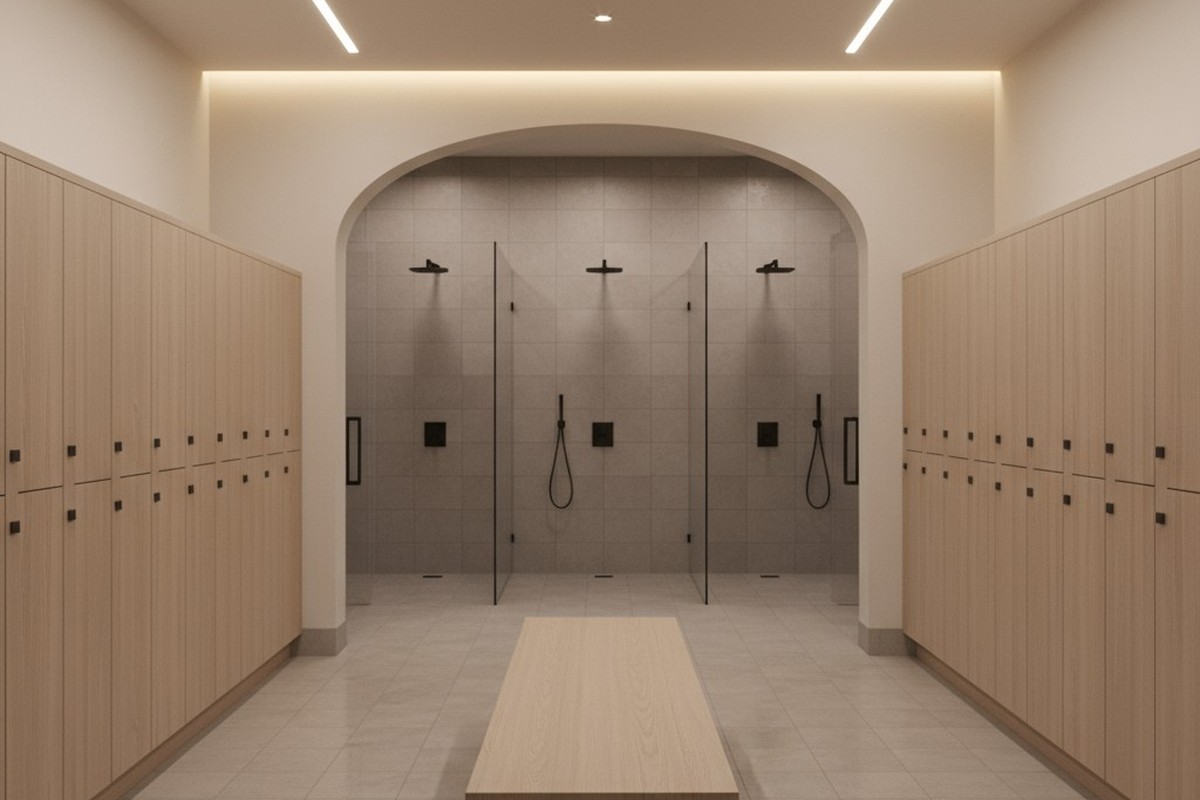
Automating a commercial locker room is a balancing act. The push for energy efficiency often clashes with the non-negotiable demands of personal privacy and user comfort. A poorly implemented occupancy system creates a hostile environment, plunging a room into darkness mid-shower or leaving occupants with the unnerving feeling of being monitored. Yet leaving lights and ventilation running 24/7 in these intermittently used spaces is a massive operational waste.
An intelligent solution refuses to sacrifice dignity for savings. It achieves both by moving beyond simple motion detection to a more nuanced, human-centric design. By establishing clear principles for sensor placement, zone management, and system timing, you can build an automated environment that is respectful, predictable, and highly efficient.
The Locker Room Dilemma: Balancing Energy Efficiency and User Dignity
A locker room is a place of transition and vulnerability. Unlike an office or hallway, its occupancy patterns are erratic, and long periods of low movement are common, particularly within shower stalls and changing areas. A standard occupancy sensor, armed with a short timeout delay, will inevitably fail here. It misinterprets the stillness of someone showering as vacancy, killing the lights and causing frustration and alarm.
This failure creates a cycle of user distrust and manual overrides, defeating the purpose of automation. Facility managers are often left with two poor choices: revert to an “always on” state that wastes money, or field constant complaints about a system that feels broken and intrusive.
A better framework is required.
The Foundation of Discretion: Zoning for Predictable Control
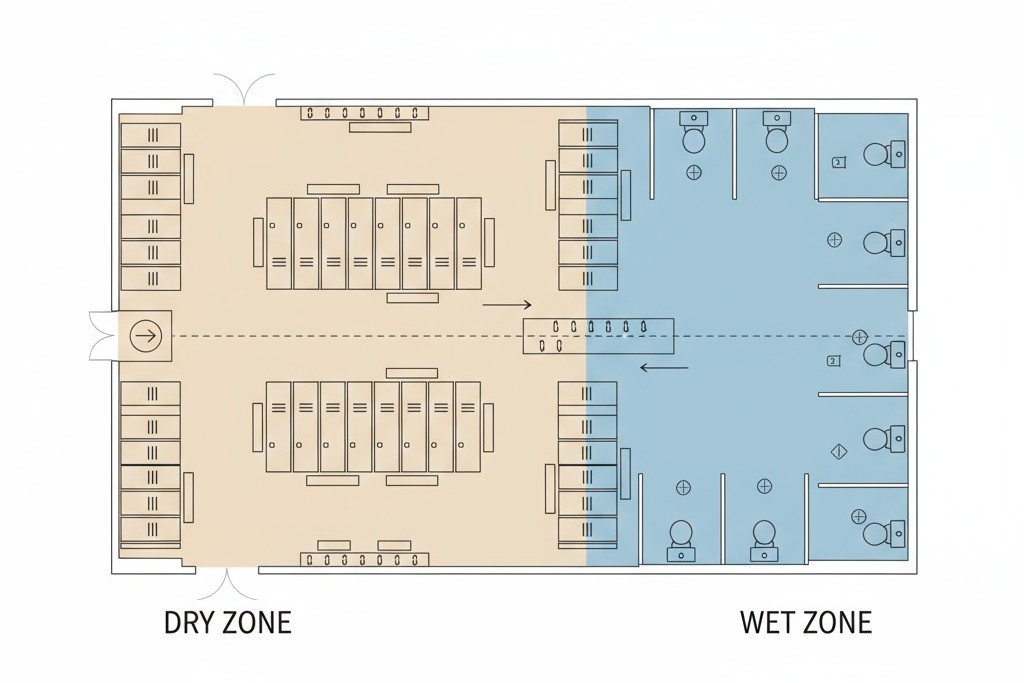
A successful system begins by dividing the locker room into distinct logical zones based on function and user behavior. This strategic separation allows for different control rules to be applied to each area, forming the foundation of a discrete and effective system.
The first area is the Dry Zone, encompassing main circulation paths, entryways, locker banks, and benches. This part of the room sees relatively consistent motion as people walk, open lockers, or get ready. Because a lack of motion here is a reliable indicator of vacancy, the control logic can be more aggressive, with shorter timeout delays.
The second is the Wet Zone, which includes all private, multi-stall areas like showers, toilet enclosures, and adjacent drying spaces. This zone is defined by minimal physical movement and a high expectation of privacy. Applying the same logic as the dry zone is a guaranteed failure. This area requires a fundamentally different approach that prioritizes long, deliberate timeouts and sensor placements that are incapable of direct observation.
こちらの商品もおすすめです

- 電圧: 単4形乾電池 2本
- 昼/夜モード
- タイマー設定時間: 15分、30分、1時間(デフォルト)、2時間

- 無電圧接点リレー出力付き天井取り付け型PIR人感センサー
- 12/24VDCまたは12/24VAC低電圧電源
- EMS、HVAC、および建物制御入力用COM、NO、NC絶縁リレー接点

- 低電圧DC天井埋め込み型マイクロ波人感センサースイッチ
- 10~30 VDC範囲の12 VDC / 24 VDC入力
- 調整可能なタイムラグ、照度(Lux)閾値、感度を備えた最大動作電流10A仕様
- 高負荷対応型 埋込型天井取付けマイクロ波人感センサースイッチ
- 100-265 VAC 商用電源入力、10Aモデル
- 調整可能なタイムラグ、照度(Lux)閾値、感度を備えた5.8 GHzマイクロ波検知
- 埋込型天井取付けマイクロ波人感センサースイッチ
- 100-265 VAC商用電圧入力、5Aモデル
- 調整可能なタイムラグ、照度(Lux)閾値、感度を備えた5.8 GHzマイクロ波検知
- 220V電源対応 天井取付けRZ037 PIR(赤外線)人感センサー調光器
- 定格負荷660W、最大動作電流3A
- LUXボタンによる照度センサーのON/OFFおよびユーザー設定の調光明るさ制御
- 110V電源対応 天井取付けRZ037 PIR(赤外線)人感センサー調光器
- 定格負荷330W、最大動作電流3A
- LUXボタンによる照度センサーのON/OFFおよびユーザー設定の調光明るさ制御

- 低電圧DC対応 天井取付けマイクロ波人感センサースイッチ
- 10~30 VDC範囲の12 VDC / 24 VDC入力
- 調整可能なタイムラグ、照度(Lux)閾値、感度を備えた最大動作電流10A仕様
- 高負荷対応 天井取付型マイクロ波人感センサースイッチ
- 100-265 VAC 商用電源入力、10Aモデル
- 調整可能なタイムラグ、照度(Lux)閾値、感度を備えた5.8 GHzマイクロ波検知
- 天井取り付け型マイクロ波人感センサースイッチ
- 100-265 VAC商用電圧入力、5Aモデル
- 調整可能なタイムラグ、照度(Lux)閾値、感度を備えた5.8 GHzマイクロ波検知

- 低電圧DC埋込型天井PIR人感センサースイッチ
- 10~30 VDC範囲の12 VDC / 24 VDC入力
- 最大動作電流10A(調整可能なタイムラグ、照度閾値、感度設定付き)

- 高負荷対応 埋込型天井PIR人感センサースイッチ
- 100-265 VAC 商用電源入力、10Aモデル
- 360度検知(調整可能なタイムラグ、照度閾値、感度設定付き)
- 埋込型天井PIR人感センサースイッチ
- 100-265 VAC商用電圧入力、5Aモデル
- 360度検知(調整可能なタイムラグ、照度閾値、感度設定付き)

- 屋内用照明ON/OFF制御ワイヤレススイッチ&受信機キット
- 100-230VAC、50/60Hz、定格電流5A受信機
- 2.4GHz通信対応 CR2032電池駆動ワイヤレススイッチ
- Occupancy(自動点灯/自動消灯)
- 12–24V DC (10–30VDC)、最大10A
- 360°検知エリア、直径8–12m
- タイムラグ 15秒–30分
- 照度センサー オフ/15/25/35 Lux
- 高/低感度
- 自動点灯/自動消灯人感モード
- 100–265V AC, 10A(中性線必須)
- 360°検知範囲、検知直径8–12 m
- タイムデレイ15秒–30分、Lux OFF/15/25/35、感度 高/低
- 自動点灯/自動消灯人感モード
- 100–265V AC, 5A(中性線必須)
- 360°検知範囲、検知直径8–12 m
- タイムデレイ15秒–30分、Lux OFF/15/25/35、感度 高/低
Strategic Sensor Placement: How to See Presence, Not People
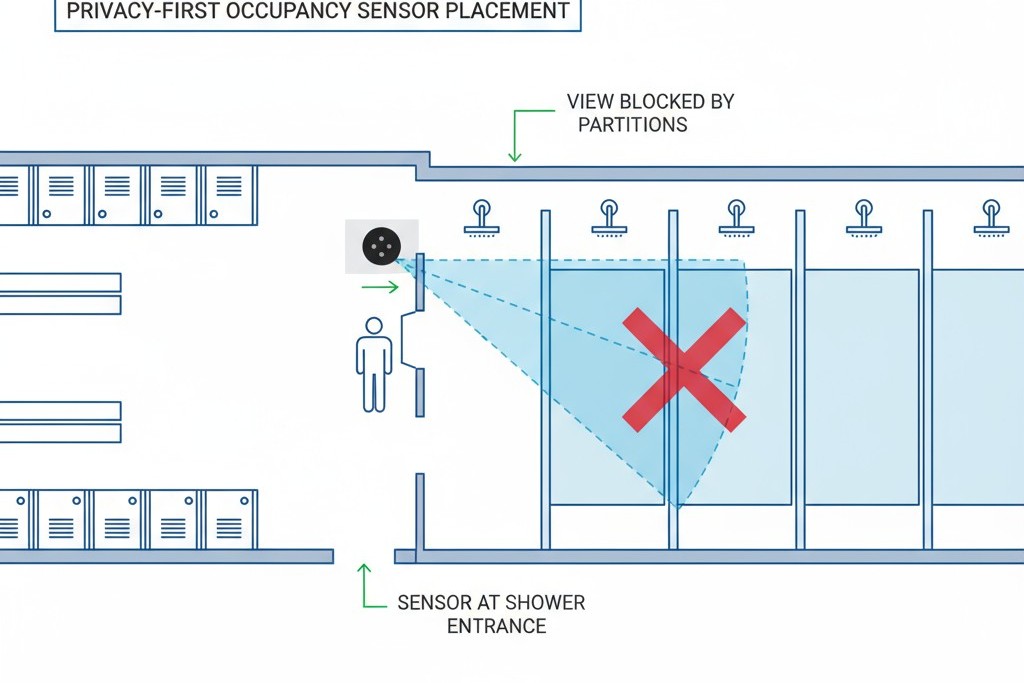
With distinct zones established, the goal of sensor placement shifts: the system must confirm presence, not watch people. The sensor acts as a silent gatekeeper for the room’s resources, using carefully planned sightlines to perform its function without ever compromising privacy.
Before installing any hardware, a sightline analysis is critical. From any proposed sensor location, it must be physically impossible for its field of view to extend into a shower stall, over a partition, or around a privacy screen. This often means mounting sensors lower on walls instead of high on ceilings, or using architectural features like soffits and alcoves to block unwanted views. The sensor should only confirm that a person has entered the general wet zone, not what they are doing inside it.
The most effective placement locations are the natural “choke points” of the space. The entryway to the main locker room and the threshold leading into the wet zone are ideal spots. A sensor positioned here reliably detects every person entering or leaving a zone. This trigger starts the clock on a zone-specific timeout, keeping the space activated for a predictable period without needing continuous monitoring.
Rayzeek人感センサーのポートフォリオを見る.
お探しの製品が見つかりませんか?ご安心ください。課題を解決する手段は常に複数存在します。当社の製品ポートフォリオのいずれかがお役に立つかもしれません。
Intelligent Timeouts: The Key to a Seamless User Experience
The perceived intelligence of an occupancy system is determined almost entirely by its timeout logic. A predictable system builds user trust; a random one erodes it. In a locker room, a one-size-fits-all approach is the primary source of frustration. A short timeout of 5 to 10 minutes, perfectly acceptable in an office, is unworkable here. It fails to account for the long periods of inactivity common in a shower, inevitably assuming vacancy and deactivating the utilities.
The solution is a layered timeout strategy tied to the zones. When a sensor at the dry zone entrance detects someone, it activates the lights in that area with a moderate timeout of perhaps 15 minutes. When a sensor at the wet zone entrance is triggered, it activates the lights and ventilation for that specific area with a much longer, more generous timeout of 30 minutes or more. This duration acts as a grace period, ensuring facilities remain active for the entire expected use time, regardless of how little the occupant moves. The system becomes reliable by design.
Choosing the Right Sensing Technology
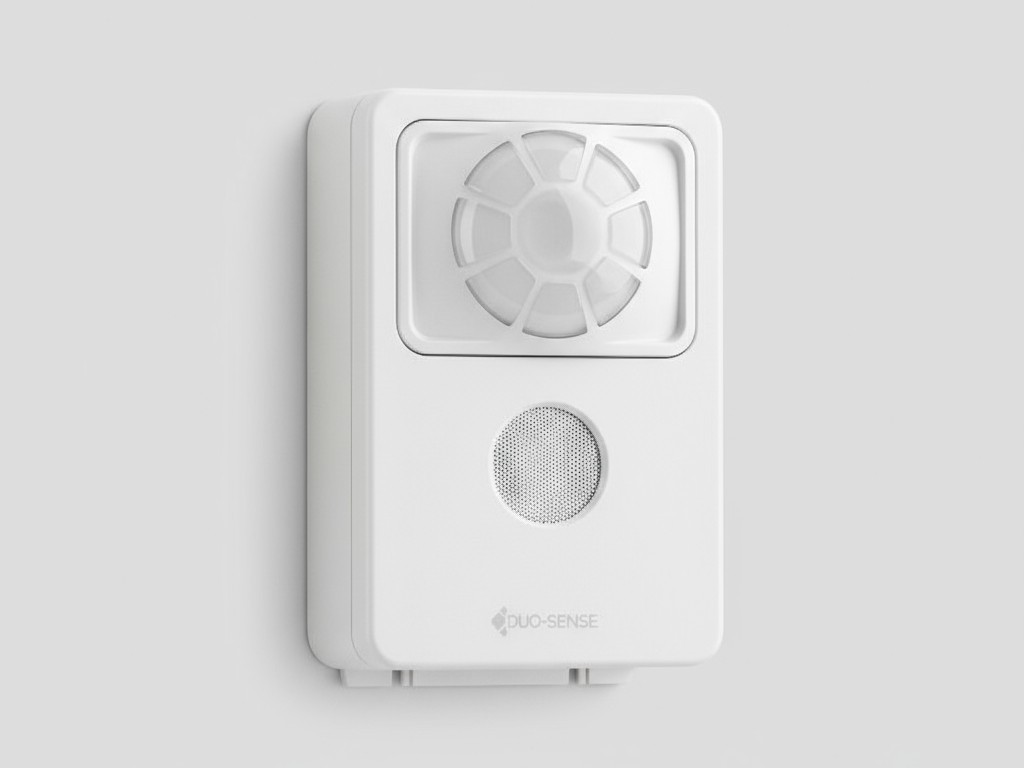
The right hardware prevents false alarms. For a complex space like a locker room, dual-technology sensors are the superior choice. These devices combine two methods: passive infrared (PIR) to detect body heat and ultrasonic waves to detect motion by bouncing sound off objects. This combination provides excellent coverage, picking up both major movements (a person walking) and minor ones (the slight shift of an arm in a stall), dramatically reducing the chance of a false vacancy detection.
Humidity-based controls, however, should be avoided for primary occupancy logic. A plume of steam from a single shower can trigger a humidity sensor, turning on lights and ventilation for the entire room even if it is otherwise empty. This leads to significant energy waste and makes the system’s behavior chaotic and disconnected from actual human presence.
Beyond Lighting: Integrating Ventilation for Health and Efficiency
The same occupancy logic that controls the lights should also control the ventilation. High-powered exhaust fans are significant energy consumers, and tying their activation to the wet zone’s sensor ensures they run only when needed to manage moisture and maintain air quality. This can be refined by adding a delay, so fans activate only after the wet zone has been occupied for a few minutes, preventing them from cycling on and off for someone just passing through.
人感センサーを活用した省エネソリューションをお探しですか?
PIR人感センサー、人感センサー搭載省エネ製品、人感センサースイッチ、商業施設向けOccupancy/Vacancy(在室/不在)ソリューションについては、お気軽にお問い合わせください。
Designing for Reliability and Accessibility
A well-designed system is reliable because it anticipates user behavior. By implementing zones, strategic placement, and layered timeouts, the most common failure modes are designed out from the start. This approach also supports broader building requirements. A system that provides consistent illumination without requiring a user to wave their arms is inherently more accessible, supporting goals outlined by the Americans with Disabilities Act (ADA). By focusing on dignity and predictability, you create an environment that works seamlessly for everyone, ensuring that privacy and efficiency are never mutually exclusive.







