

Dual-technology sensors have become the reflexive choice for occupancy detection. Specifiers reach for them by default, assuming that two detection methods must be better than one and that redundancy guarantees reliability.
In most cases, this assumption is wrong.
For the majority of spaces—offices, homes, hallways, retail stores—a properly tuned passive infrared (PIR) sensor outperforms its dual-technology alternatives. PIR delivers fewer false trips, more stable operation, and a lower total cost. The industry’s reflex toward dual-tech is a solution in search of a problem that rarely exists. Understanding why this misconception persists, and where PIR truly excels, is the key to making smarter specification decisions.
Why Dual-Technology Became the Default
The preference for dual-technology sensors is rooted in risk aversion, not evidence. Facility managers and contractors believe that more detection mechanisms provide insurance against missed occupancy. If the infrared sensor fails, the reasoning goes, the ultrasonic or microwave component will provide a backup. This logic appeals to a culture of over-specification, where the perceived cost of a single failure, like a light turning off on an occupant, outweighs the tangible costs of added complexity.
Marketing narratives have reinforced this reflex by positioning dual-technology as a premium, professional-grade solution, implying that single-technology sensors are a compromise. This framing ignores a critical operational reality: dual-technology systems require precise coordination between two independent methods that respond to different environmental variables. When both must agree to trigger an action (AND logic), the system becomes sluggish. When either can trigger independently (OR logic), the system becomes hypersensitive, reacting to HVAC airflow or shifting curtains.
The resulting sensors are more expensive to purchase, install, and tune. They demand sophisticated adjustments to balance the two detection layers, often requiring multiple site visits. In environments with variable airflow, temperature gradients, or reflective surfaces, the ultrasonic or microwave component generates false positives that erode user confidence. The result is a system that costs more, performs inconsistently, and frustrates occupants. The alternative is not to abandon advanced sensing, but to match the sensor to the actual detection challenge.
How PIR Sensors Detect Occupancy
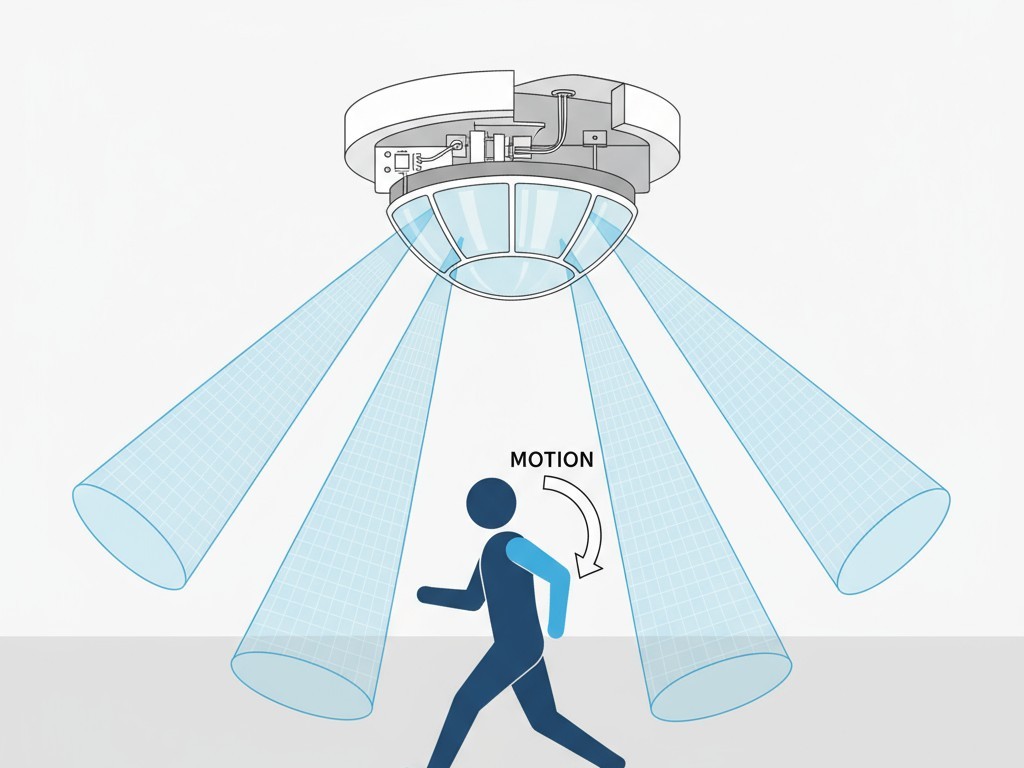
Passive infrared sensors operate on a fundamental principle: all objects warmer than absolute zero emit infrared radiation. Human bodies, at approximately 98.6°F, have a consistent infrared signature distinct from the surfaces of a typical room. A PIR sensor doesn’t see motion like a camera; it detects changes in infrared energy within its field of view.
The sensor’s core is a pyroelectric element, a material that generates an electrical charge when its exposure to infrared radiation changes. This element is paired with a segmented Fresnel lens that divides the coverage area into multiple detection zones. When a person moves from one zone to another, the shifting infrared energy creates a distinct electrical pattern that the sensor interprets as occupancy. The sensor is designed to ignore static heat sources, focusing only on the dynamic signature of a moving heat emitter.
This design directly shapes the sensor’s coverage. The lens creates a conical or rectangular detection pattern, with sensitivity highest in the zones directly aligned with the pyroelectric element. While the effective range typically extends 15 to 30 feet, sensitivity decreases with distance as the infrared signal diffuses. Within its effective range, however, a commercial-grade unit can detect motion across a wide angle, often exceeding 90 degrees.
人感センサーを活用した省エネソリューションをお探しですか?
PIR人感センサー、人感センサー搭載省エネ製品、人感センサースイッチ、商業施設向けOccupancy/Vacancy(在室/不在)ソリューションについては、お気軽にお問い合わせください。
What PIR Sensors See—and What They Miss
PIR sensors excel at detecting the most common type of motion in occupied spaces: a person walking, shifting position, or performing tasks. The technology is highly effective in rooms with active occupants because it responds to the temperature differential between a human body and the background as it moves across detection zones.
PIR’s limitation isn’t a failure to detect people, but an inability to see a stationary heat source once motion has ceased. If a person enters a room and then remains completely still for an extended period, the sensor may time out. In practice, this scenario is rare. Office workers shift in chairs and type on keyboards. Residents move between tasks. Conference room attendees gesture and lean forward. The threshold for re-triggering a PIR sensor is low; even micro-movements invisible to an outside observer are often enough to maintain detection.
The environments where prolonged, motionless activity is a genuine concern are the exception, not the rule.
How Dual-Technology Sensors Complicate the Picture
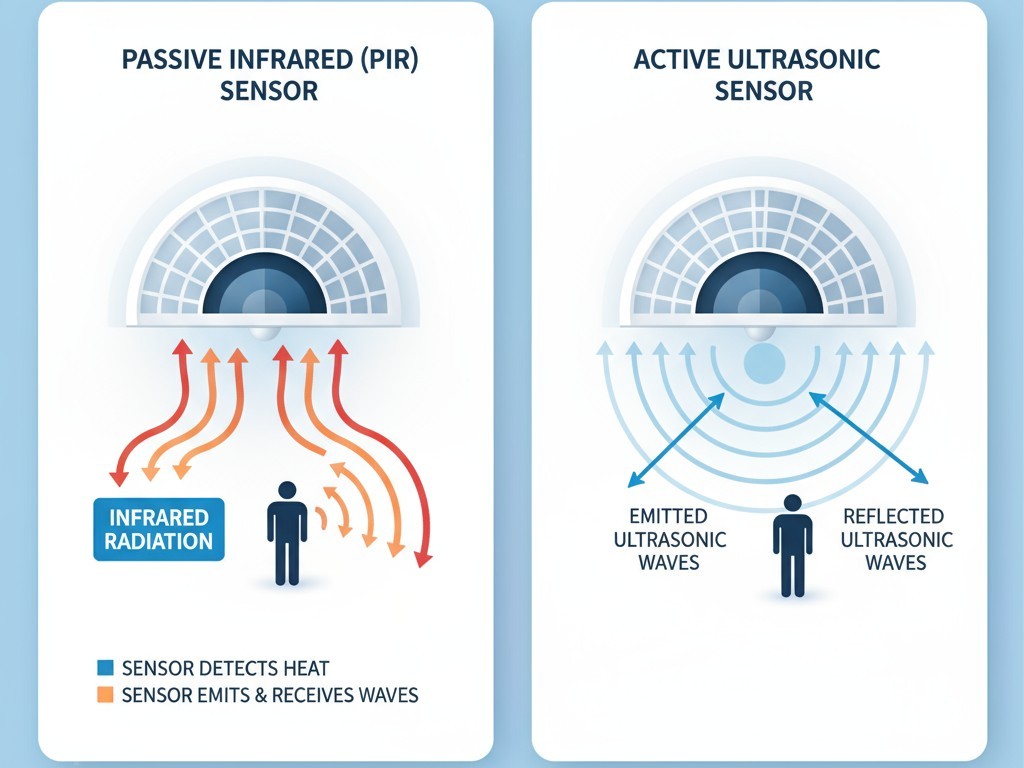
Dual-technology sensors combine passive infrared with a second, active sensing method—usually ultrasonic or microwave. The active component emits a signal (sound or radio waves) and measures the reflections. When an object moves, it changes the reflected signal’s frequency via the Doppler effect, allowing the sensor to detect motion without relying on heat.
The intended benefit is to catch stationary occupants who are still breathing or fidgeting in ways that don’t cross PIR detection zones. This redundancy, in theory, addresses PIR’s primary limitation. In practice, however, it introduces complexity that often outweighs the benefit. Most dual-tech sensors are set to AND logic to avoid nuisance activations from either sensor firing alone, which negates much of the supposed responsiveness.
The False Promise of Redundancy
Redundancy does not inherently improve reliability. Each sensing method is vulnerable to different environmental factors. Ultrasonic sensors are notoriously sensitive to air turbulence from HVAC vents and ceiling fans. Microwave sensors can penetrate walls and trigger on movement in adjacent rooms.
Tuning a dual-technology sensor means balancing two independent systems, each with its own coverage pattern and susceptibility to interference. Increase ultrasonic sensitivity to catch subtle movements, and you invite false trips from environmental noise. Decrease it, and the component adds no functional value beyond what the PIR already provides. Field reports from facility managers consistently show higher callback rates for dual-technology installations. They struggle in real-world spaces, while the simpler PIR sensor, which responds only to heat and motion, delivers predictable performance.
Where PIR Sensors Deliver Superior Performance
In most commercial and residential spaces, occupants are rarely stationary for long. When they are still, the duration is brief enough that a properly configured time delay is all that’s needed. PIR sensors thrive in these environments because the detection challenge aligns perfectly with the technology’s design.
Offices and Conference Rooms

In a typical office, the case for PIR is self-evident. Workers at desks are in continuous micro-motion: typing, reaching for phones, shifting posture. A ceiling-mounted PIR with overlapping detection zones easily covers these workspaces. In conference rooms, participants gesture, take notes, and adjust their seating. A PIR sensor with a 10- to 15-minute time delay easily accommodates brief lulls in motion without timing out. A dual-tech sensor in the same room might trigger on HVAC airflow, creating false-on events that undermine trust in the system.
Residential Spaces
Homes are spaces of constant activity when occupied. Kitchens, living rooms, and bathrooms see frequent movement. PIR excels here by design. Its advantage also extends to the user experience. PIR sensors are passive; they emit no sound or radio waves, eliminating any potential for audible noise or electromagnetic interference. Their simplicity translates to reliability, with fewer components providing fewer points of failure.
Hallways and Transition Zones
Hallways, stairwells, and lobbies are among the easiest applications for PIR. Occupancy is defined by high motion and brief duration. A person walking through generates a strong signal, triggering the sensor immediately. A short time delay of 30 seconds to two minutes ensures energy savings without compromising convenience. Dual-technology offers no advantage here and can introduce activation delays.
Retail and Commercial Interiors
Retail spaces benefit from PIR’s ability to track the constant motion of customers and staff. Shoppers browse aisles and staff restock shelves, generating continuous motion signatures. These environments often have active HVAC systems whose airflow can easily fool an ultrasonic sensor, leading to wasted energy. PIR ignores air movement and focuses solely on the heat signatures of people, providing stable, reliable operation.
The Critical Role of Tuning
A PIR sensor’s performance depends less on its core mechanism and more on its configuration. Proper tuning—the adjustment of sensitivity, time delay, and coverage—transforms a generic device into a tailored solution.
Sensitivity controls how much infrared change is needed for a trigger; higher settings detect smaller movements at greater distances but risk false activations from minor temperature fluctuations. The time delay determines how long the sensor waits after the last detected motion before signaling vacancy; it must be long enough to prevent nuisance shutoffs but short enough to save energy. Finally, the sensor’s physical placement and lens orientation shape its coverage pattern, ensuring that high-traffic areas fall within its most sensitive range.
Rayzeek人感センサーのポートフォリオを見る.
お探しの製品が見つかりませんか?ご安心ください。課題を解決する手段は常に複数存在します。当社の製品ポートフォリオのいずれかがお役に立つかもしれません。
Well-designed sensors simplify this process with pre-calibrated sensitivity levels and adaptive algorithms that adjust time delays based on learned occupancy patterns. This proves the ceiling for PIR performance isn’t the technology, but the intelligence behind its deployment. A well-tuned PIR sensor will outperform a poorly configured dual-technology sensor in accuracy, stability, and user satisfaction.
The Rare Cases for Dual-Technology

Dual-technology sensors are not obsolete, but they are specialized tools. They serve a purpose in a small subset of applications where PIR’s limitations become operationally significant. By most estimates, fewer than one in five commercial or residential applications justify the switch.
High-Ceiling Warehouses and Industrial Spaces: PIR effectiveness drops as distance increases. In warehouses with ceilings over 30 feet, a PIR sensor may struggle to detect motion at floor level. Here, the active signal of an ultrasonic or microwave sensor offers more reliable long-range detection.
Extreme Temperature Uniformity: PIR relies on the temperature contrast between a person and their surroundings. In spaces where the ambient temperature is maintained close to human body temperature, such as certain climate-controlled labs, this contrast diminishes. Dual-technology, which detects motion rather than heat, is a more robust solution.
Prolonged Stillness with Critical Needs: In some environments, like patient recovery rooms or security monitoring stations, an occupant may be motionless for long periods where a missed detection has serious consequences. The active component of a dual-technology sensor provides continuous verification of presence, justifying its complexity. These applications are clear exceptions, not the rule.
Choosing the Right Sensor
The choice between PIR and dual-technology isn’t subjective; it’s a technical decision based on room characteristics and occupant behavior. The principle is to match the sensor to the challenge.
Start with ceiling height. For ceilings under 25 feet, PIR provides reliable coverage. Next, consider temperature. Rooms with normal HVAC operation are ideal for PIR. If the ambient temperature is consistently within 15 degrees of body temperature, dual-technology is the safer bet. Finally, analyze motion patterns. If occupants are stationary for less than 10-15 minutes at a time, a PIR sensor with an appropriate time delay is sufficient.
Use this checklist as a guide:
こちらの商品もおすすめです

- 電圧: 単4形乾電池 2本
- 昼/夜モード
- タイマー設定時間: 15分、30分、1時間(デフォルト)、2時間

- 無電圧接点リレー出力付き天井取り付け型PIR人感センサー
- 12/24VDCまたは12/24VAC低電圧電源
- EMS、HVAC、および建物制御入力用COM、NO、NC絶縁リレー接点

- 低電圧DC天井埋め込み型マイクロ波人感センサースイッチ
- 10~30 VDC範囲の12 VDC / 24 VDC入力
- 調整可能なタイムラグ、照度(Lux)閾値、感度を備えた最大動作電流10A仕様
- 高負荷対応型 埋込型天井取付けマイクロ波人感センサースイッチ
- 100-265 VAC 商用電源入力、10Aモデル
- 調整可能なタイムラグ、照度(Lux)閾値、感度を備えた5.8 GHzマイクロ波検知
- 埋込型天井取付けマイクロ波人感センサースイッチ
- 100-265 VAC商用電圧入力、5Aモデル
- 調整可能なタイムラグ、照度(Lux)閾値、感度を備えた5.8 GHzマイクロ波検知
- 220V電源対応 天井取付けRZ037 PIR(赤外線)人感センサー調光器
- 定格負荷660W、最大動作電流3A
- LUXボタンによる照度センサーのON/OFFおよびユーザー設定の調光明るさ制御
- 110V電源対応 天井取付けRZ037 PIR(赤外線)人感センサー調光器
- 定格負荷330W、最大動作電流3A
- LUXボタンによる照度センサーのON/OFFおよびユーザー設定の調光明るさ制御

- 低電圧DC対応 天井取付けマイクロ波人感センサースイッチ
- 10~30 VDC範囲の12 VDC / 24 VDC入力
- 調整可能なタイムラグ、照度(Lux)閾値、感度を備えた最大動作電流10A仕様
- 高負荷対応 天井取付型マイクロ波人感センサースイッチ
- 100-265 VAC 商用電源入力、10Aモデル
- 調整可能なタイムラグ、照度(Lux)閾値、感度を備えた5.8 GHzマイクロ波検知
- 天井取り付け型マイクロ波人感センサースイッチ
- 100-265 VAC商用電圧入力、5Aモデル
- 調整可能なタイムラグ、照度(Lux)閾値、感度を備えた5.8 GHzマイクロ波検知

- 低電圧DC埋込型天井PIR人感センサースイッチ
- 10~30 VDC範囲の12 VDC / 24 VDC入力
- 最大動作電流10A(調整可能なタイムラグ、照度閾値、感度設定付き)

- 高負荷対応 埋込型天井PIR人感センサースイッチ
- 100-265 VAC 商用電源入力、10Aモデル
- 360度検知(調整可能なタイムラグ、照度閾値、感度設定付き)
- 埋込型天井PIR人感センサースイッチ
- 100-265 VAC商用電圧入力、5Aモデル
- 360度検知(調整可能なタイムラグ、照度閾値、感度設定付き)

- 屋内用照明ON/OFF制御ワイヤレススイッチ&受信機キット
- 100-230VAC、50/60Hz、定格電流5A受信機
- 2.4GHz通信対応 CR2032電池駆動ワイヤレススイッチ
- Occupancy(自動点灯/自動消灯)
- 12–24V DC (10–30VDC)、最大10A
- 360°検知エリア、直径8–12m
- タイムラグ 15秒–30分
- 照度センサー オフ/15/25/35 Lux
- 高/低感度
- 自動点灯/自動消灯人感モード
- 100–265V AC, 10A(中性線必須)
- 360°検知範囲、検知直径8–12 m
- タイムデレイ15秒–30分、Lux OFF/15/25/35、感度 高/低
- 自動点灯/自動消灯人感モード
- 100–265V AC, 5A(中性線必須)
- 360°検知範囲、検知直径8–12 m
- タイムデレイ15秒–30分、Lux OFF/15/25/35、感度 高/低
- Default to PIR in hallways, homes, standard offices, and retail spaces where motion is frequent and conditions are normal.
- Use PIR if the ceiling is under 25 feet, the room has normal temperature swings, and occupants move at least every 10 minutes.
- Consider dual-technology only if the ceiling exceeds 30 feet, the ambient temperature mirrors body temperature, or occupants remain motionless for long periods where detection is critical.
The vast majority of rooms fall into the PIR-compatible categories. The industry’s reflex toward dual-tech is a legacy of outdated assumptions. The evidence supports a simpler approach: specify PIR first.







