
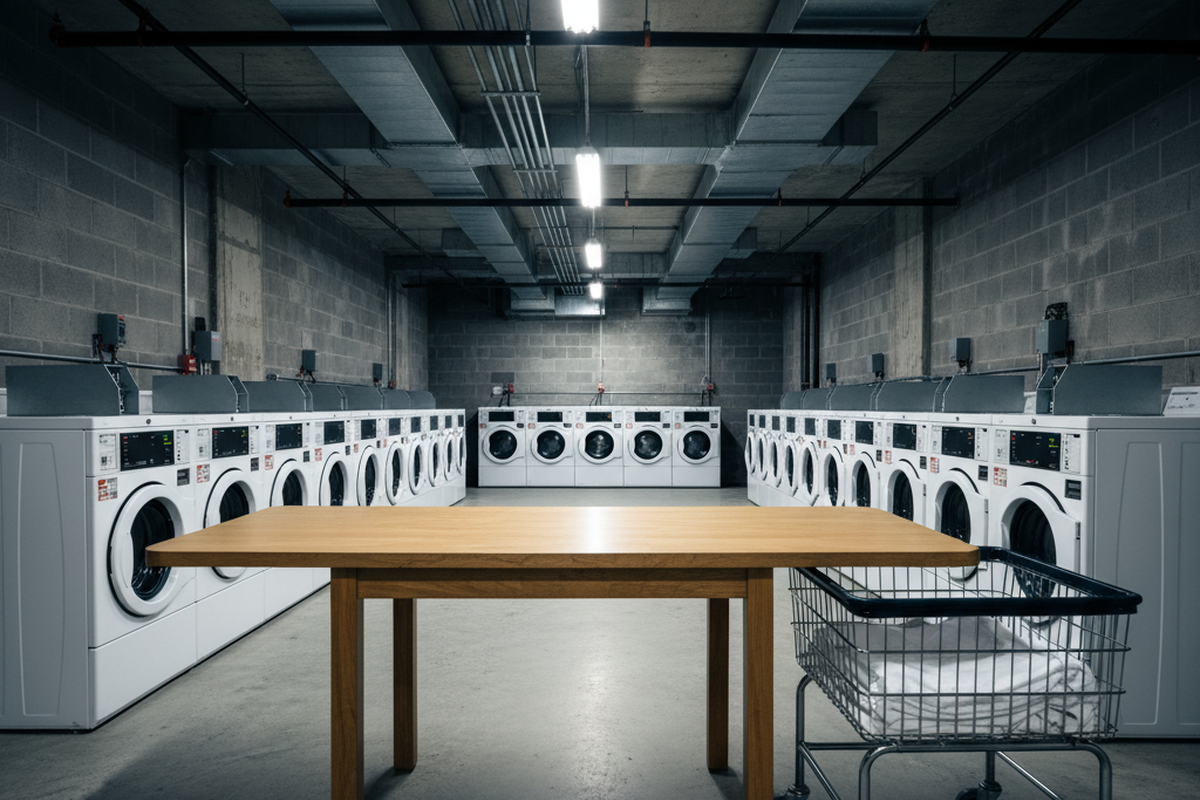
Imagine a resident standing in the corner of a basement laundry room. They have just pulled a load of whites from the dryer and are beginning to fold a fitted sheet. This is a two-person job being done by one person, arms wide, concentrating on the corners. Suddenly, the room plunges into absolute darkness.
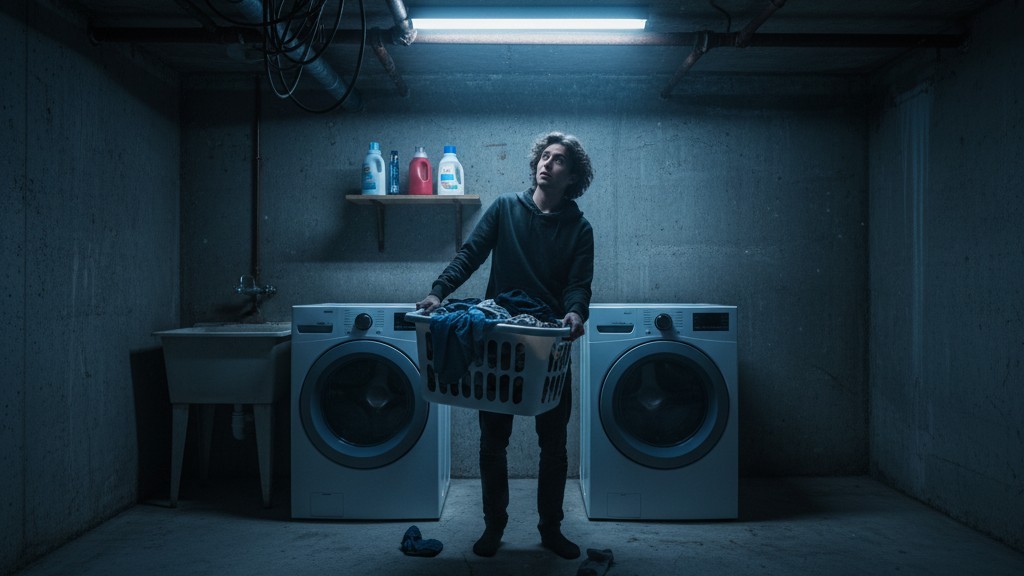
The resident freezes. They are holding a laundry basket, surrounded by machinery, in a pitch-black room. They have to drop the clean linen—potentially onto a dirty floor—to wave their arms frantically at the ceiling sensor like a castaway signaling a plane. If they are lucky, the lights flicker back on. If they are unlucky, they trip over a laundry cart in the dark.
This isn’t just an inconvenience. It is a liability event waiting to happen. Property managers often treat laundry rooms as simple “transit zones” similar to hallways, installing basic motion sensors that assume anyone in the room is walking. But a laundry room creates two distinct spaces: the Washer Aisle (high activity, transit) and the Folding Table (low activity, station). When you regulate the folding table with the same cheap controls used for the hallway, you create a hostile environment. This drives up complaints, risks injury settlements, and encourages residents to vandalize the sensors just to keep the lights on.
The Physics of Invisibility
To fix the lights, you have to know what the sensor is actually seeing. The standard device found in 90% of multifamily retrofits is a Passive Infrared (PIR) sensor. It is cheap, reliable for hallways, and completely unsuited for a folding station.
PIR sensors do not “see” people; they detect rapid changes in heat signatures across a segmented field of view. They require a warm object (a body) to move across the sensor’s background zones. This works perfectly for a resident walking from the door to the washing machine. Their entire body is a massive heat signature cutting across multiple detection beams.
The problem arises at the folding table. When a resident stands at a table, their lower body is often blocked by the table itself. Their torso is relatively stationary. The only movement comes from the hands and arms, often manipulating fabric that is still warm from the dryer. To a cheap PIR sensor, a warm sheet moving in front of a warm body looks like thermal noise, not a person.
There is also the “Disco Effect,” or rapid cycling, often caused when sensors are cranked to maximum sensitivity to catch these small movements. The lights bang on and off, stressing the LED drivers and annoying residents. But more often, the sensor simply decides the room is empty. It cannot distinguish between a person folding socks and an empty room because the motion is too “micro” for the coarse “macro” lens of a standard PIR unit.
Geometry and The Cone of Vision
The failure is often compounded by placement. Contractors almost always mount the sensor in the center of the ceiling to save on wiring labor, often utilizing an existing J-box.
Rayzeek人感センサーのポートフォリオを見る.
お探しの製品が見つかりませんか?ご安心ください。課題を解決する手段は常に複数存在します。当社の製品ポートフォリオのいずれかがお役に立つかもしれません。
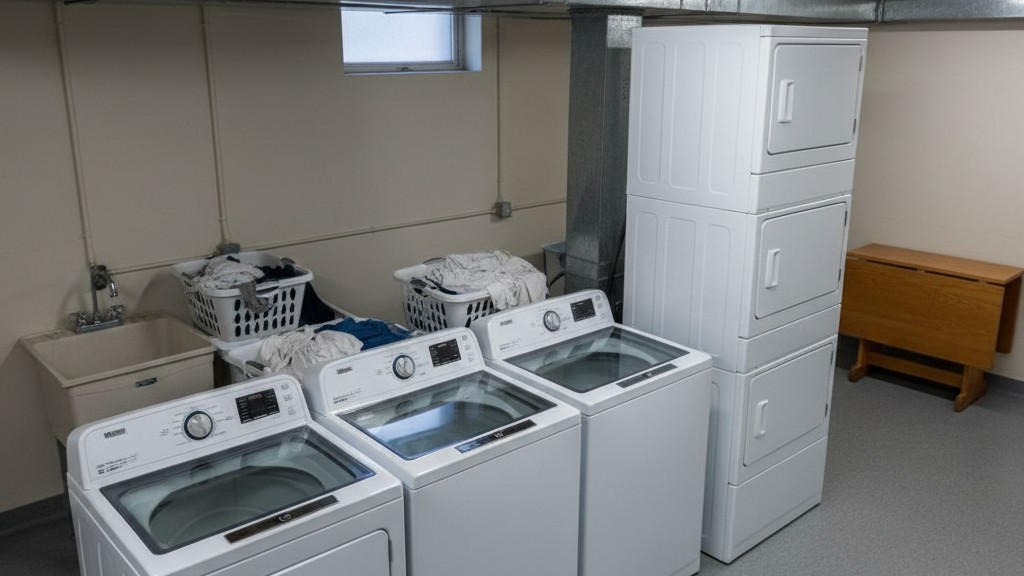
In a perfect square room, this might work. But laundry rooms are rarely perfect squares. They are often L-shaped or crowded with stacks of dryers that create “shadows” in the sensor’s field of view. A center-mounted sensor might have a perfect view of the washing machine tops but be completely blind to the corner where the folding table has been shoved.
This geometric blindness leads to a specific type of resident rebellion. When the lights repeatedly die on them, residents stop trusting the building’s infrastructure. They begin propping doors open to let hallway light in, violating fire codes. In more aggressive cases, they tape over the sensor lens or smash the faceplate, assuming the device is broken. Safety committees often flag dark laundry rooms as high-risk zones for theft or assault, yet the root cause—poor sensor geometry—is rarely addressed until a physical incident occurs.
人感センサーを活用した省エネソリューションをお探しですか?
PIR人感センサー、人感センサー搭載省エネ製品、人感センサースイッチ、商業施設向けOccupancy/Vacancy(在室/不在)ソリューションについては、お気軽にお問い合わせください。
Effective coverage requires looking at the room as a volume of obstructions, not just a floor plan. The sensor needs to be corner-mounted, looking out across the folding table toward the machines. This ensures the “station” zone sits in the primary foreground of the detection pattern.
The Dual-Tech Standard
If PIR is the problem, Dual-Technology is the only professional solution. Dual-Tech sensors combine standard PIR with a secondary detection method, typically Ultrasonic or Microphonics.
While PIR looks for heat in motion, Ultrasonic sensors fill the room with high-frequency sound waves (well above human hearing) and listen for the return echo. They operate on the Doppler shift principle. If a resident is standing stone-still but moving their hands to pair socks, that tiny movement shifts the frequency of the sound waves bouncing back. The sensor detects this “micro-motion” and keeps the lights on.
This is the industry standard for restrooms and laundry areas for a reason. It allows the system to be triggered by the large motion of walking in (PIR) but held on by the tiny motion of working (Ultrasonic).
However, this technology requires competent commissioning. Ultrasonic sensors are sensitive to air movement. If you place the sensor too close to an HVAC supply vent, the rushing air can mimic the Doppler shift of a moving person, causing the lights to stay on 24/7. This “false on” burns energy, but it is preferable to the “false off” that leaves residents in the dark. A properly commissioned Dual-Tech sensor—like the Wattstopper DT-300 series or similar commercial-grade units—can be tuned to ignore the HVAC vibration while still catching the hand motion of a resident folding a towel.
The 20-Minute Dignity Floor
Hardware is only half the battle. You also need to fix the software setting: the timeout. This is the duration the lights stay on after the last detected motion.
In a misguided attempt to secure LEED points or meet aggressive energy targets, many property managers set these timeouts to 5 minutes. This is fundamentally hostile. It takes the average person 6 to 8 minutes to properly fold a single load of laundry. If the timer is set to 5 minutes, you guarantee that every single resident will be plunged into darkness at least once per load.
There is a tension here with energy codes. The International Energy Conservation Code (IECC) and standards like ASHRAE 90.1 push for shorter timeouts to maximize savings. Local inspectors are the final authority, and some jurisdictions are strict. However, most codes allow for up to 20 or even 30 minutes in specific usage scenarios, or they allow for manual overrides.
A 20-minute timeout is the “dignity floor” for a laundry room. It covers the duration of a fold cycle with a safety buffer. If local code forces you to use a 15-minute or shorter timer, you must install a manual override switch—a button the resident can hit to buy more time. Relying solely on a sensor that has already proven it can’t see them is a recipe for tenant churn.
Landlord Math: The Cost of Cheap
The objection to Dual-Tech sensors and corner-mounting is always cost. A basic PIR wall switch might cost $40. A ceiling-mounted Dual-Tech sensor plus a power pack might run $150 to $200 in material, plus the electrician’s labor to run new wire to the corner.
But that is “sticker price” thinking. It ignores the lifecycle cost. Consider the price of a single service call. When a resident complains that the lights are broken (because they went out while she was folding), you send a technician. That truck roll costs $150 minimum. You have just wiped out the savings of the cheaper sensor in one afternoon.
こちらの商品もおすすめです

- 電圧: 単4形乾電池 2本
- 昼/夜モード
- タイマー設定時間: 15分、30分、1時間(デフォルト)、2時間

- 無電圧接点リレー出力付き天井取り付け型PIR人感センサー
- 12/24VDCまたは12/24VAC低電圧電源
- EMS、HVAC、および建物制御入力用COM、NO、NC絶縁リレー接点

- 低電圧DC天井埋め込み型マイクロ波人感センサースイッチ
- 10~30 VDC範囲の12 VDC / 24 VDC入力
- 調整可能なタイムラグ、照度(Lux)閾値、感度を備えた最大動作電流10A仕様
- 高負荷対応型 埋込型天井取付けマイクロ波人感センサースイッチ
- 100-265 VAC 商用電源入力、10Aモデル
- 調整可能なタイムラグ、照度(Lux)閾値、感度を備えた5.8 GHzマイクロ波検知
- 埋込型天井取付けマイクロ波人感センサースイッチ
- 100-265 VAC商用電圧入力、5Aモデル
- 調整可能なタイムラグ、照度(Lux)閾値、感度を備えた5.8 GHzマイクロ波検知
- 220V電源対応 天井取付けRZ037 PIR(赤外線)人感センサー調光器
- 定格負荷660W、最大動作電流3A
- LUXボタンによる照度センサーのON/OFFおよびユーザー設定の調光明るさ制御
- 110V電源対応 天井取付けRZ037 PIR(赤外線)人感センサー調光器
- 定格負荷330W、最大動作電流3A
- LUXボタンによる照度センサーのON/OFFおよびユーザー設定の調光明るさ制御

- 低電圧DC対応 天井取付けマイクロ波人感センサースイッチ
- 10~30 VDC範囲の12 VDC / 24 VDC入力
- 調整可能なタイムラグ、照度(Lux)閾値、感度を備えた最大動作電流10A仕様
- 高負荷対応 天井取付型マイクロ波人感センサースイッチ
- 100-265 VAC 商用電源入力、10Aモデル
- 調整可能なタイムラグ、照度(Lux)閾値、感度を備えた5.8 GHzマイクロ波検知
- 天井取り付け型マイクロ波人感センサースイッチ
- 100-265 VAC商用電圧入力、5Aモデル
- 調整可能なタイムラグ、照度(Lux)閾値、感度を備えた5.8 GHzマイクロ波検知

- 低電圧DC埋込型天井PIR人感センサースイッチ
- 10~30 VDC範囲の12 VDC / 24 VDC入力
- 最大動作電流10A(調整可能なタイムラグ、照度閾値、感度設定付き)

- 高負荷対応 埋込型天井PIR人感センサースイッチ
- 100-265 VAC 商用電源入力、10Aモデル
- 360度検知(調整可能なタイムラグ、照度閾値、感度設定付き)
- 埋込型天井PIR人感センサースイッチ
- 100-265 VAC商用電圧入力、5Aモデル
- 360度検知(調整可能なタイムラグ、照度閾値、感度設定付き)

- 屋内用照明ON/OFF制御ワイヤレススイッチ&受信機キット
- 100-230VAC、50/60Hz、定格電流5A受信機
- 2.4GHz通信対応 CR2032電池駆動ワイヤレススイッチ
- Occupancy(自動点灯/自動消灯)
- 12–24V DC (10–30VDC)、最大10A
- 360°検知エリア、直径8–12m
- タイムラグ 15秒–30分
- 照度センサー オフ/15/25/35 Lux
- 高/低感度
- 自動点灯/自動消灯人感モード
- 100–265V AC, 10A(中性線必須)
- 360°検知範囲、検知直径8–12 m
- タイムデレイ15秒–30分、Lux OFF/15/25/35、感度 高/低
- 自動点灯/自動消灯人感モード
- 100–265V AC, 5A(中性線必須)
- 360°検知範囲、検知直径8–12 m
- タイムデレイ15秒–30分、Lux OFF/15/25/35、感度 高/低
If a resident trips in the dark, the liability deductible alone will cover the cost of retrofitting every laundry room in a 200-unit portfolio. And if the “hostile” feeling of the building contributes to a resident moving out, the vacancy loss of one month’s rent ($1,500 – $3,000) dwarfs the $100 premium for a better sensor.
Real “Landlord Math” recognizes that the laundry room is a high-touch amenity. It is one of the few places where residents interact directly with the building’s mechanical soul. If the building ignores them there, they assume it will ignore them everywhere else.







