
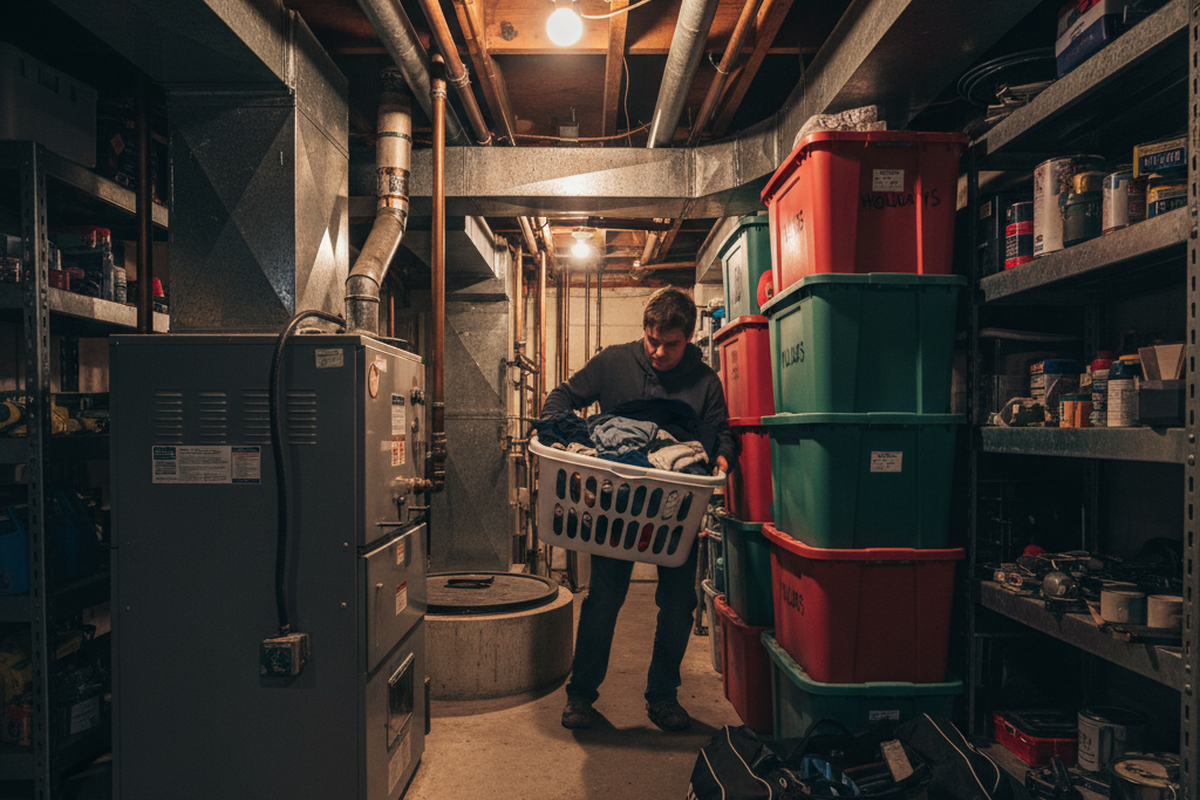
The basement utility corner isn’t really a room. It’s a machine that people walk inside.
Most homeowners treat this space as a purgatory for holiday bins and off-season sports gear, visiting only when a breaker trips or a laundry basket needs to be dropped. These visits average ten to fifteen seconds. In that brief window, you are typically carrying a load, distracted by a task, and operating in low light.
This specific combination of human behaviors—distraction, haste, and full hands—is the primary driver of mechanical failure in the home.
The failure doesn’t happen during the visit, though. It happens three days later. The light switch that couldn’t be flipped because your hands were full of linens stays on, heating up a small, enclosed room for ninety-six hours. The sump pump plug bumped by a hockey bag goes unnoticed because the corner is dim.
The “10-Second Visit” seems harmless in isolation, but the cumulative effect of unmonitored mechanicals is a slow-motion disaster. A properly designed mechanical room acknowledges a harsh truth: human memory is the first point of failure. The only fix is to remove the human from the loop entirely.
Photons as Diagnostic Tools
Lighting in a mechanical room isn’t an aesthetic choice. It is a diagnostic tool. If you cannot see the equipment, you cannot maintain it.

The standard builder-grade specification—a single porcelain pull-chain fixture with a 60-watt equivalent bulb—is functionally negligent. It casts deep shadows behind the furnace and water heater, creating “dead zones” where corrosion thrives.
Rayzeek人感センサーのポートフォリオを見る.
お探しの製品が見つかりませんか?ご安心ください。課題を解決する手段は常に複数存在します。当社の製品ポートフォリオのいずれかがお役に立つかもしれません。
A copper pipe joint doesn’t burst instantly. It weeps for months, developing a crust of green copper oxide. In a dim room, this green crust looks black or gray, indistinguishable from dust. Under high-quality light, it screams for attention.
The standard here is specific: you need a 4000K to 5000K color temperature. This “daylight” spectrum accurately renders wire colors (red vs. orange) and oxidation. Anything lower (warm white, 2700K) adds a yellow cast that masks rust. A high CRI (Color Rendering Index) of 80+ is mandatory. You aren’t setting a mood; you are inspecting a crime scene before it happens.
The control mechanism for this light is even more critical than the bulb itself. The “hands-full” simulation dictates the design. If a homeowner walks in with a laundry basket, they can’t flip a switch. If they leave with the basket, they can’t flip it off.
The solution is the occupancy sensor, specifically a passive infrared (PIR) model like the Lutron Maestro MS-OPS2. These hard-wired switches replace the standard toggle, detecting the heat signature of a body entering the room and triggering the lights immediately.
Crucially, the timeout setting on these sensors matters more than the sensitivity. A common frustration is the “False-Off” panic, which happens when a sensor is left on the factory default of one minute. If you are standing still reading the fine print on a breaker panel or threading a pipe, the lights plunge you into darkness, forcing you to wave your arms like a castaway. This is dangerous near live circuits.
こちらの商品もおすすめです

- 電圧: 単4形乾電池 2本
- 昼/夜モード
- タイマー設定時間: 15分、30分、1時間(デフォルト)、2時間

- 無電圧接点リレー出力付き天井取り付け型PIR人感センサー
- 12/24VDCまたは12/24VAC低電圧電源
- EMS、HVAC、および建物制御入力用COM、NO、NC絶縁リレー接点

- 低電圧DC天井埋め込み型マイクロ波人感センサースイッチ
- 10~30 VDC範囲の12 VDC / 24 VDC入力
- 調整可能なタイムラグ、照度(Lux)閾値、感度を備えた最大動作電流10A仕様
- 高負荷対応型 埋込型天井取付けマイクロ波人感センサースイッチ
- 100-265 VAC 商用電源入力、10Aモデル
- 調整可能なタイムラグ、照度(Lux)閾値、感度を備えた5.8 GHzマイクロ波検知
- 埋込型天井取付けマイクロ波人感センサースイッチ
- 100-265 VAC商用電圧入力、5Aモデル
- 調整可能なタイムラグ、照度(Lux)閾値、感度を備えた5.8 GHzマイクロ波検知
- 220V電源対応 天井取付けRZ037 PIR(赤外線)人感センサー調光器
- 定格負荷660W、最大動作電流3A
- LUXボタンによる照度センサーのON/OFFおよびユーザー設定の調光明るさ制御
- 110V電源対応 天井取付けRZ037 PIR(赤外線)人感センサー調光器
- 定格負荷330W、最大動作電流3A
- LUXボタンによる照度センサーのON/OFFおよびユーザー設定の調光明るさ制御

- 低電圧DC対応 天井取付けマイクロ波人感センサースイッチ
- 10~30 VDC範囲の12 VDC / 24 VDC入力
- 調整可能なタイムラグ、照度(Lux)閾値、感度を備えた最大動作電流10A仕様
- 高負荷対応 天井取付型マイクロ波人感センサースイッチ
- 100-265 VAC 商用電源入力、10Aモデル
- 調整可能なタイムラグ、照度(Lux)閾値、感度を備えた5.8 GHzマイクロ波検知
- 天井取り付け型マイクロ波人感センサースイッチ
- 100-265 VAC商用電圧入力、5Aモデル
- 調整可能なタイムラグ、照度(Lux)閾値、感度を備えた5.8 GHzマイクロ波検知

- 低電圧DC埋込型天井PIR人感センサースイッチ
- 10~30 VDC範囲の12 VDC / 24 VDC入力
- 最大動作電流10A(調整可能なタイムラグ、照度閾値、感度設定付き)

- 高負荷対応 埋込型天井PIR人感センサースイッチ
- 100-265 VAC 商用電源入力、10Aモデル
- 360度検知(調整可能なタイムラグ、照度閾値、感度設定付き)
- 埋込型天井PIR人感センサースイッチ
- 100-265 VAC商用電圧入力、5Aモデル
- 360度検知(調整可能なタイムラグ、照度閾値、感度設定付き)

- 屋内用照明ON/OFF制御ワイヤレススイッチ&受信機キット
- 100-230VAC、50/60Hz、定格電流5A受信機
- 2.4GHz通信対応 CR2032電池駆動ワイヤレススイッチ
- Occupancy(自動点灯/自動消灯)
- 12–24V DC (10–30VDC)、最大10A
- 360°検知エリア、直径8–12m
- タイムラグ 15秒–30分
- 照度センサー オフ/15/25/35 Lux
- 高/低感度
- 自動点灯/自動消灯人感モード
- 100–265V AC, 10A(中性線必須)
- 360°検知範囲、検知直径8–12 m
- タイムデレイ15秒–30分、Lux OFF/15/25/35、感度 高/低
- 自動点灯/自動消灯人感モード
- 100–265V AC, 5A(中性線必須)
- 360°検知範囲、検知直径8–12 m
- タイムデレイ15秒–30分、Lux OFF/15/25/35、感度 高/低
Set the timeout to five or ten minutes. This accounts for the “static worker” scenario while ensuring the lights eventually cut out after the homeowner inevitably forgets them. Note that sensor technology varies; PIR sensors require a line of sight, whereas ultrasonic sensors can “see” around corners but are prone to false triggers from HVAC vibration. For most residential mechanical closets, PIR with a long timeout is the reliable standard.
There is a persistent argument that dedicated lighting is unnecessary because “everyone has a flashlight on their phone.” This is the logic of someone who has never had to strip a 12-gauge wire or shut off a seized ball valve in an emergency. Mechanical interventions require torque and dexterity. You need both hands. Relying on a phone flashlight means you are working one-handed, or worse, balancing a thousand-dollar glass device on the edge of a vibrating sump pit. Lighting must be ambient, automatic, and omnidirectional.
The Hydrostatic Time Bomb
If the electrical panel is the brain, the sump pump is the heart. When it stops, the house dies. Yet, it is often treated with less respect than a toaster.
The failure mode here is rarely the motor. It’s the switch. Cheap pumps use a tethered float switch—a ball on a wire that swings up and down. These are prone to getting pinned against the side of the crock or tangled in their own cords. When they hang up, the pump runs dry until it burns out, or it never turns on at all.
The upgrade path is industrial, not digital. A vertical float switch, protected by a cage or guide rail (common on units like the Zoeller M53), removes the geometry problem. The switch travels in a straight line; it cannot get caught on the pit wall.
However, even the best cast-iron pump is useless without power. Relying on grid power for water management is a gamble no homeowner should take.
This leads to the battery backup. Do not be seduced by “smart” water monitors that rely on WiFi to alert you. A WiFi-enabled shutoff valve sounds futuristic until the storm that floods your basement also knocks out the power and the cable line. Your router dies, your “smart” valve goes offline, and the water keeps rising.
The defense must be local and analog. A dedicated backup pump with a fresh AGM (Absorbent Glass Mat) battery doesn’t need an internet connection to save the foundation. It needs simple logic: if the water hits this level, pump. If the main pump fails, alarm. The alarm should be audible—a piercing screech that cannot be ignored—rather than a push notification that might be missed while sleeping.
人感センサーを活用した省エネソリューションをお探しですか?
PIR人感センサー、人感センサー搭載省エネ製品、人感センサースイッチ、商業施設向けOccupancy/Vacancy(在室/不在)ソリューションについては、お気軽にお問い合わせください。
The Geometry of Safety
The final layer of defense is purely spatial. The National Electrical Code (NEC 110.26) isn’t a suggestion. It is a rulebook written in blood.
It mandates a working space of 30 inches in width and 36 inches in depth in front of electrical equipment. This isn’t for the inspector; it is for the firefighter or electrician who needs to kill the main breaker without leaning over a pile of cardboard boxes.
In the real world, “storage creep” is the enemy. A homeowner places a holiday bin “just for a second” in front of the panel. Six months later, it is a wall of boxes. When the sump pump breaker trips at 3:00 AM during a thaw, moving that wall takes valuable minutes. If the basement is flooded, those boxes are now wet, heavy obstacles.
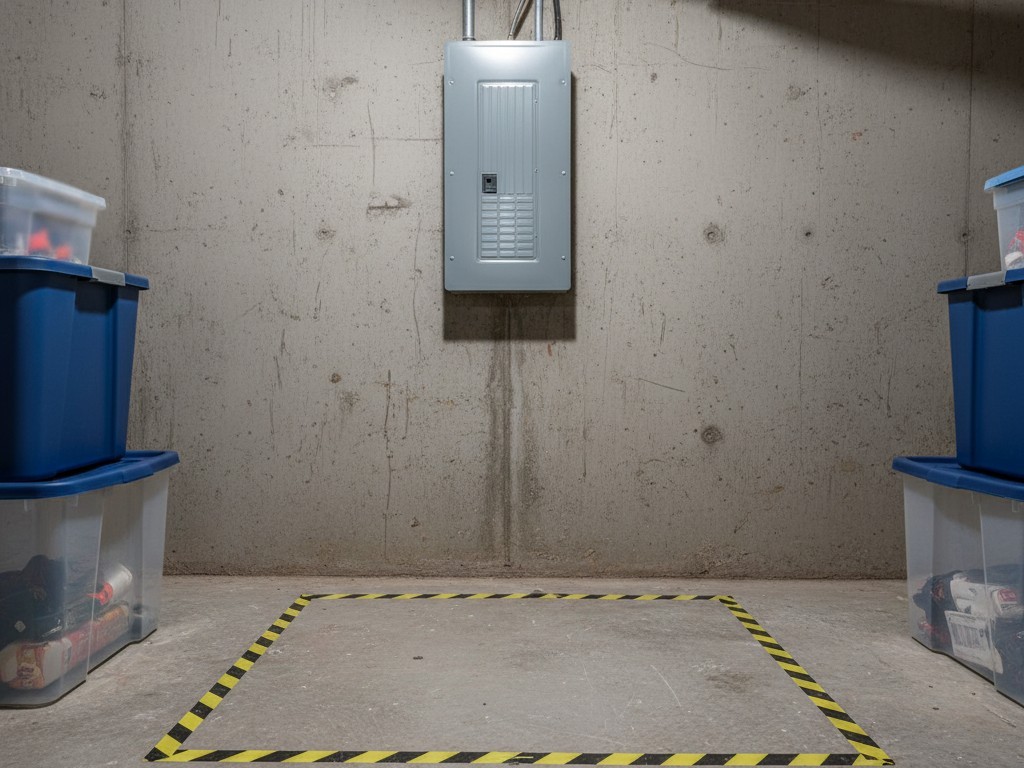
The fix is low-tech: floor tape. High-visibility vinyl tape marking the 36-inch clearance zone on the concrete floor is remarkably effective. It creates a psychological boundary. Even the most cluttered homeowner hesitates to place a box inside a yellow-and-black hazard rectangle. It shifts the dynamic from “storage space” to “machine space.”
The Zero-Touch Standard
The goal of the mechanical room isn’t to be visited. It is to function.
Every time a human has to remember to do something—flip a switch, check a battery, move a box—the system degrades. By automating the lighting, reinforcing the pumping capacity with local power, and physically demarcating the safety zones, we acknowledge the reality of the 10-second visit. We build the room to survive our own negligence.







