

There is a story that circulates among commercial energy auditors, usually shared over lukewarm coffee in a basement mechanical room. It concerns a steakhouse in the Chicago Loop that underwent a renovation. During a routine trace of the electrical load two years later, a technician found a discrepancy in the baseline usage: a constant draw that never dipped, even at 4:00 AM on a Monday.
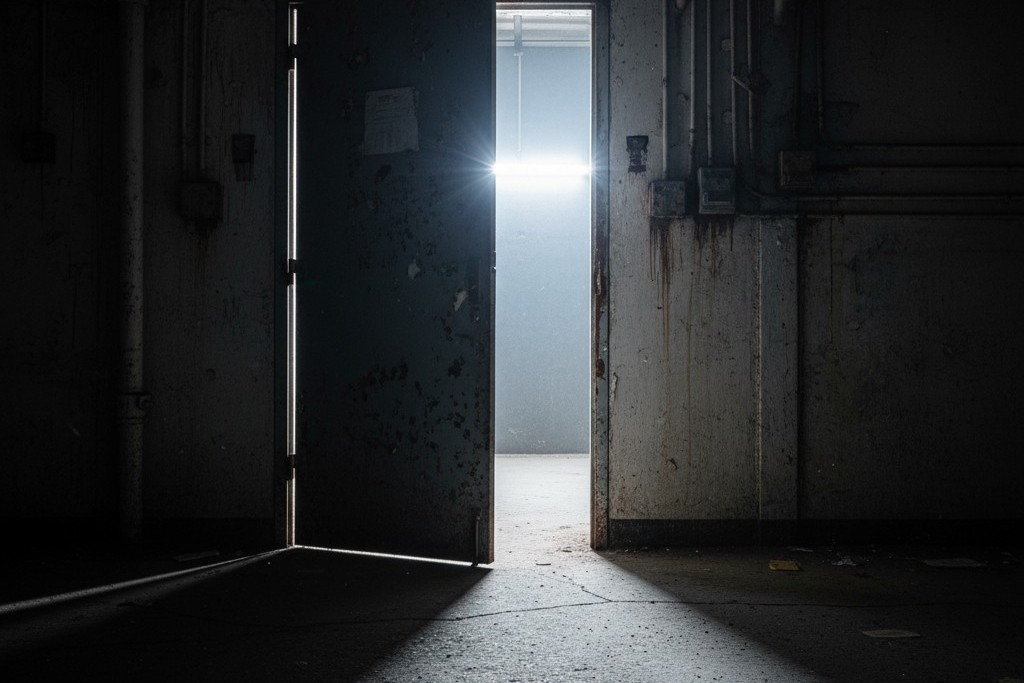
Eventually, they punched a hole in a section of drywall that didn’t match the original blueprints. Inside was a sealed-off dry storage pantry, forgotten during the remodel. The T8 fluorescent fixtures were still there, humming away. And they were on. They had been burning 24 hours a day, 7 days a week, for 24 months.
This is the “Ghost Closet.” While extreme, it isn’t unique. In almost every restaurant, hotel, or commissary kitchen, there is a room bleeding money simply because no one looks at it. It might be the chemical closet, the mop sink room, or the dry storage cage. The lights are on because a delivery driver bumped the switch with a hand truck, a dishwasher left them on with wet hands, or simply because in the chaos of a dinner rush, photons are free but time is expensive.
The industry solution is usually a stern memo or a “Turn Off Lights” sticker. These are failures of imagination. You cannot behavior-modify a line cook who is in the weeds. The only solution is hardware, but most operators buy the wrong kind, install it in the wrong place, and then wonder why their utility bill hasn’t budged.
Geometry Defeats Hardware
The primary failure point in lighting control isn’t the sensor itself; it’s the shape of the room it inhabits. Restaurant back-of-house spaces are not empty boxes. They are dynamic environments filled with shifting obstacles. A standard wall-mounted occupancy switch—the $25 hardware store special—relies on a clear line of sight. It assumes an empty room.
But a dry storage room is never empty. It is a game of Tetris played with Cambros, shelving units, and stacks of No. 10 tomato cans. If you install a wall switch sensor at the standard 48-inch height next to the door, you create a failure condition the moment a delivery arrives. The door swings open and blocks the sensor’s view. Or a metro shelf gets pushed two inches to the left, creating a “Shadow Zone”—a wedge of invisibility where the sensor cannot see motion.
您可能也會感興趣

- 電壓:2 粒 AAA 電池
- 日/夜模式
- 延遲時間:15 分鐘、30 分鐘、1 小時(預設)、2 小時

- 吸頂式 PIR 人體感應器,配備乾觸點繼電器輸出
- 12/24VDC 或 12/24VAC 低電壓供電
- 用於 EMS、HVAC 和建築控制輸入的 COM、NO 和 NC 隔離繼電器觸點

- 低壓直流嵌入式天花安裝微波人體感應開關
- 12 VDC / 24 VDC 輸入,支援 10-30 VDC 範圍
- 最大工作電流 10A,配備可調節延時、光感閾值及靈敏度
- 高負載嵌入式天花安裝微波人體感應開關
- 100-265 VAC 市電輸入,10A 型號
- 5.8 GHz 微波感應,配備可調節延時、光感閾值及靈敏度
- 嵌入式天花安裝微波人體感應開關
- 100-265 VAC 市電輸入,5A 型號
- 5.8 GHz 微波感應,配備可調節延時、光感閾值及靈敏度
- 適用於 220V 電源的天花安裝 RZ037 PIR 被動式紅外線佔空感應調光開關
- 最大工作電流 3A,額定負載 660W
- LUX 按鈕控制光線感應器開關及用戶設定之調光亮度
- 適用於 110V 電源的天花安裝 RZ037 PIR 被動式紅外線佔空感應調光開關
- 最大工作電流 3A,額定負載 330W
- LUX 按鈕控制光線感應器開關及用戶設定之調光亮度

- 低壓直流天花安裝微波人體感應開關
- 12 VDC / 24 VDC 輸入,支援 10-30 VDC 範圍
- 最大工作電流 10A,配備可調節延時、光感閾值及靈敏度
- 高負載吸頂式微波動態感應器開關
- 100-265 VAC 市電輸入,10A 型號
- 5.8 GHz 微波感應,配備可調節延時、光感閾值及靈敏度
- 吸頂式微波動態感應器開關
- 100-265 VAC 市電輸入,5A 型號
- 5.8 GHz 微波感應,配備可調節延時、光感閾值及靈敏度

- 低壓直流嵌頂式 PIR 動態感應器開關
- 12 VDC / 24 VDC 輸入,支援 10-30 VDC 範圍
- 最大工作電流 10A,具備可調式時間延遲、光照度閾值及靈敏度

- 高負載嵌頂式 PIR 動態感應器開關
- 100-265 VAC 市電輸入,10A 型號
- 360度偵測,具備可調式時間延遲、光照度閾值及靈敏度
- 嵌頂式 PIR 動態感應器開關
- 100-265 VAC 市電輸入,5A 型號
- 360度偵測,具備可調式時間延遲、光照度閾值及靈敏度

- 用於室內開關照明控制的無線開關及接收器套裝
- 100-230VAC,50/60Hz 接收器,額定電流 5A
- CR2032 電池供電無線開關,採用 2.4GHz 通訊
- 佔用感應(自動開啟/自動關閉)
- 12–24V DC (10–30VDC),最高 10A
- 360° 覆蓋,直徑 8–12 米
- 延遲時間 15 秒至 30 分鐘
- 光感應器 關閉/15/25/35 Lux
- 高/低靈敏度
- 自動開啟/自動關閉佔用模式
- 100–265V AC,10A(需接零線)
- 360° 全方位覆蓋;8–12 米偵測直徑
- 延遲時間 15 秒至 30 分鐘;Lux 關閉/15/25/35;靈敏度 高/低
- 自動開啟/自動關閉佔用模式
- 100–265V AC,5A(需接零線)
- 360° 全方位覆蓋;8–12 米偵測直徑
- 延遲時間 15 秒至 30 分鐘;Lux 關閉/15/25/35;靈敏度 高/低
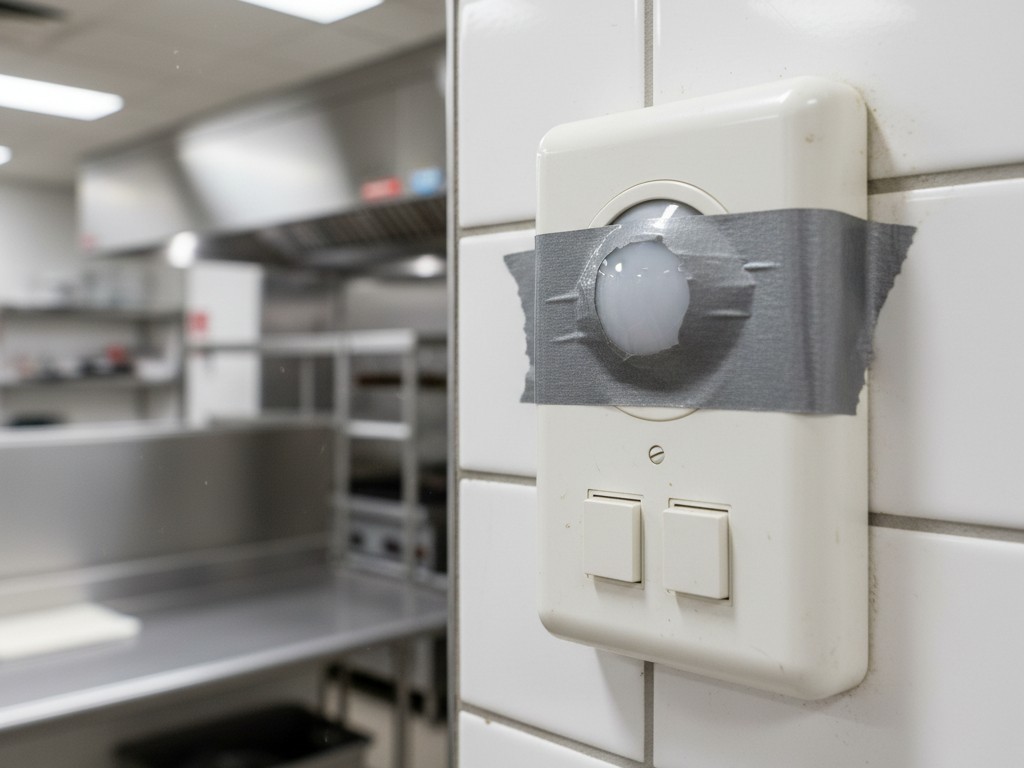
Consider the “Mop Sink Rule”: if the sensor cannot see the mop sink, the sensor does not exist. This is often the only place in a kitchen with privacy. If a porter is filling a bucket or scrubbing a mat in the corner, and a stack of crates blocks the wall switch’s view, the lights go out. To the sensor, the room is empty. To the porter, they have just been plunged into pitch darkness while handling caustic chemicals. The result is inevitably a piece of duct tape over the sensor lens, forcing the lights permanently On. The geometry of the clutter has defeated the technology of the switch.
The Sensor War: PIR vs. Ultrasonic
If you want to kill phantom loads, you have to understand how the device actually sees you. The vast majority of cheap sensors use Passive Infrared (PIR). They look for heat moving across a background grid. In a hallway or a restroom, PIR is fine. A human body is a giant heat radiator.
But in a walk-in cooler or a dense storage room, PIR is a liability. If a manager is counting inventory in a wire cage, standing relatively still in a parka, they are thermally invisible to a cheap sensor. This leads to the “Waving Arms Syndrome,” where staff must periodically stop working to wave frantically at the ceiling. It breaks flow, irritates the crew, and eventually leads to sabotage.
The commercial standard for these spaces is Dual Technology, specifically units that combine PIR with 超聲波 detection. Ultrasonic sensors work like a bat: they fill the room with high-frequency sound waves (doppler) and listen for the reflection. They don’t need a line of sight. They detect volume displacement. If a prep cook is slicing onions behind a six-foot stack of flour sacks, the ultrasonic sensor “hears” the micro-movements of their knife. The sound waves bounce around corners and over shelves.
A Dual Tech ceiling-mounted sensor—something like a Wattstopper DT-300 or a Lutron equivalent—costs significantly more than a wall switch. But it works in a room full of junk. It works when the door is open. It works when the user is hidden. If you rely on infrared alone in a cluttered BOH environment, you are essentially betting that your storage room will never be full.
The Cost of Aggressive Efficiency
There is a temptation, once you have installed the sensors, to set the timeout to the minimum possible setting—usually 1 minute or 5 minutes. The logic is that every minute the light is off is money saved. This is “spreadsheet logic,” and it is dangerous in the field.
正在尋找動態感應節能解決方案?
歡迎聯絡我們以獲取完整的 PIR 動態感應器、動態感應節能產品、動態感應器開關以及人體感應/無人感應商業解決方案。
Aggressive efficiency breeds aggressive sabotage. If a prep cook is working in a side room and the lights snap off every 60 seconds because they haven’t moved enough to satisfy a sensitive timer, they won’t appreciate the energy savings. They will find a way to disable the device. I have seen sensors smashed with meat tenderizers. I have seen them painted over. I have seen them ripped out of the ceiling with the wires left dangling.
The sweet spot for a storage room is a 20-minute timeout. Yes, you “waste” 19 minutes of electricity if someone runs in for a single item. But you gain compliance. You ensure that a staff member taking a valid break or doing a deep inventory clean is not harassed by the building. The cost of those extra minutes is pennies compared to the cost of replacing a vandalized $150 sensor unit.
A brief note on the “Smart Home” temptation: Do not install WiFi-enabled smart bulbs or residential hubs in a commercial kitchen. Grease is airborne. Heat is intense. A residential hub will fail within six months, and nobody in a kitchen has time to re-pair a lightbulb to the WiFi during a Friday rush. Stick to hardwired, industrial-grade voltage controls.
The Brutal Math of the Retrofit
Margins in this industry are too thin to burn cash on empty rooms. Let’s run the numbers. A standard storage room with four 4-lamp fluorescent fixtures draws about 500 watts. If left on 24/7 (the “Ghost Closet” scenario), that’s 4,380 kWh per year. At a blended commercial rate of $0.14/kWh, that single room costs you over $600 a year.
A ceiling-mounted Dual Tech sensor and a power pack will cost you roughly $150 in hardware. Labor for an electrician to fish the wire and install it might be another $200. Total investment: $350.
If that sensor cuts the burn time from 24 hours to 2 hours a day, you save $550 in the first year alone. The payback period is under nine months. After that, the savings are pure profit. This is better ROI than any menu item you serve.
從 Rayzeek 動態感測器產品組合中獲得靈感。
找不到您想要的產品?別擔心。總有其他方法可以解決您的問題。也許我們的其中一個產品組合可以幫到您。
But the math only holds if the system works. If you buy the cheap wall switch, and the staff tapes over it because it keeps turning off on them, your ROI is negative. You spent money to annoy your staff and saved zero electricity.
The directive is simple: Stop trusting your staff to flip switches. They have better things to do. Stop buying residential-grade wall sensors that get blocked by shelving. Call an electrician, spend the money on ultrasonic ceiling sensors, set the timer to 20 minutes, and never think about that room again.







