

There is a story that circulates among commercial energy auditors, usually shared over lukewarm coffee in a basement mechanical room. It concerns a steakhouse in the Chicago Loop that underwent a renovation. During a routine trace of the electrical load two years later, a technician found a discrepancy in the baseline usage: a constant draw that never dipped, even at 4:00 AM on a Monday.

Eventually, they punched a hole in a section of drywall that didn’t match the original blueprints. Inside was a sealed-off dry storage pantry, forgotten during the remodel. The T8 fluorescent fixtures were still there, humming away. And they were on. They had been burning 24 hours a day, 7 days a week, for 24 months.
This is the “Ghost Closet.” While extreme, it isn’t unique. In almost every restaurant, hotel, or commissary kitchen, there is a room bleeding money simply because no one looks at it. It might be the chemical closet, the mop sink room, or the dry storage cage. The lights are on because a delivery driver bumped the switch with a hand truck, a dishwasher left them on with wet hands, or simply because in the chaos of a dinner rush, photons are free but time is expensive.
The industry solution is usually a stern memo or a “Turn Off Lights” sticker. These are failures of imagination. You cannot behavior-modify a line cook who is in the weeds. The only solution is hardware, but most operators buy the wrong kind, install it in the wrong place, and then wonder why their utility bill hasn’t budged.
Geometry Defeats Hardware
The primary failure point in lighting control isn’t the sensor itself; it’s the shape of the room it inhabits. Restaurant back-of-house spaces are not empty boxes. They are dynamic environments filled with shifting obstacles. A standard wall-mounted occupancy switch—the $25 hardware store special—relies on a clear line of sight. It assumes an empty room.
But a dry storage room is never empty. It is a game of Tetris played with Cambros, shelving units, and stacks of No. 10 tomato cans. If you install a wall switch sensor at the standard 48-inch height next to the door, you create a failure condition the moment a delivery arrives. The door swings open and blocks the sensor’s view. Or a metro shelf gets pushed two inches to the left, creating a “Shadow Zone”—a wedge of invisibility where the sensor cannot see motion.
คุณอาจสนใจ

- แรงดันไฟฟ้า: ถ่าน AAA 2 ก้อน
- โหมดกลางวัน/กลางคืน
- การหน่วงเวลา: 15 นาที, 30 นาที, 1 ชั่วโมง (ค่าเริ่มต้น), 2 ชั่วโมง

- เซนเซอร์ตรวจจับการถือครองห้อง PIR ติดตั้งบนเพดาน พร้อมเอาต์พุตรีเลย์หน้าสัมผัสแห้ง
- ระบบจ่ายไฟแรงดันต่ำ 12/24VDC หรือ 12/24VAC
- หน้าสัมผัสรีเลย์แบบแยก COM, NO และ NC สำหรับสัญญาณอินพุตของระบบ EMS, HVAC และระบบควบคุมอาคาร

- สวิตช์เซนเซอร์ตรวจจับการเคลื่อนไหวด้วยไมโครเวฟแบบติดเพดานฝังฝ้า ไฟฟ้ากระแสตรงแรงดันต่ำ
- อินพุต 12 VDC / 24 VDC พร้อมช่วงรองรับ 10-30 VDC
- กระแสไฟฟ้าทำงานสูงสุด 10A พร้อมการปรับตั้งค่าเวลาหน่วง เกณฑ์ค่า Lux และความไวในการตรวจจับ
- สวิตช์เซนเซอร์ตรวจจับการเคลื่อนไหวด้วยไมโครเวฟแบบติดเพดานฝังฝ้า สำหรับโหลดสูง
- อินพุตแรงดันสาย 100-265 VAC รุ่น 10A
- ระบบตรวจจับด้วยไมโครเวฟความถี่ 5.8 GHz พร้อมการปรับตั้งค่าเวลาหน่วง เกณฑ์ค่า Lux และความไวในการตรวจจับ
- สวิตช์เซนเซอร์ตรวจจับการเคลื่อนไหวด้วยไมโครเวฟแบบติดเพดานฝังฝ้า
- อินพุตแรงดันสาย 100-265 VAC รุ่น 5A
- ระบบตรวจจับด้วยไมโครเวฟความถี่ 5.8 GHz พร้อมการปรับตั้งค่าเวลาหน่วง เกณฑ์ค่า Lux และความไวในการตรวจจับ
- สวิตช์หรี่ไฟเซนเซอร์ตรวจจับการเข้าใช้พื้นที่ระบบ PIR รุ่น RZ037 แบบติดเพดาน สำหรับระบบไฟฟ้า 220V
- กระแสไฟฟ้าทำงานสูงสุด 3A พร้อมโหลดพิกัด 660W
- ปุ่ม LUX ควบคุมการเปิด/ปิดเซนเซอร์แสง และความสว่างในการหรี่ไฟที่ผู้ใช้กำหนด
- สวิตช์หรี่ไฟเซนเซอร์ตรวจจับการเข้าใช้พื้นที่ระบบ PIR รุ่น RZ037 แบบติดเพดาน สำหรับระบบไฟฟ้า 110V
- กระแสไฟฟ้าทำงานสูงสุด 3A พร้อมโหลดพิกัด 330W
- ปุ่ม LUX ควบคุมการเปิด/ปิดเซนเซอร์แสง และความสว่างในการหรี่ไฟที่ผู้ใช้กำหนด

- สวิตช์เซนเซอร์ตรวจจับการเคลื่อนไหวด้วยไมโครเวฟแบบติดเพดาน ไฟฟ้ากระแสตรงแรงดันต่ำ
- อินพุต 12 VDC / 24 VDC พร้อมช่วงรองรับ 10-30 VDC
- กระแสไฟฟ้าทำงานสูงสุด 10A พร้อมการปรับตั้งค่าเวลาหน่วง เกณฑ์ค่า Lux และความไวในการตรวจจับ
- สวิตช์เซนเซอร์ตรวจจับความเคลื่อนไหวคลื่นไมโครเวฟแบบติดเพดาน รองรับโหลดสูง
- อินพุตแรงดันสาย 100-265 VAC รุ่น 10A
- ระบบตรวจจับด้วยไมโครเวฟความถี่ 5.8 GHz พร้อมการปรับตั้งค่าเวลาหน่วง เกณฑ์ค่า Lux และความไวในการตรวจจับ
- สวิตช์เซนเซอร์ตรวจจับความเคลื่อนไหวคลื่นไมโครเวฟแบบติดเพดาน
- อินพุตแรงดันสาย 100-265 VAC รุ่น 5A
- ระบบตรวจจับด้วยไมโครเวฟความถี่ 5.8 GHz พร้อมการปรับตั้งค่าเวลาหน่วง เกณฑ์ค่า Lux และความไวในการตรวจจับ

- สวิตช์เซนเซอร์ตรวจจับความเคลื่อนไหว PIR แบบฝังฝ้าเพดาน แรงดันไฟฟ้าต่ำ DC
- อินพุต 12 VDC / 24 VDC พร้อมช่วงรองรับ 10-30 VDC
- กระแสไฟฟ้าทำงานสูงสุด 10A พร้อมระบบปรับตั้งเวลาหน่วง ค่าความสว่าง Lux และความไวในการตรวจจับได้

- สวิตช์เซนเซอร์ตรวจจับความเคลื่อนไหว PIR แบบฝังฝ้าเพดาน รองรับโหลดสูง
- อินพุตแรงดันสาย 100-265 VAC รุ่น 10A
- ระบบตรวจจับ 360 องศา พร้อมระบบปรับตั้งเวลาหน่วง ค่าความสว่าง Lux และความไวในการตรวจจับได้
- สวิตช์เซนเซอร์ตรวจจับความเคลื่อนไหว PIR แบบฝังฝ้าเพดาน
- อินพุตแรงดันสาย 100-265 VAC รุ่น 5A
- ระบบตรวจจับ 360 องศา พร้อมระบบปรับตั้งเวลาหน่วง ค่าความสว่าง Lux และความไวในการตรวจจับได้

- ชุดสวิตช์ไร้สายและตัวรับสัญญาณสำหรับควบคุมการเปิด/ปิดไฟภายในอาคาร
- ตัวรับสัญญาณ 100-230VAC, 50/60Hz พิกัดกระแสไฟฟ้า 5A
- สวิตช์ไร้สายใช้พลังงานจากแบตเตอรี่ CR2032 พร้อมการสื่อสารผ่านความถี่ 2.4GHz
- ตรวจจับการใช้งาน (เปิดอัตโนมัติ/ปิดอัตโนมัติ)
- 12–24V DC (10–30VDC), สูงสุด 10A
- ครอบคลุม 360° เส้นผ่านศูนย์กลาง 8–12 ม.
- หน่วงเวลา 15 วินาที–30 นาที
- เซนเซอร์วัดแสง ปิด/15/25/35 Lux
- ความไวสูง/ต่ำ
- โหมดตรวจจับการใช้งาน เปิดอัตโนมัติ/ปิดอัตโนมัติ
- 100–265V AC, 10A (จำเป็นต้องมีสายสายนิวทรัล)
- ครอบคลุม 360°; เส้นผ่านศูนย์กลางการตรวจจับ 8–12 ม.
- หน่วงเวลา 15 วินาที–30 นาที; Lux ปิด/15/25/35; ความไวสูง/ต่ำ
- โหมดตรวจจับการใช้งาน เปิดอัตโนมัติ/ปิดอัตโนมัติ
- 100–265V AC, 5A (จำเป็นต้องมีสายสายนิวทรัล)
- ครอบคลุม 360°; เส้นผ่านศูนย์กลางการตรวจจับ 8–12 ม.
- หน่วงเวลา 15 วินาที–30 นาที; Lux ปิด/15/25/35; ความไวสูง/ต่ำ
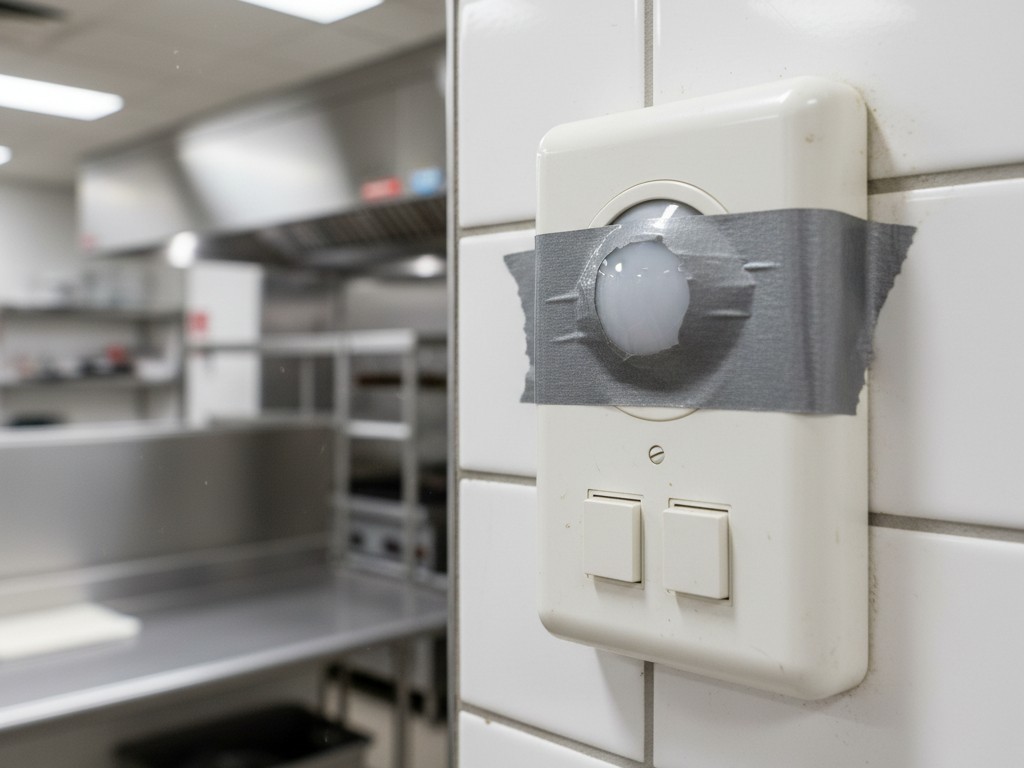
Consider the “Mop Sink Rule”: if the sensor cannot see the mop sink, the sensor does not exist. This is often the only place in a kitchen with privacy. If a porter is filling a bucket or scrubbing a mat in the corner, and a stack of crates blocks the wall switch’s view, the lights go out. To the sensor, the room is empty. To the porter, they have just been plunged into pitch darkness while handling caustic chemicals. The result is inevitably a piece of duct tape over the sensor lens, forcing the lights permanently On. The geometry of the clutter has defeated the technology of the switch.
The Sensor War: PIR vs. Ultrasonic
If you want to kill phantom loads, you have to understand how the device actually sees you. The vast majority of cheap sensors use Passive Infrared (PIR). They look for heat moving across a background grid. In a hallway or a restroom, PIR is fine. A human body is a giant heat radiator.
But in a walk-in cooler or a dense storage room, PIR is a liability. If a manager is counting inventory in a wire cage, standing relatively still in a parka, they are thermally invisible to a cheap sensor. This leads to the “Waving Arms Syndrome,” where staff must periodically stop working to wave frantically at the ceiling. It breaks flow, irritates the crew, and eventually leads to sabotage.
The commercial standard for these spaces is Dual Technology, specifically units that combine PIR with คลื่นอัลตราโซนิก detection. Ultrasonic sensors work like a bat: they fill the room with high-frequency sound waves (doppler) and listen for the reflection. They don’t need a line of sight. They detect volume displacement. If a prep cook is slicing onions behind a six-foot stack of flour sacks, the ultrasonic sensor “hears” the micro-movements of their knife. The sound waves bounce around corners and over shelves.
A Dual Tech ceiling-mounted sensor—something like a Wattstopper DT-300 or a Lutron equivalent—costs significantly more than a wall switch. But it works in a room full of junk. It works when the door is open. It works when the user is hidden. If you rely on infrared alone in a cluttered BOH environment, you are essentially betting that your storage room will never be full.
The Cost of Aggressive Efficiency
There is a temptation, once you have installed the sensors, to set the timeout to the minimum possible setting—usually 1 minute or 5 minutes. The logic is that every minute the light is off is money saved. This is “spreadsheet logic,” and it is dangerous in the field.
กำลังมองหาโซลูชันประหยัดพลังงานทำงานตามการเคลื่อนไหวอยู่ใช่หรือไม่
ติดต่อเราเพื่อรับโซลูชันครบวงจรสำหรับ PIR motion sensor, ผลิตภัณฑ์ประหยัดพลังงานทำงานตามการเคลื่อนไหว, สวิตช์เซนเซอร์ตรวจจับการเคลื่อนไหว และโซลูชัน Occupancy/Vacancy สำหรับเชิงพาณิชย์.
Aggressive efficiency breeds aggressive sabotage. If a prep cook is working in a side room and the lights snap off every 60 seconds because they haven’t moved enough to satisfy a sensitive timer, they won’t appreciate the energy savings. They will find a way to disable the device. I have seen sensors smashed with meat tenderizers. I have seen them painted over. I have seen them ripped out of the ceiling with the wires left dangling.
The sweet spot for a storage room is a 20-minute timeout. Yes, you “waste” 19 minutes of electricity if someone runs in for a single item. But you gain compliance. You ensure that a staff member taking a valid break or doing a deep inventory clean is not harassed by the building. The cost of those extra minutes is pennies compared to the cost of replacing a vandalized $150 sensor unit.
A brief note on the “Smart Home” temptation: Do not install WiFi-enabled smart bulbs or residential hubs in a commercial kitchen. Grease is airborne. Heat is intense. A residential hub will fail within six months, and nobody in a kitchen has time to re-pair a lightbulb to the WiFi during a Friday rush. Stick to hardwired, industrial-grade voltage controls.
The Brutal Math of the Retrofit
Margins in this industry are too thin to burn cash on empty rooms. Let’s run the numbers. A standard storage room with four 4-lamp fluorescent fixtures draws about 500 watts. If left on 24/7 (the “Ghost Closet” scenario), that’s 4,380 kWh per year. At a blended commercial rate of $0.14/kWh, that single room costs you over $600 a year.
A ceiling-mounted Dual Tech sensor and a power pack will cost you roughly $150 in hardware. Labor for an electrician to fish the wire and install it might be another $200. Total investment: $350.
If that sensor cuts the burn time from 24 hours to 2 hours a day, you save $550 in the first year alone. The payback period is under nine months. After that, the savings are pure profit. This is better ROI than any menu item you serve.
รับแรงบันดาลใจจากกลุ่มผลิตภัณฑ์เซนเซอร์ตรวจจับความเคลื่อนไหว Rayzeek.
ยังไม่พบสิ่งที่ต้องการใช่หรือไม่? ไม่ต้องกังวล เพราะยังมีแนวทางอื่นในการแก้ปัญหาของคุณเสมอ บางทีหนึ่งในกลุ่มผลิตภัณฑ์ของเราอาจช่วยคุณได้.
But the math only holds if the system works. If you buy the cheap wall switch, and the staff tapes over it because it keeps turning off on them, your ROI is negative. You spent money to annoy your staff and saved zero electricity.
The directive is simple: Stop trusting your staff to flip switches. They have better things to do. Stop buying residential-grade wall sensors that get blocked by shelving. Call an electrician, spend the money on ultrasonic ceiling sensors, set the timer to 20 minutes, and never think about that room again.







