

In commercial retrofits and tenant improvements, speed is currency. A project that finishes on time and passes inspection on the first attempt isn’t just a win; it’s the expected standard. Yet, delays and budget overruns often originate from the lighting controls in the smallest, most unassuming rooms. The push for “smart” buildings has led to complex, networked systems being deployed in spaces where they offer minimal benefit and maximum friction.
For small, predictable-use rooms like restrooms, storage closets, and utility spaces, a non-networked lighting control strategy is a superior methodology, not a compromise. By selecting simple, robust, standalone devices, contractors and facility managers can achieve full code compliance, eliminate complex commissioning, and ensure a swift path to project completion. This is a strategy rooted in choosing the right tool for the job, delivering results instead of just dashboards.
The Overkill Problem: When Smart Lighting Creates Dumb Delays
The appeal of a fully integrated, networked building is undeniable. A central system promises ultimate control, detailed data analytics, and future-proof flexibility. While these benefits are tangible in large, dynamic open-plan offices or conference centers, they become liabilities when misapplied to small, single-purpose rooms. This mismatch between technological capability and practical need creates significant project friction.
The Hidden Costs of Networked Complexity
A networked lighting system introduces multiple layers of dependency. Each sensor, switch, and fixture must be physically installed and then digitally integrated into a central controller. This process, known as commissioning, requires specialized knowledge and can reveal interoperability issues that are difficult to troubleshoot on a tight schedule. Every node on the network is another point of failure; a single misconfigured device can hold up the sign-off for an entire area. The hours a technician spends programming scenes for a storage closet translate directly into higher project costs and a delayed timeline.
Defining the “Small Room” Challenge: Restrooms, Closets, and Storage
The argument for simplicity is most potent in rooms with predictable usage. A restroom or a janitorial closet has a binary function: it is either occupied or unoccupied. The lighting requirement is equally simple, needing to be on when someone is present and off when they are not. These spaces gain nothing from networked features like daylight harvesting, scene control, or remote scheduling. Forcing them into a complex, building-wide system ignores their fundamental nature and burdens them with unnecessary technological overhead.
Căutați soluții de economisire a energiei activate de mișcare?
Contactați-ne pentru senzori de mișcare PIR compleți, produse de economisire a energiei cu activare la mișcare, întrerupătoare cu senzor de mișcare și soluții comerciale de prezență/vacanță.
The Principle of Appropriate Tech: A Non-Networked Philosophy
The most effective solution aligns with the scale of the problem. Instead of defaulting to the most feature-rich option, a philosophy of appropriate technology prioritizes reliability, simplicity, and fitness for purpose. For small room lighting control, this means rejecting the networked paradigm in favor of standalone devices that perform their core function flawlessly.
Stability Over Features: The Argument for Standalone Devices
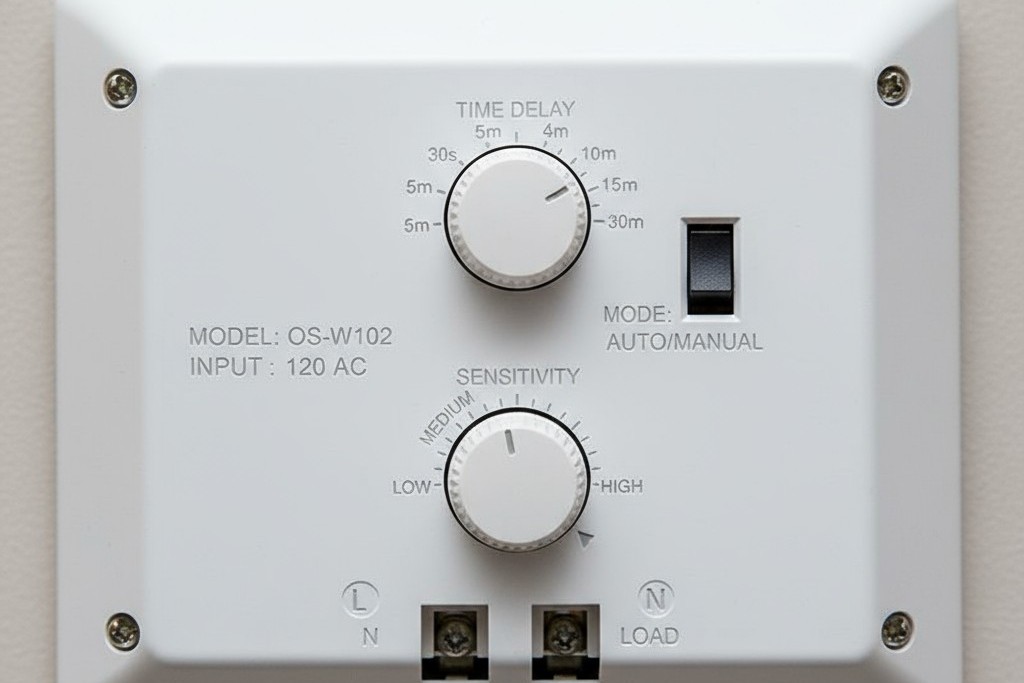
A non-networked occupancy sensor is a self-contained system. Its logic is internal and its operation is independent, unaffected by the status of a central network. This inherent stability is a powerful asset on a construction site. There are no IP addresses to assign, no gateways to configure, and no software updates to manage. The device is installed, its settings are adjusted with simple physical dials, and it works. This reduces the project’s risk profile by isolating the functionality of each room, ensuring a problem in one area cannot cascade into others.
The Power of Minimal Commissioning
The greatest advantage of a non-networked approach is the near-total elimination of digital commissioning. Setting up a standalone sensor is a physical and immediate task. A technician can adjust the time delay and sensitivity in seconds, test the device, and move on. This “commissioning” happens at the device level, requiring no specialized software or network access. This radical simplification condenses hours of potential configuration into a few minutes of straightforward adjustment, accelerating the project and shortening the path to final approval.
The Code-Compliant Retrofit Kit: Wall-Box and Ceiling Solutions
Adopting a non-networked philosophy doesn’t mean sacrificing choice. Standalone solutions from portfolios like Rayzeek’s offer two primary form factors that cover nearly every small-room retrofit, ensuring a simple path to code compliance with minimal installation effort.
The Wall-Box Option: An All-in-One Switch Replacement
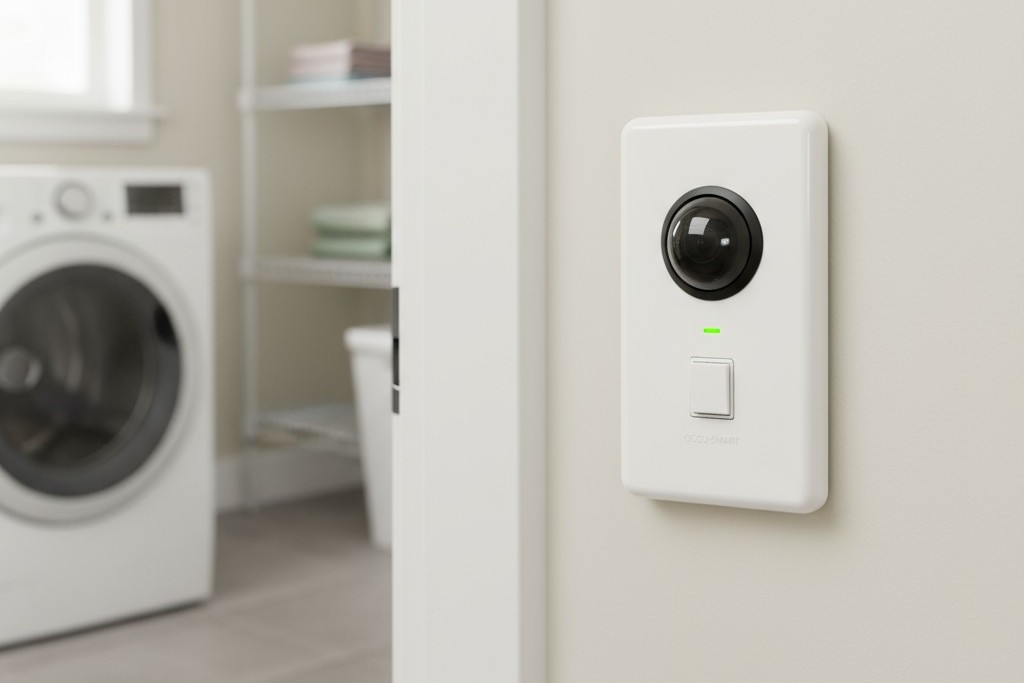
For most standard retrofits, the wall-box occupancy sensor is the most efficient solution. These devices combine a passive infrared sensor with a relay and switch into a single unit that replaces the existing wall switch, with an installation as simple as wiring a standard dimmer. This approach is ideal for small offices, closets, and single-occupant restrooms where the sensor’s wall position provides a clear line of sight. It requires no new wiring, no ceiling work, and consolidates control into a familiar location.
S-ar putea să vă intereseze și

- Tensiune: 2 baterii AAA
- Mod Zi/Noapte
- Temporizare: 15min, 30min, 1h (implicit), 2h

- Senzor de prezență PIR cu montaj pe tavan și ieșire de releu cu contact uscat
- Alimentare de joasă tensiune de 12/24VDC sau 12/24VAC
- Contacte de releu izolate COM, NO și NC pentru intrări de control al sistemelor EMS, HVAC și al clădirilor

- Întrerupător cu senzor de mișcare cu microunde încastrat în tavan, de joasă tensiune DC
- Intrare de 12 VDC / 24 VDC cu un interval cuprins între 10-30 VDC
- Curent de lucru maxim de 10A cu temporizare reglabilă, prag Lux și sensibilitate ajustabile
- Întrerupător cu senzor de mișcare cu microunde încastrat în tavan, pentru sarcini mai mari
- Intrare la tensiunea rețelei de 100-265 VAC, model de 10A
- Detectare cu microunde de 5.8 GHz cu temporizare reglabilă, prag Lux și sensibilitate ajustabile
- Întrerupător încastrat pentru plafon cu senzor de mișcare cu microunde
- Tensiune de intrare 100-265 VAC, model de 5A
- Detectare cu microunde de 5.8 GHz cu temporizare reglabilă, prag Lux și sensibilitate ajustabile
- Variator cu senzor de prezență PIR RZ037 pentru plafon, pentru alimentare la 220V
- Curent maxim de lucru de 3A cu sarcină nominală de 660W
- Butonul LUX controlează funcția ON/OFF a senzorului de lumină și luminozitatea setată de utilizator
- Variator cu senzor de prezență PIR RZ037 pentru plafon, pentru alimentare la 110V
- Curent maxim de lucru de 3A cu sarcină nominală de 330W
- Butonul LUX controlează funcția ON/OFF a senzorului de lumină și luminozitatea setată de utilizator

- Întrerupător cu senzor de mișcare cu microunde pentru plafon, de joasă tensiune C.C.
- Intrare de 12 VDC / 24 VDC cu un interval cuprins între 10-30 VDC
- Curent de lucru maxim de 10A cu temporizare reglabilă, prag Lux și sensibilitate ajustabile
- Întrerupător cu senzor de mișcare cu microunde pentru plafon, pentru sarcini mai mari
- Intrare la tensiunea rețelei de 100-265 VAC, model de 10A
- Detectare cu microunde de 5.8 GHz cu temporizare reglabilă, prag Lux și sensibilitate ajustabile
- Întrerupător cu senzor de mișcare cu microunde pentru plafon
- Tensiune de intrare 100-265 VAC, model de 5A
- Detectare cu microunde de 5.8 GHz cu temporizare reglabilă, prag Lux și sensibilitate ajustabile

- Întrerupător cu senzor de mișcare PIR încastrat în tavan, CC de joasă tensiune
- Intrare de 12 VDC / 24 VDC cu un interval cuprins între 10-30 VDC
- Curent maxim de lucru 10A cu temporizare reglabilă, prag Lux și sensibilitate

- Întrerupător cu senzor de mișcare PIR încastrat în tavan pentru sarcini mai mari
- Intrare la tensiunea rețelei de 100-265 VAC, model de 10A
- Detecție la 360 de grade cu temporizare reglabilă, prag Lux și sensibilitate
- Întrerupător cu senzor de mișcare PIR încastrat în tavan
- Tensiune de intrare 100-265 VAC, model de 5A
- Detecție la 360 de grade cu temporizare reglabilă, prag Lux și sensibilitate

- Kit de întrerupător și receptor wireless pentru controlul iluminatului de interior PORNIT/OPRIT
- Receptor 100-230VAC, 50/60Hz cu curent nominal de 5A
- Întrerupător wireless alimentat cu baterie CR2032 cu comunicare la 2.4GHz
- Prezență (PORNIRE automată/OPRIRE automată)
- 12–24V CC (10–30VCC), până la 10A
- Acoperire 360°, diametru 8–12 m
- Temporizare 15 s–30 min
- Senzor de lumină Oprit/15/25/35 Lux
- Sensibilitate ridicată/scăzută
- Mod de prezență Auto-ON/Auto-OFF
- 100–265V AC, 10A (necesită nul)
- Acoperire 360°; diametru de detecție 8–12 m
- Temporizare 15 s–30 min; Lux OFF/15/25/35; Sensibilitate ridicată/scăzută
- Mod de prezență Auto-ON/Auto-OFF
- 100–265V AC, 5A (necesită nul)
- Acoperire 360°; diametru de detecție 8–12 m
- Temporizare 15 s–30 min; Lux OFF/15/25/35; Sensibilitate ridicată/scăzută
The Ceiling-Mount Option: For Complete Coverage
In rooms with irregular shapes, tall shelving, or restroom stalls that obstruct a wall-mounted sensor’s view, a ceiling-mounted occupancy sensor is the more robust choice. Paired with a simple power pack, these sensors provide a top-down, unobstructed view of the entire space for reliable detection. While this requires minimal low-voltage wiring between the sensor and its power pack, the solution guarantees motion detection regardless of partitions or furniture, making it the definitive option for multi-stall restrooms and cluttered storage areas.
Satisfying Code Intent: How Simplicity Keeps Inspectors Calm
Passing a final inspection is a critical milestone, and lighting controls are a frequent point of scrutiny. Modern energy codes mandate automatic shutoff in most non-residential spaces. While networked systems can meet these requirements, their complexity can create ambiguity for an inspector. A simple, standalone system offers a clear and undeniable demonstration of compliance.
Moving Beyond Literalism to Functional Compliance
Building inspectors are tasked with enforcing the intent of the code: ensuring lights do not remain on in unoccupied spaces. A standalone occupancy sensor transparently fulfills this purpose. Its function is obvious. When no one is in the room, the lights turn off after a set period, with no hidden schedules or network overrides to complicate the matter. An inspector can test the device in 30 seconds, see a direct and reliable link between presence and power, and sign off with confidence.
Lăsați-vă inspirat de portofoliile de senzori de mișcare Rayzeek.
Nu găsiți ceea ce căutați? Nu vă faceți griji. Există întotdeauna modalități alternative de a vă rezolva problemele. Poate vă poate ajuta unul dintre portofoliile noastre.

Essential Settings for Day-One Approval
To ensure a first-pass approval, non-networked sensors should be configured to common code requirements before the inspector arrives. This typically involves setting the time delay to 20 minutes or less, a standard maximum in most energy codes. The sensor’s operation mode should also be set to “auto-on/auto-off” or, in jurisdictions like California, “manual-on/auto-off.” These settings are clearly marked on the device, can be adjusted in seconds, and provide visible proof of a compliant configuration.
The Payoff: Short Punch Lists and Long-Term Reliability
A non-networked strategy for small rooms delivers immediate returns at project closeout and continues to add value over the life of the building. Any fast-moving tenant improvement aims to hand the keys back to the client with a minimal punch list. Because standalone sensors are simple to install and test, they rarely become a lingering issue.
This initial victory is followed by the long-term benefit of exceptional reliability. With no network dependency or central processor, standalone devices have an extremely low failure rate. This means fewer service calls for the facility manager, lower maintenance costs, and a better experience for tenants. Ultimately, choosing a simple, robust sensor for a small room is a decision that prioritizes operational excellence over technological exhibitionism, ensuring the project is not just done, but done right.







