
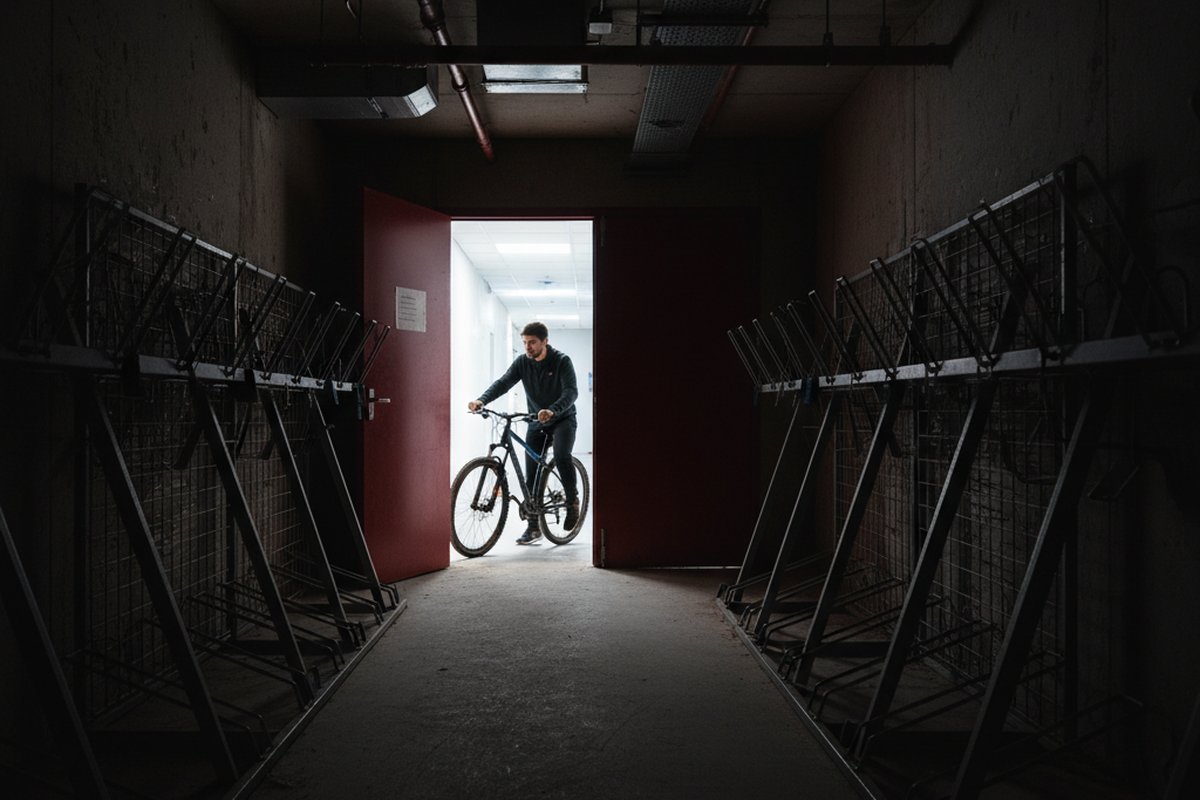
The most dangerous moment in a bike storage room isn’t when a thief breaks in. It’s the three seconds after a resident opens the door.
A resident enters the room carrying a muddy mountain bike or balancing two pannier bags. The hallway is bright. They push open the heavy fire-rated door, step across the threshold, and the hydraulic closer shuts the door behind them. For three seconds—before they can fumble for a switch or trigger a poorly placed sensor—they stand in total darkness in a room full of metal obstacles.
This is where the slip-and-fall claims happen. This is where wheels get crushed. This is the “Blackout Gap,” and it represents a fundamental design failure.
Lighting in a high-density bike room is a safety system, not an aesthetic choice or an energy-saving opportunity. If the lights aren’t at full brightness before the door latch engages, the system has failed. Yet building after building features retrofits prioritizing vacancy sensors or consumer-grade “smart” bulbs that leave residents waving their arms in the dark. The physics of a bike room—concrete walls, metal cages, and cluttered sightlines—demand an automation approach that consumer tech simply cannot handle.
There is often a conflict here between strict energy codes (like IECC or Title 24) and practical reality. Codes often mandate “Vacancy” sensors (Manual-On, Auto-Off) to ensure lights aren’t left burning. In a bike room, Manual-On is a liability. A cyclist does not have a free hand to hit a switch. Fortunately, safety exemptions almost always allow for “Occupancy” (Auto-On) sensors in areas where safety is a concern. You must categorize these rooms as high-risk transition zones, not standard storage closets, to justify the Auto-On setting.
正在尋找動態感應節能解決方案?
歡迎聯絡我們以獲取完整的 PIR 動態感應器、動態感應節能產品、動態感應器開關以及人體感應/無人感應商業解決方案。
Geometry Is Destiny
Most bike room lighting fails because of geometry, not electricity. A standard electrician’s instinct is to center the motion sensor on the ceiling. While this looks tidy on a reflected ceiling plan, it is functionally useless for the person entering the room.
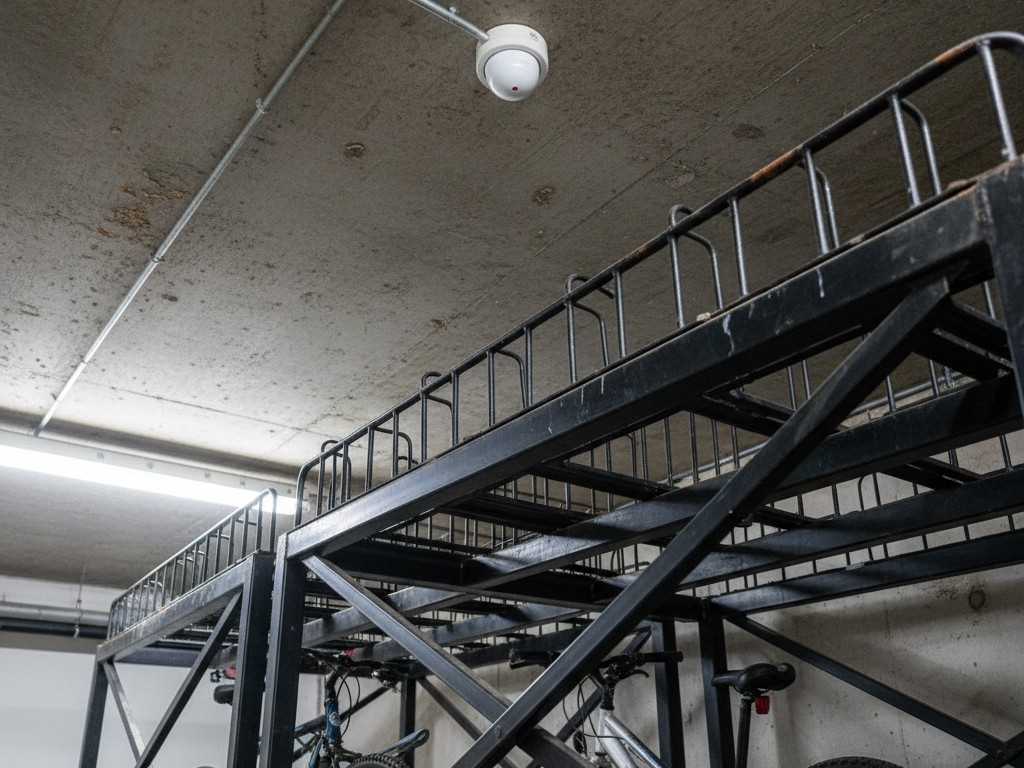
Center a sensor in a room filled with vertical bike racks or cages, and the racks block the view. The entering resident is hidden from the sensor by the racks or the door swing itself. The sensor needs to “see” the threat, and the threat is the threshold. The trigger zone must be the 3×3 foot square immediately inside the doorframe. If the sensor cannot see the floor at the entrance, it won’t trigger until the user is already deep inside the danger zone.
This creates a secondary problem: the “Hallway Disco.” If you position a high-sensitivity sensor to stare directly at the door, it may pick up heat signatures from people walking past in the hallway, triggering the lights unnecessarily. This is the number one complaint from ground-floor units near common areas.
Don’t move the sensor back to the center to fix this. Instead, use the masking strips provided with commercial-grade sensors (like the Lutron Maestro series or Wattstopper units). Physically tape over the lens segments that view the hallway, creating a hard cut-off line exactly at the threshold. It takes five minutes on a ladder to tune, but it prevents years of resident complaints.
You can test this geometry without tools. Walk the path from the hallway imagining you are holding a 40-pound e-bike. If you have to step fully into the room or wave an arm to get the lights to fire, the placement is wrong. The light should strike the floor the moment the door cracks open.
The Hardware: Why PIR Fails
Most cheap motion sensors rely on Passive Infrared (PIR) technology. PIR looks for moving heat signatures. It works perfectly in an empty living room, but fails miserably in a bike room.
Bike rooms are obstacle courses. Rows of double-decker racks, hanging bikes, and wire mesh cages break up the line of sight. Since PIR relies on line of sight, a resident crouching behind a cargo bike to lock their wheel becomes invisible. The sensor assumes the room is empty and cuts the lights. This leaves the resident in pitch blackness, mid-lock, forcing them to stand up and perform the “waving arms dance” to re-trigger the sensor. Beyond the annoyance, this creates a panic moment that leads to complaints.
The only viable hardware for a cluttered bike room is “Dual Technology” sensors. These units combine standard PIR with Ultrasonic detection. While PIR looks for heat, Ultrasonic sensors fill the room with high-frequency sound waves (Doppler shift) to detect volume changes. They can “hear” a person moving behind a solid object, detecting the micro-movements of someone turning a padlock key or shifting a tire.
Ultrasonic tech does have quirks—it is sensitive enough to be triggered by strong airflow from an HVAC vent, causing “phantom tripping.” However, modern commercial units (like the Wattstopper DT-300 series) allow you to adjust the sensitivity of the ultrasonic and PIR channels independently. Set high sensitivity on the ultrasonic side to catch the small movements of someone working on a bike, and moderate PIR sensitivity to catch the initial entry. You cannot get this level of granularity from a $20 big-box store sensor.
The “Smart” Trap
Property managers often try to solve these problems with “Smart” bulbs—Wi-Fi enabled retrofits that promise app control and scheduling. In a bike storage environment, this is a catastrophic mistake.
您可能也會感興趣

- 電壓:2 粒 AAA 電池
- 日/夜模式
- 延遲時間:15 分鐘、30 分鐘、1 小時(預設)、2 小時

- 吸頂式 PIR 人體感應器,配備乾觸點繼電器輸出
- 12/24VDC 或 12/24VAC 低電壓供電
- 用於 EMS、HVAC 和建築控制輸入的 COM、NO 和 NC 隔離繼電器觸點

- 低壓直流嵌入式天花安裝微波人體感應開關
- 12 VDC / 24 VDC 輸入,支援 10-30 VDC 範圍
- 最大工作電流 10A,配備可調節延時、光感閾值及靈敏度
- 高負載嵌入式天花安裝微波人體感應開關
- 100-265 VAC 市電輸入,10A 型號
- 5.8 GHz 微波感應,配備可調節延時、光感閾值及靈敏度
- 嵌入式天花安裝微波人體感應開關
- 100-265 VAC 市電輸入,5A 型號
- 5.8 GHz 微波感應,配備可調節延時、光感閾值及靈敏度
- 適用於 220V 電源的天花安裝 RZ037 PIR 被動式紅外線佔空感應調光開關
- 最大工作電流 3A,額定負載 660W
- LUX 按鈕控制光線感應器開關及用戶設定之調光亮度
- 適用於 110V 電源的天花安裝 RZ037 PIR 被動式紅外線佔空感應調光開關
- 最大工作電流 3A,額定負載 330W
- LUX 按鈕控制光線感應器開關及用戶設定之調光亮度

- 低壓直流天花安裝微波人體感應開關
- 12 VDC / 24 VDC 輸入,支援 10-30 VDC 範圍
- 最大工作電流 10A,配備可調節延時、光感閾值及靈敏度
- 高負載吸頂式微波動態感應器開關
- 100-265 VAC 市電輸入,10A 型號
- 5.8 GHz 微波感應,配備可調節延時、光感閾值及靈敏度
- 吸頂式微波動態感應器開關
- 100-265 VAC 市電輸入,5A 型號
- 5.8 GHz 微波感應,配備可調節延時、光感閾值及靈敏度

- 低壓直流嵌頂式 PIR 動態感應器開關
- 12 VDC / 24 VDC 輸入,支援 10-30 VDC 範圍
- 最大工作電流 10A,具備可調式時間延遲、光照度閾值及靈敏度

- 高負載嵌頂式 PIR 動態感應器開關
- 100-265 VAC 市電輸入,10A 型號
- 360度偵測,具備可調式時間延遲、光照度閾值及靈敏度
- 嵌頂式 PIR 動態感應器開關
- 100-265 VAC 市電輸入,5A 型號
- 360度偵測,具備可調式時間延遲、光照度閾值及靈敏度

- 用於室內開關照明控制的無線開關及接收器套裝
- 100-230VAC,50/60Hz 接收器,額定電流 5A
- CR2032 電池供電無線開關,採用 2.4GHz 通訊
- 佔用感應(自動開啟/自動關閉)
- 12–24V DC (10–30VDC),最高 10A
- 360° 覆蓋,直徑 8–12 米
- 延遲時間 15 秒至 30 分鐘
- 光感應器 關閉/15/25/35 Lux
- 高/低靈敏度
- 自動開啟/自動關閉佔用模式
- 100–265V AC,10A(需接零線)
- 360° 全方位覆蓋;8–12 米偵測直徑
- 延遲時間 15 秒至 30 分鐘;Lux 關閉/15/25/35;靈敏度 高/低
- 自動開啟/自動關閉佔用模式
- 100–265V AC,5A(需接零線)
- 360° 全方位覆蓋;8–12 米偵測直徑
- 延遲時間 15 秒至 30 分鐘;Lux 關閉/15/25/35;靈敏度 高/低
Bike rooms are typically located in basements or parking garages, surrounded by reinforced concrete and filled with grounded metal racks. This environment is effectively a Faraday cage that blocks Wi-Fi signals aggressively. Consumer smart bulbs (often Tuya-based white label products) rely on a constant cloud connection to maintain their logic. When the signal drops—and it will—these bulbs often default to an “OFF” state or a blinking pairing mode.
Furthermore, critical infrastructure lighting should never depend on a router. If the building’s internet goes down, residents should still be able to see their bikes. If a router reset causes the lighting system to fail, you have introduced a dependency chain that the property manager cannot troubleshoot. Stick to hard-wired, local logic. The sensor should physically cut the line voltage. No apps, no hubs, no firmware updates.
The Specification Logic
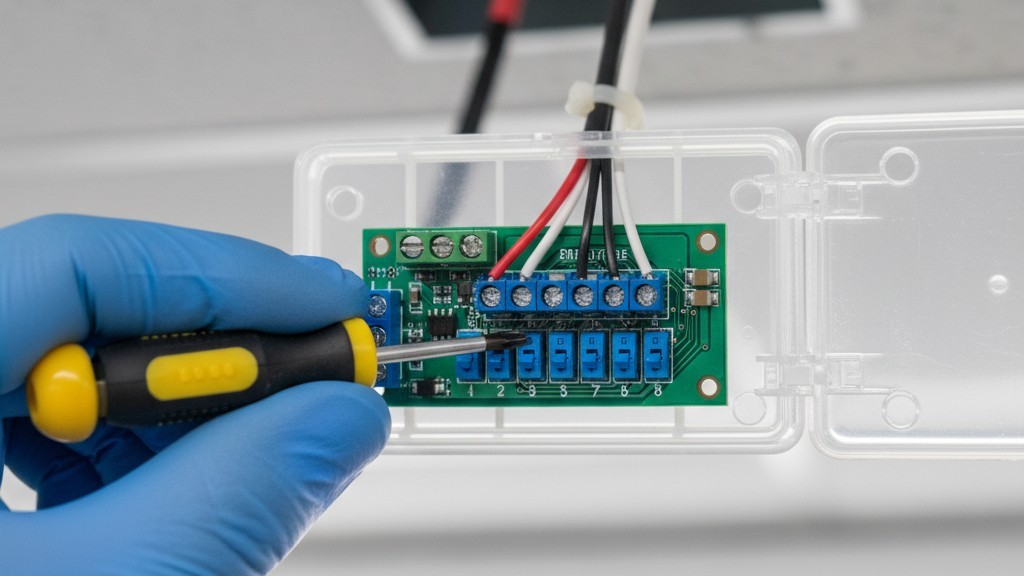
When specifying the upgrade, provide clear instructions to the installer or you will get the default settings. Most commercial sensors default to “Vacancy” (Manual-On) to meet energy code compliance out of the box.
You must specify:
- Mode: Occupancy (Auto-On / Auto-Off).
- Technology: Dual Tech (PIR + Ultrasonic) for any room over 200 sq ft or with visual obstructions.
- 延時設定: Set to 15 or 20 minutes. The standard 5-minute test mode is too short for someone repairing a flat tire.
- Wiring: Ensure the building has a neutral wire at the switch location. Many older buildings do not, which limits your hardware choices to “leakage-to-ground” sensors or requires pulling new wire.
Check the dip switches yourself. Before the installer closes up the sensor, ask to see the settings. It is much cheaper to flip a tiny switch now than to pay for a service call when the lights keep turning off on residents.
Final Checklist
If you are reviewing a proposal for bike room lighting, look for these red flags. If you see them, send the quote back.
從 Rayzeek 動態感測器產品組合中獲得靈感。
找不到您想要的產品?別擔心。總有其他方法可以解決您的問題。也許我們的其中一個產品組合可以幫到您。
- Any mention of an “App” or “Wi-Fi”: Immediate rejection.
- “Vacancy” sensors: Change to “Occupancy” or “Auto-On.”
- Standard PIR sensors in a racked room: Demand Dual Technology.
- Battery-powered sensors: Maintenance nightmare. Hard-wired only.
The goal is a room where the user never thinks about the lighting. It is simply on when they need it, and off when they don’t. Anything less is a liability.







