
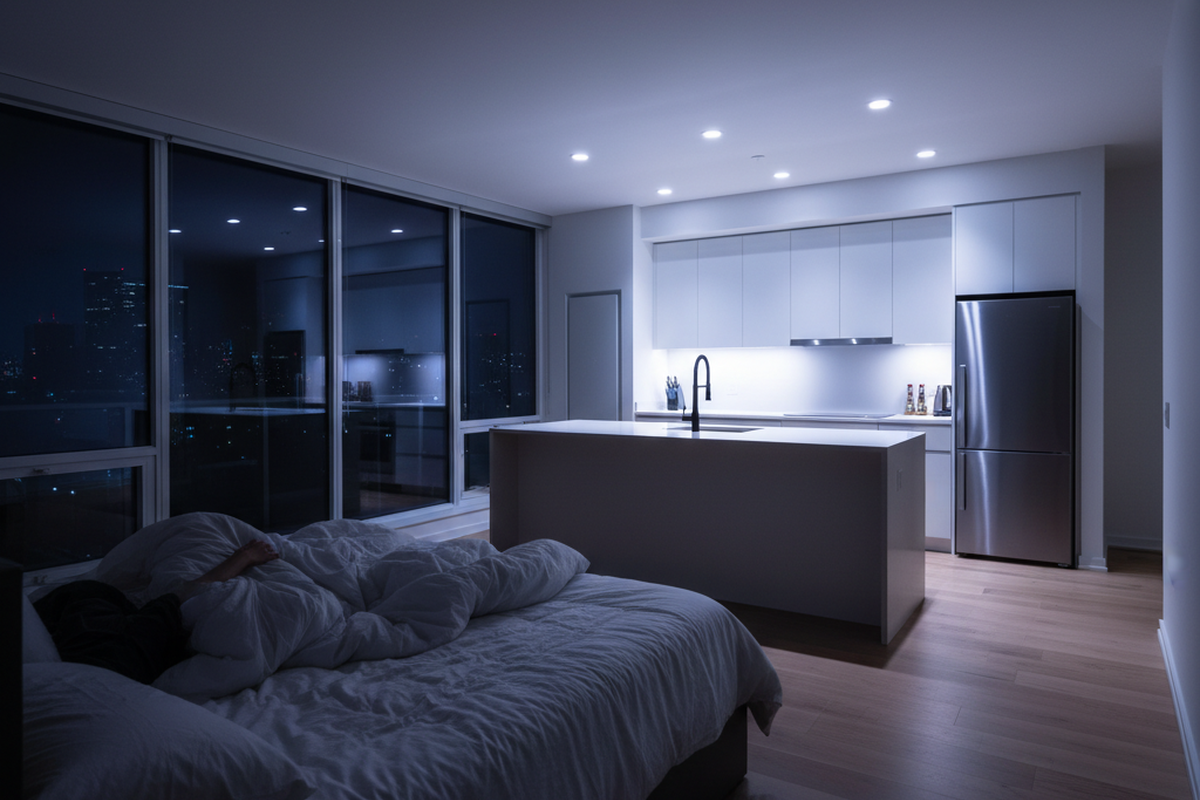
It starts with a cat, or perhaps a shift in sleep position. It’s 3:14 AM. The studio apartment, previously a sanctuary of shadow and sleep, is instantly hit with 4,000 lumens of 4000K neutral-white light. The overhead wafers, installed by a developer who prioritized “modern efficiency” over biology, have been triggered by a motion sensor mounted near the kitchenette. Because there are no walls to stop the light, the “kitchen” is now the “bedroom,” and the “bedroom” is an operating theater. The resident squints, cortisol spikes, and the night is effectively over.
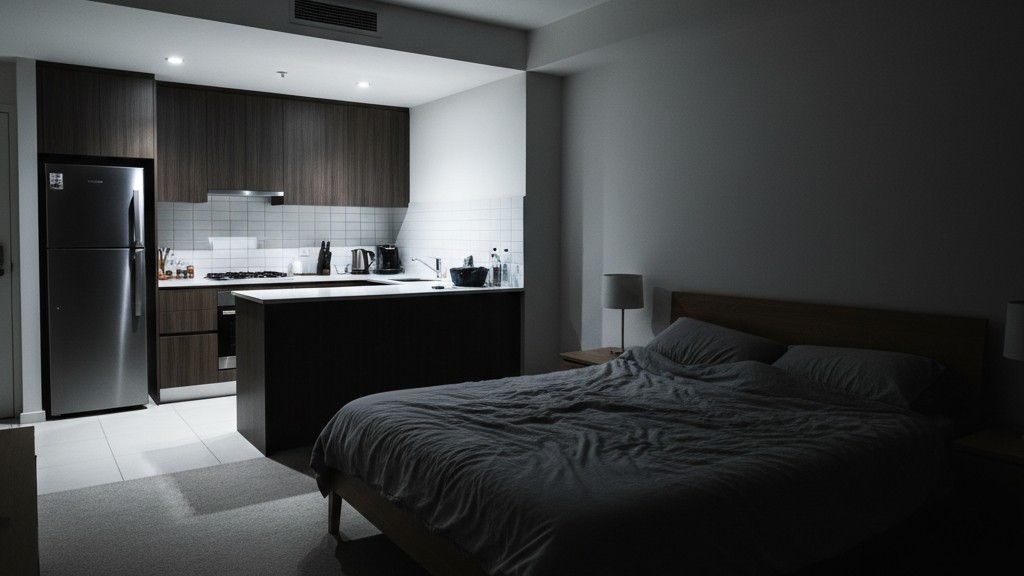
This phenomenon, the “Stadium Effect,” is the primary failure mode of smart lighting in small, open-plan spaces. In a traditional home, walls contain the mistakes of a lighting system. If the bathroom light triggers accidentally, the door blocks the glare. In a studio or loft, light travels until it hits a surface. Without drywall, darkness must become the divider. Creating that divider requires abandoning the default settings of consumer electronics and applying a stricter, almost hostile logic to how sensors view the room.
The Physics of False Positives
To stop the accidental blinding, you have to understand how the sensor actually sees. Most residential motion detectors use Passive Infrared (PIR) technology. They aren’t cameras. They’re heat-seekers looking for differential changes. A PIR sensor looks out at the room through a faceted Fresnel lens—those little plastic domes that look like insect eyes. This lens slices the room into radial sectors. When a heat source (a human, a large dog, or a blast of forced air) moves from one sector to another, the sensor registers a voltage change and closes the relay. Lights on.
The problem in a studio is that these sensors are designed with a “more is better” philosophy. Manufacturers like Leviton or Lutron compete on sensitivity and coverage area, boasting 180-degree fields of view and 900 square feet of coverage. In a 500-square-foot studio, this means a sensor on the entry wall can often “see” heat signatures in the bed, or even reflections off glass partitions.
Glass is particularly treacherous in modern renovations. A PIR sensor cannot see heat through glass, but it can be triggered by rapid temperature changes on the glass surface or, more commonly, by the sensor having a line of sight around the divider. Furthermore, “pet immunity” claims on consumer-grade sensors are often overstated. A 15-pound cat jumping from a counter to the floor generates a heat vector significant enough to trigger a standard sensitivity setting. If the sensor controls the main overhead array, the cat’s midnight snack becomes the resident’s wake-up call.
從 Rayzeek 動態感測器產品組合中獲得靈感。
找不到您想要的產品?別擔心。總有其他方法可以解決您的問題。也許我們的其中一個產品組合可以幫到您。
The Logic Fix: Vacancy Over Occupancy
We often blame the hardware, but the configuration is usually the culprit. In automated lighting, there are two distinct logic modes: Occupancy 負責任的 Vacancy. The terms sound identical to the layperson, but the distinction saves leases and marriages.
佔空模式 is “Auto-On / Auto-Off.” You walk in, lights turn on. You leave, lights turn off. This is excellent for public restrooms and commercial corridors. It is disastrous for a studio apartment sleeping zone. If you toss and turn, the room thinks you have entered.
空置模式 is “Manual-On / Auto-Off.” To turn the lights on, you must physically tap the switch. But if you leave the apartment (or fall asleep) and no motion is detected for a set period, the lights turn off automatically. This simple inversion of logic solves the vast majority of “Stadium Effect” incidents. It ensures light never occurs without explicit human intent, while retaining the safety net of auto-shutoff when forgotten.
For renters dealing with older wiring or strict landlords, this logic doesn’t always require a screwdriver. While a hardwired Lutron Maestro sensor switch is the gold standard for this, plug-in smart home ecosystems often allow this logic to be programmed via app. A motion sensor placed under a kitchen cabinet can be linked to a smart bulb, but configured in the app to only turn the light off after 10 minutes of stillness, never on. The “On” command remains the domain of a physical button.
The Physics Fix: Blinders and Tape
Sometimes, software logic isn’t enough. If the sensor controls a pass-through area—like the hallway connecting the bathroom and the living space—you might still want Auto-On functionality, but strictly limited to where it triggers. The sensor’s vision must be physically amputated.
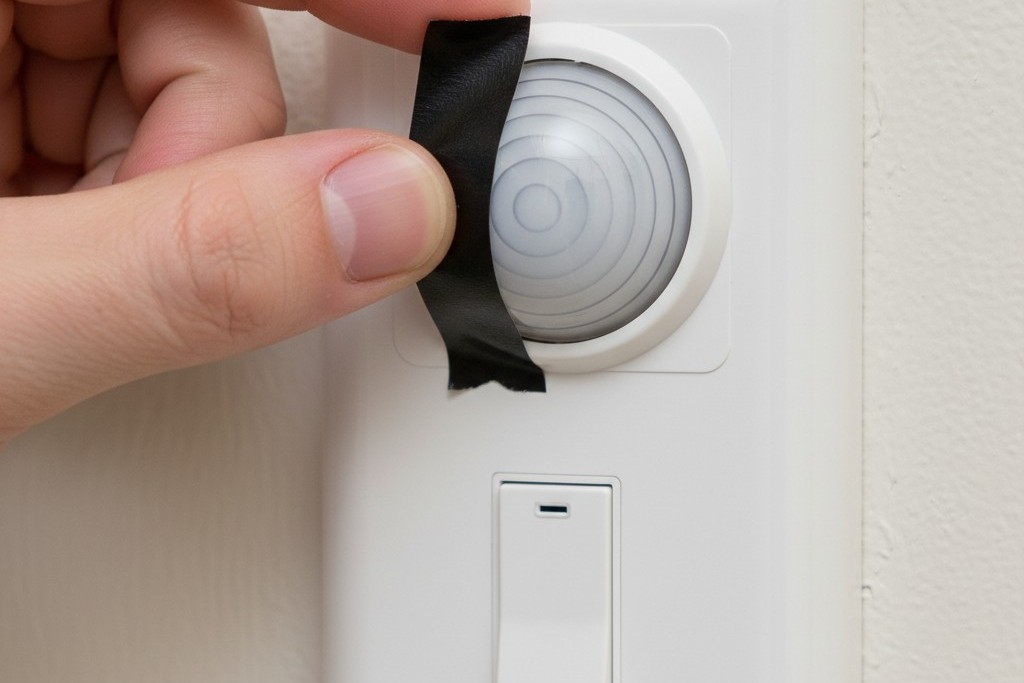
High-end commercial sensors come with internal plastic shutters to block specific segments of the lens. Residential units rarely do. The solution is black gaffer tape (or electrical tape in a pinch). By taping over the left or right third of the PIR lens, you artificially narrow the Field of View (FOV).
Imagine the sensor’s view as a cone. If that cone spills over onto the corner of the bed, the lights will trigger when you roll over. By applying a vertical strip of tape to the side of the lens facing the bed, you slice that part of the cone off. The sensor now has “tunnel vision.” It will only fire when you physically step into the specific zone of the kitchen or hallway, not when you are merely near it. It is a crude, analog hack that outperforms sophisticated software sensitivity sliders every time.
您可能也會感興趣

- 電壓:2 粒 AAA 電池
- 日/夜模式
- 延遲時間:15 分鐘、30 分鐘、1 小時(預設)、2 小時

- 吸頂式 PIR 人體感應器,配備乾觸點繼電器輸出
- 12/24VDC 或 12/24VAC 低電壓供電
- 用於 EMS、HVAC 和建築控制輸入的 COM、NO 和 NC 隔離繼電器觸點

- 低壓直流嵌入式天花安裝微波人體感應開關
- 12 VDC / 24 VDC 輸入,支援 10-30 VDC 範圍
- 最大工作電流 10A,配備可調節延時、光感閾值及靈敏度
- 高負載嵌入式天花安裝微波人體感應開關
- 100-265 VAC 市電輸入,10A 型號
- 5.8 GHz 微波感應,配備可調節延時、光感閾值及靈敏度
- 嵌入式天花安裝微波人體感應開關
- 100-265 VAC 市電輸入,5A 型號
- 5.8 GHz 微波感應,配備可調節延時、光感閾值及靈敏度
- 適用於 220V 電源的天花安裝 RZ037 PIR 被動式紅外線佔空感應調光開關
- 最大工作電流 3A,額定負載 660W
- LUX 按鈕控制光線感應器開關及用戶設定之調光亮度
- 適用於 110V 電源的天花安裝 RZ037 PIR 被動式紅外線佔空感應調光開關
- 最大工作電流 3A,額定負載 330W
- LUX 按鈕控制光線感應器開關及用戶設定之調光亮度

- 低壓直流天花安裝微波人體感應開關
- 12 VDC / 24 VDC 輸入,支援 10-30 VDC 範圍
- 最大工作電流 10A,配備可調節延時、光感閾值及靈敏度
- 高負載吸頂式微波動態感應器開關
- 100-265 VAC 市電輸入,10A 型號
- 5.8 GHz 微波感應,配備可調節延時、光感閾值及靈敏度
- 吸頂式微波動態感應器開關
- 100-265 VAC 市電輸入,5A 型號
- 5.8 GHz 微波感應,配備可調節延時、光感閾值及靈敏度

- 低壓直流嵌頂式 PIR 動態感應器開關
- 12 VDC / 24 VDC 輸入,支援 10-30 VDC 範圍
- 最大工作電流 10A,具備可調式時間延遲、光照度閾值及靈敏度

- 高負載嵌頂式 PIR 動態感應器開關
- 100-265 VAC 市電輸入,10A 型號
- 360度偵測,具備可調式時間延遲、光照度閾值及靈敏度
- 嵌頂式 PIR 動態感應器開關
- 100-265 VAC 市電輸入,5A 型號
- 360度偵測,具備可調式時間延遲、光照度閾值及靈敏度

- 用於室內開關照明控制的無線開關及接收器套裝
- 100-230VAC,50/60Hz 接收器,額定電流 5A
- CR2032 電池供電無線開關,採用 2.4GHz 通訊
- 佔用感應(自動開啟/自動關閉)
- 12–24V DC (10–30VDC),最高 10A
- 360° 覆蓋,直徑 8–12 米
- 延遲時間 15 秒至 30 分鐘
- 光感應器 關閉/15/25/35 Lux
- 高/低靈敏度
- 自動開啟/自動關閉佔用模式
- 100–265V AC,10A(需接零線)
- 360° 全方位覆蓋;8–12 米偵測直徑
- 延遲時間 15 秒至 30 分鐘;Lux 關閉/15/25/35;靈敏度 高/低
- 自動開啟/自動關閉佔用模式
- 100–265V AC,5A(需接零線)
- 360° 全方位覆蓋;8–12 米偵測直徑
- 延遲時間 15 秒至 30 分鐘;Lux 關閉/15/25/35;靈敏度 高/低
Hardware That Respects Boundaries
When the “Landlord Special” dome light must be bypassed entirely, the choice of hardware becomes a defensive strategy. The goal is to separate the control point from the load point.
正在尋找動態感應節能解決方案?
歡迎聯絡我們以獲取完整的 PIR 動態感應器、動態感應節能產品、動態感應器開關以及人體感應/無人感應商業解決方案。
Smart bulbs (like Philips Hue or LIFX) are often marketed as the solution, but they fail the “Guest Test” miserably if used alone. If a guest flips the wall switch, the bulb loses power and becomes a brick. The sophisticated approach for a studio is to use a “No-Neutral” smart dimmer at the wall (such as the Lutron Caséta line) or a switch-lock cover (like the Lutron Aurora) that keeps the circuit live while giving you a physical knob.
This allows you to decouple the switch from the ceiling light. You can program the wall switch to control a floor lamp instead of the overhead glare bomb. This is vital for the “Disco Effect” fear many design-conscious residents have. Smart lighting does not have to mean RGB party modes. The highest utility of smart lighting in a studio is Warm Dim technology—lights that get warmer (more orange/amber, 2200K) as they dim, mimicking the sunset curve.
Note: While the industry is moving toward the Matter standard for interoperability, the reality on the ground is still a messy beta. Sticking to established bridges (Hue, Lutron) is currently the only way to guarantee the lights actually work when the Wi-Fi acts up.
Light as a Divider
Ultimately, solving the Stadium Effect does more than prevent accidental triggers—it creates zones of darkness. In a single room, a pool of light over the kitchen island and a pool of light by the reading chair, separated by a band of shadow, creates the psychological illusion of two rooms.
By forcing sensors into Vacancy Mode, blinding their peripheral vision with tape, and lowering the source of light to below eye level (floor lamps, table lamps) after 9 PM, the studio apartment stops feeling like a surveillance box. The technology recedes, walls of shadow appear, and the resident can finally sleep.







