
The marketing promise on the box is seductive. “No Neutral Required,” it says, suggesting a five-minute swap where you trade an old toggle switch for a modern motion sensor. You turn off the breaker, cap the wires, screw it in, and restore power. Then the trouble starts.
In the best-case scenario, the lights turn on but refuse to turn off completely, leaving a ghostly, dim glow in the fixture at 2 AM. In the worst case—often called the “Hallway Disco”—the sensor clicks frantically, strobing the lights like a rave until you kill the breaker. This isn’t a defective unit, nor is it a poltergeist in the wiring. It’s a fundamental conflict between 1970s wiring logic and the physics of modern LED drivers. The switch is starving for power, and it’s trying to eat through your light bulbs to survive.
The Leakage Current Reality
To understand why a Rayzeek RZ021 or similar sensor fails in an older home, you have to stop viewing the switch as a mechanical gate. Think of it as a computer. A standard toggle switch physically breaks the circuit; when it’s off, the wire is dead. A motion sensor, however, has a brain—an infrared detector and a logic chip—that needs to stay awake 24/7 to watch for movement.
In a modern home (largely post-2011 NEC code), the box contains a white neutral wire. This provides a clean return path for the sensor’s operating current to cycle back to the panel without touching the lights. But in older switch loops, that white wire is missing or used as a traveler. The sensor still needs to complete its circuit to breathe, so it has only one option: send its operating current—the “leakage current”—out through the load wire, through the bulb’s filament, and back to the panel.
This worked beautifully in the era of incandescent bulbs. A 60-watt tungsten filament is a sturdy, dumb resistor. It lets that tiny trickle of current pass through without heating up enough to glow. The sensor gets its power, the bulb stays dark, and everyone is happy.
The problem arises when you replace that sturdy filament with a sensitive LED driver. LED bulbs aren’t simple resistors; they are complex electronic devices with capacitors that store energy. When the motion sensor sends its “leakage” current down the line, the LED’s capacitor catches it. It charges up, slowly and silently, until it hits its activation threshold. Pop—the light flashes on for a split second, dumping the energy. The capacitor drains, the light dies, and the cycle begins again. This is the heartbeat of the strobe effect. If you hear a buzzing sound coming from the fixture itself, that’s the audible frequency of the driver fighting this current—a clear signal that the components are mismatched.
The Minimum Load Math
You won’t find the solution in the switch settings. It’s a math problem. Every no-neutral sensor has a “Minimum Load Requirement,” often buried deep in the PDF datasheet. For many Rayzeek models, this floor is around 15 watts.
您可能也會感興趣

- 電壓:2 粒 AAA 電池
- 日/夜模式
- 延遲時間:15 分鐘、30 分鐘、1 小時(預設)、2 小時

- 吸頂式 PIR 人體感應器,配備乾觸點繼電器輸出
- 12/24VDC 或 12/24VAC 低電壓供電
- 用於 EMS、HVAC 和建築控制輸入的 COM、NO 和 NC 隔離繼電器觸點

- 低壓直流嵌入式天花安裝微波人體感應開關
- 12 VDC / 24 VDC 輸入,支援 10-30 VDC 範圍
- 最大工作電流 10A,配備可調節延時、光感閾值及靈敏度
- 高負載嵌入式天花安裝微波人體感應開關
- 100-265 VAC 市電輸入,10A 型號
- 5.8 GHz 微波感應,配備可調節延時、光感閾值及靈敏度
- 嵌入式天花安裝微波人體感應開關
- 100-265 VAC 市電輸入,5A 型號
- 5.8 GHz 微波感應,配備可調節延時、光感閾值及靈敏度
- 適用於 220V 電源的天花安裝 RZ037 PIR 被動式紅外線佔空感應調光開關
- 最大工作電流 3A,額定負載 660W
- LUX 按鈕控制光線感應器開關及用戶設定之調光亮度
- 適用於 110V 電源的天花安裝 RZ037 PIR 被動式紅外線佔空感應調光開關
- 最大工作電流 3A,額定負載 330W
- LUX 按鈕控制光線感應器開關及用戶設定之調光亮度

- 低壓直流天花安裝微波人體感應開關
- 12 VDC / 24 VDC 輸入,支援 10-30 VDC 範圍
- 最大工作電流 10A,配備可調節延時、光感閾值及靈敏度
- 高負載吸頂式微波動態感應器開關
- 100-265 VAC 市電輸入,10A 型號
- 5.8 GHz 微波感應,配備可調節延時、光感閾值及靈敏度
- 吸頂式微波動態感應器開關
- 100-265 VAC 市電輸入,5A 型號
- 5.8 GHz 微波感應,配備可調節延時、光感閾值及靈敏度

- 低壓直流嵌頂式 PIR 動態感應器開關
- 12 VDC / 24 VDC 輸入,支援 10-30 VDC 範圍
- 最大工作電流 10A,具備可調式時間延遲、光照度閾值及靈敏度

- 高負載嵌頂式 PIR 動態感應器開關
- 100-265 VAC 市電輸入,10A 型號
- 360度偵測,具備可調式時間延遲、光照度閾值及靈敏度
- 嵌頂式 PIR 動態感應器開關
- 100-265 VAC 市電輸入,5A 型號
- 360度偵測,具備可調式時間延遲、光照度閾值及靈敏度

- 用於室內開關照明控制的無線開關及接收器套裝
- 100-230VAC,50/60Hz 接收器,額定電流 5A
- CR2032 電池供電無線開關,採用 2.4GHz 通訊
- 佔用感應(自動開啟/自動關閉)
- 12–24V DC (10–30VDC),最高 10A
- 360° 覆蓋,直徑 8–12 米
- 延遲時間 15 秒至 30 分鐘
- 光感應器 關閉/15/25/35 Lux
- 高/低靈敏度
- 自動開啟/自動關閉佔用模式
- 100–265V AC,10A(需接零線)
- 360° 全方位覆蓋;8–12 米偵測直徑
- 延遲時間 15 秒至 30 分鐘;Lux 關閉/15/25/35;靈敏度 高/低
- 自動開啟/自動關閉佔用模式
- 100–265V AC,5A(需接零線)
- 360° 全方位覆蓋;8–12 米偵測直徑
- 延遲時間 15 秒至 30 分鐘;Lux 關閉/15/25/35;靈敏度 高/低
In the age of efficiency, hitting 15 watts is harder than it sounds. A single generic LED bulb might draw 4 watts. A fancy vintage-style Edison LED might draw only 2.5. If a hallway fixture has two of these bulbs, the total load is 5 to 8 watts—well below the threshold required to stabilize the current. The sensor tries to pull power, the load is too light to anchor it, and the internal relay starts clicking. It sounds like a turn signal in a car that won’t start.
This is where the “Bulb Lottery” comes into play. Not all LEDs are created equal. Brands like Philips and Cree often build better damping into their dimmable drivers, allowing them to tolerate the leakage current without ghosting. Conversely, budget brands found in the checkout aisle of a hardware store—Feit Electric or the unbranded bulk packs—often lack this regulation. They are efficient, but fragile. A sensor that works perfectly with a 10-watt Cree bulb might strobe uncontrollably with a 10-watt generic bulb simply because the driver architecture is different. And since manufacturers change internal components without changing the model number, a bulb that worked last year might not work this year.
正在尋找動態感應節能解決方案?
歡迎聯絡我們以獲取完整的 PIR 動態感應器、動態感應節能產品、動態感應器開關以及人體感應/無人感應商業解決方案。
The Bypass Fix
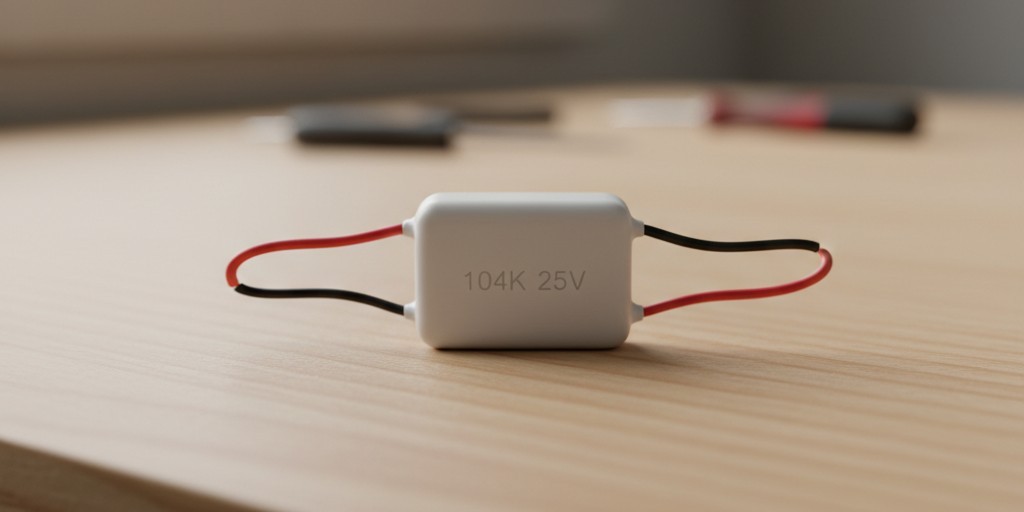
When the math doesn’t work and the bulbs are flickering, there is a brute-force solution that preserves the sensor without rewiring the house: the bypass capacitor.
Often sold as a “dynamic load adapter” or under part numbers like the Lutron LUT-MLC, this small component is the secret weapon for no-neutral installs. It’s not a battery; it’s a dummy load. You install it not at the switch, but up at the light fixture itself, wiring it in parallel between the hot and neutral wires inside the canopy.
The bypass acts as a pressure valve. It provides a dedicated path for that leakage current to go around the sensitive LED bulbs. The sensor gets its power through the capacitor, the LEDs stay dark until actually turned on, and the flickering stops. It feels like a hack—adding a “useless” part to a circuit—but in a no-neutral environment, it is often the difference between a working smart home and a fire hazard.
Wiring the Ground
There is a final, uncomfortable reality regarding the Rayzeek RZ021 and similar units: the role of the green wire. In a strictly code-compliant world, current should never flow on the grounding conductor. The ground is for safety, not for returning power to the panel.
從 Rayzeek 動態感測器產品組合中獲得靈感。
找不到您想要的產品?別擔心。總有其他方法可以解決您的問題。也許我們的其中一個產品組合可以幫到您。
However, many no-neutral sensors are engineered to cheat this rule slightly. They use the ground wire as a reference point to stabilize their internal electronics. If you open a 1950s metal switch box and see only two black wires and the bare metal of the box, you might be tempted to leave the green wire on the sensor disconnected. Don’t do it. Without that ground reference, the sensor’s brain often floats electrically, leading to erratic detection or a failure to energize.
If your home uses armored cable (BX) or metal conduit, the box itself is the ground. You must bond the sensor’s green wire to the box. If you have older Romex with a bare copper wire, that must be connected. It is a compromise—using the safety drain for a tiny amount of operational stability—but it is how these specific units are designed to function. If you are uncomfortable with current on the ground, the only code-perfect solution is to pull a new neutral wire, a job that involves tearing open drywall and spending thousands.
Knowing When to Fold
Sometimes, the physics wins. If you are trying to control a single 3-watt LED tape light in a pantry, or a specialized low-voltage fixture, no amount of bypass capacitors or expensive bulbs will stabilize a high-voltage no-neutral sensor. The load is simply too small.
In these cases, the correct move is to stop fighting the wiring. Cap the wires, put a standard toggle switch back in (or wire it always-on), and buy a battery-powered motion sensor like a Philips Hue or a generic Zigbee device paired with a smart bulb. It lacks the permanence of a hardwired switch, and you will have to change batteries every two years, but it separates the control logic from the power delivery. In a house fighting against 50-year-old wiring constraints, that separation is sometimes the only way to keep the lights off at 3 AM.







