

Walk through any subdivision in December, and you’ll see two schools of thought regarding inflatable holiday decor. First, there’s the “24/7” approach, where a 12-foot Santa hums aggressively through the night, keeping the neighbors awake with the drone of a cheap brushless fan while burning through its limited bearing life. Second—and far more depressing—is the “Timer” approach. This results in the daytime spectacle of rain-soaked nylon carcasses strewn across the lawn like crime scene evidence, waiting for a 5:00 PM resurrection that may or may not happen depending on how much water they’ve swallowed.

Neither is acceptable for a competent homeowner.
The obvious middle ground—triggering the display only when someone actually walks by—seems like the elegant solution. It saves electricity, spares the motor bearings, and reduces noise pollution. But if you’ve ever tried to rig a standard motion sensor to a large inflatable, you know the result: a visitor triggers the sensor, walks past a deflated pile of fabric, and is halfway to the front door before the decoration manages to lift its head off the mulch. The concept is fine. The physics are the problem. To make an inflatable respond to a human presence without looking like a struggling green slug, you have to engineer around the lag.
The Lag Calculation
Your sensor isn’t the issue. Air displacement is. A standard consumer-grade inflatable—let’s take a common 8-foot Gemmy model—is powered by a 12V DC fan or a small 120V induction motor. These fans are designed to maintain internal pressure, not to generate the high static pressure needed for rapid inflation. They are essentially low-torque air movers.
When the power cuts, the nylon collapses. If it’s raining, the fabric absorbs water, increasing the specific weight of the material. When the power returns, the fan has to overcome not just atmospheric pressure, but the dead weight of wet, folded nylon. This takes time. In ideal conditions, a dry inflatable might stand up in 30 seconds. In a Pacific Northwest drizzle, that can stretch to 90 seconds or more.
Compare this to the walking speed of a human. An average adult moves at about 3 to 4 feet per second. If your walkway is 30 feet long, a visitor covers the entire distance in under 10 seconds. Do the math. If your motion sensor is located at the inflatable itself, the visitor will be ringing your doorbell while Santa is still trying to inflate his left boot. The “surprise” element is gone; you’re just left with the noise of a fan starting up behind them, which sounds less like holiday cheer and more like a vacuum cleaner malfunction.
從 Rayzeek 動態感測器產品組合中獲得靈感。
找不到您想要的產品?別擔心。總有其他方法可以解決您的問題。也許我們的其中一個產品組合可以幫到您。
One critical warning on motor control: don’t attempt to solve the noise problem by putting the fan on a dimmer or a “smart” speed controller. These are usually induction motors or simple DC brushless fans that rely on specific voltage curves. Starving them of voltage doesn’t make them whisper-quiet; it increases the in-rush current as the motor struggles to maintain torque, leading to overheating and eventually a melted thermal fuse. If the fan is too loud, buy a better fan or build a baffle box. Do not throttle the voltage.
Perimeter Defense and Geometry
To solve the lag, you must divorce the trigger from the event. Stop thinking “motion-activated light.” Start thinking “perimeter defense system.” The sensor cannot be on the decoration. It must be placed at the entry point of the property, or at least 40 to 50 feet up-path from the target area.
正在尋找動態感應節能解決方案?
歡迎聯絡我們以獲取完整的 PIR 動態感應器、動態感應節能產品、動態感應器開關以及人體感應/無人感應商業解決方案。
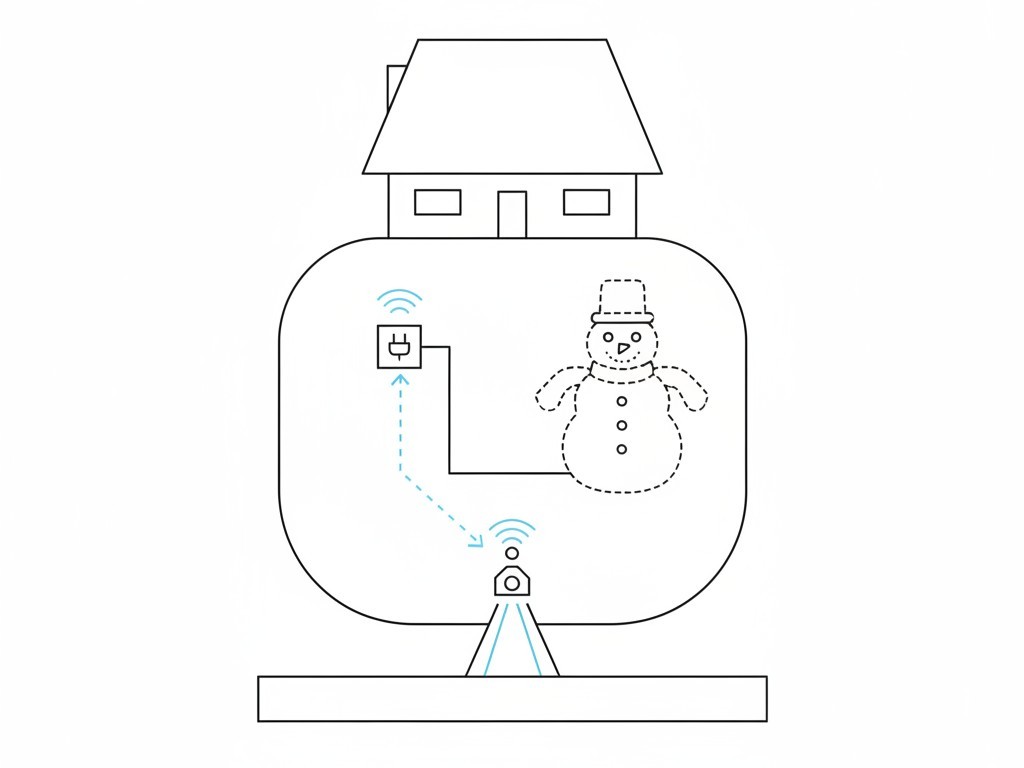
This requires a “tripwire” mindset. You need a sensor at the sidewalk or the driveway entrance that sends a signal to the switch controlling the inflatable. This buys you the necessary lead time. If you detect a target 50 feet away, you gain roughly 15 seconds of inflation time before they reach the display. It still won’t be fully upright, but it will be in the “rising” phase, which is theatrically far more interesting than the “dead” phase.
For this to work, you can’t rely on the passive infrared (PIR) sensors built into cheap solar lights. Those have a detection cone that is too wide and a range that is too short—often barely 15 feet. You need a directional sensor, something closer to a driveway alarm system. You can modify off-the-shelf driveway alerts (like the Harbor Freight Bunker Hill units) to trigger a relay, or use high-quality outdoor-rated Zigbee motion sensors. Just be aware that PIR sensitivity drops as the ambient temperature gets closer to human body temperature, though in December, the cold usually works in your favor, making the heat signature of a mail carrier pop against the background.
The Latency of the Cloud
Even with perfect sensor placement, you can lose the race if your communication protocol is sluggish. If your sensor talks to a hub, which talks to a cloud server in Virginia, which talks back to your hub, which talks to a Wi-Fi smart plug, you have introduced 500ms to 2 seconds of latency. That might sound negligible, but combined with the slow spin-up of a cheap impeller, every second counts.
Avoid Wi-Fi smart plugs for this specific application. They are chatty and dependent on internet health. The superior approach is a local protocol like Zigbee or Z-Wave, or even a direct 433MHz RF bridge if you’re comfortable with a soldering iron. Local processing means the signal goes from Sensor -> Hub -> Switch entirely within your own network, usually in under 200 milliseconds. This tightness is what allows the effect to feel responsive rather than accidental.
The Moisture and Mold Factor

There is a final, non-electrical risk to managing inflatables this way: biological growth. When you leave a nylon decoration inflated 24/7, the constant airflow keeps the interior relatively dry. When you cycle it on and off, specifically in wet climates, you create a cycle of wetting and collapsing. The folds of the deflated fabric trap pools of water.
您可能也會感興趣

- 電壓:2 粒 AAA 電池
- 日/夜模式
- 延遲時間:15 分鐘、30 分鐘、1 小時(預設)、2 小時

- 吸頂式 PIR 人體感應器,配備乾觸點繼電器輸出
- 12/24VDC 或 12/24VAC 低電壓供電
- 用於 EMS、HVAC 和建築控制輸入的 COM、NO 和 NC 隔離繼電器觸點

- 低壓直流嵌入式天花安裝微波人體感應開關
- 12 VDC / 24 VDC 輸入,支援 10-30 VDC 範圍
- 最大工作電流 10A,配備可調節延時、光感閾值及靈敏度
- 高負載嵌入式天花安裝微波人體感應開關
- 100-265 VAC 市電輸入,10A 型號
- 5.8 GHz 微波感應,配備可調節延時、光感閾值及靈敏度
- 嵌入式天花安裝微波人體感應開關
- 100-265 VAC 市電輸入,5A 型號
- 5.8 GHz 微波感應,配備可調節延時、光感閾值及靈敏度
- 適用於 220V 電源的天花安裝 RZ037 PIR 被動式紅外線佔空感應調光開關
- 最大工作電流 3A,額定負載 660W
- LUX 按鈕控制光線感應器開關及用戶設定之調光亮度
- 適用於 110V 電源的天花安裝 RZ037 PIR 被動式紅外線佔空感應調光開關
- 最大工作電流 3A,額定負載 330W
- LUX 按鈕控制光線感應器開關及用戶設定之調光亮度

- 低壓直流天花安裝微波人體感應開關
- 12 VDC / 24 VDC 輸入,支援 10-30 VDC 範圍
- 最大工作電流 10A,配備可調節延時、光感閾值及靈敏度
- 高負載吸頂式微波動態感應器開關
- 100-265 VAC 市電輸入,10A 型號
- 5.8 GHz 微波感應,配備可調節延時、光感閾值及靈敏度
- 吸頂式微波動態感應器開關
- 100-265 VAC 市電輸入,5A 型號
- 5.8 GHz 微波感應,配備可調節延時、光感閾值及靈敏度

- 低壓直流嵌頂式 PIR 動態感應器開關
- 12 VDC / 24 VDC 輸入,支援 10-30 VDC 範圍
- 最大工作電流 10A,具備可調式時間延遲、光照度閾值及靈敏度

- 高負載嵌頂式 PIR 動態感應器開關
- 100-265 VAC 市電輸入,10A 型號
- 360度偵測,具備可調式時間延遲、光照度閾值及靈敏度
- 嵌頂式 PIR 動態感應器開關
- 100-265 VAC 市電輸入,5A 型號
- 360度偵測,具備可調式時間延遲、光照度閾值及靈敏度

- 用於室內開關照明控制的無線開關及接收器套裝
- 100-230VAC,50/60Hz 接收器,額定電流 5A
- CR2032 電池供電無線開關,採用 2.4GHz 通訊
- 佔用感應(自動開啟/自動關閉)
- 12–24V DC (10–30VDC),最高 10A
- 360° 覆蓋,直徑 8–12 米
- 延遲時間 15 秒至 30 分鐘
- 光感應器 關閉/15/25/35 Lux
- 高/低靈敏度
- 自動開啟/自動關閉佔用模式
- 100–265V AC,10A(需接零線)
- 360° 全方位覆蓋;8–12 米偵測直徑
- 延遲時間 15 秒至 30 分鐘;Lux 關閉/15/25/35;靈敏度 高/低
- 自動開啟/自動關閉佔用模式
- 100–265V AC,5A(需接零線)
- 360° 全方位覆蓋;8–12 米偵測直徑
- 延遲時間 15 秒至 30 分鐘;Lux 關閉/15/25/35;靈敏度 高/低
If the inflatable sits deflated for 18 hours a day in the rain, mold will develop inside the white sections of the fabric within weeks. It looks like bruising on the nylon and is impossible to scrub off from the outside. Worse, if the temperature drops below freezing while the unit is deflated, the condensation inside the motor housing can freeze the impeller in place. When your automation triggers the power, the locked rotor current will spike. Since these cheap units rarely have sophisticated over-current protection, you’ll burn out the windings before the ice melts.
If the forecast calls for a hard freeze, turn the automation off. Either leave it inflated (so the heat of the motor prevents freezing) or bring it inside. No amount of automation logic can save a plastic fan from a block of ice.







