

Een ambachtelijk atelier is een plek van geconcentreerde creatie, maar wordt vaak geplaagd door een subtiele, hardnekkige ergernis. Lampen springen aan in een lege ruimte, geactiveerd door een afkoelende oven. Een ventilatieventilator begint luidruchtig te draaien, niet voor een persoon, maar door de warmteflikkering van een brander. Een hulpmiddel voor gemak verandert in een bron van afleiding en verspilde energie. De bewegingssensor, bedoeld als een stille helper, lijkt ineens een eigen wil te hebben.
Dit wijst niet op een defecte sensor. Deze presteert exact volgens ontwerp en detecteert exact de thermische energie waarvoor hij is gebouwd. Het probleem is een wanverhouding tussen de technologie en de unieke, uitdagende omgeving; de sensor kan de infraroodsignatuur van een mens niet onderscheiden van de krachtige thermische ruis van hete apparatuur. Het herstellen van de orde vereist een nieuwe aanpak: een van strategische plaatsing, eenvoudige aanpassingen en slimme instellingen die bewegingsgestuurde systemen loyaal maken aan mensen, niet aan gloeiende ovens.
Het spook in het atelier: Waarom warmte bewegingssensoren misleidt
Het oplossen van valse activeringen begint met het begrijpen van de technologie. De meeste bewegingssensoren zijn passieve infraroodapparaten (PIR). Het zijn geen camera's die op beweging letten, maar eenvoudige warmtedetectoren die zijn ontworpen om te reageren op veranderingen.
Hoe PIR-sensoren de wereld zien
Een PIR-sensor bewaakt de infrarode omgevingsenergie binnen zijn gezichtsveld. Dit beeld is onderverdeeld in meerdere detectiezones door een gepatrooneerde fresnellens—het veelvlakkige kunststof kapje aan de voorkant. Zolang de infraroodenergie in deze zones stabiel blijft, is het systeem in rust. Een activering vindt alleen plaats wanneer een warmtebron, zoals een persoon, van de ene zone naar de andere beweegt. Dit veroorzaakt een snelle differentiaal in gedetecteerde straling, wat de sensor interpreteert als beweging.
Stralingswarmte versus convectiestromen
Een ambachtelijk atelier kent twee hoofdbronnen van thermische interferentie die de warmtesignatuur van een persoon nabootsen. De eerste is stralingswarmte, de intense infraroodenergie die rechtstreeks uit een oven, smidsvuur of gloeiend stuk glas straalt. Als deze bron zich in de zichtlijn van de sensor bevindt, zal de enorme en fluctuerende thermische afgifte gemakkelijk een valse activering veroorzaken.
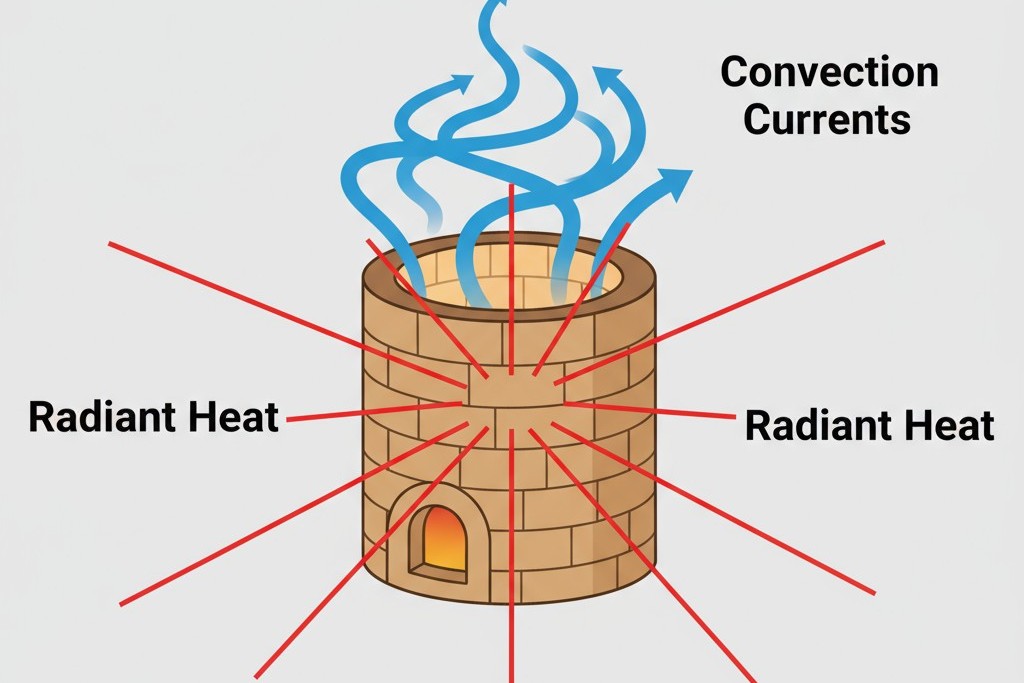
De tweede, subtielere boosdoener is convectie. Hete apparatuur verwarmt de omringende lucht, die in stijgkolommen en stromingen opstijgt. Deze bewegende zakken warme lucht drijven door de detectiezones van de sensor en veroorzaken precies het soort snelle thermische verandering waarvoor het systeem is gebouwd. Dit is de reden waarom een sensor lang nadat een brander is uitgeschakeld nog kan worden geactiveerd, doordat restwarmte door de ruimte circuleert en een verkeerd geplaatste sensor misleidt.
Een strategie van vermijding: De eerste regel van sensorplaatsing
Het krachtigste hulpmiddel om warmtegerelateerde valse activeringen te voorkomen, bevindt zich niet in de instellingen van de sensor, maar in de locatie. Strategische plaatsing is de eerste en belangrijkste regel.
Breng uw thermische zones in kaart
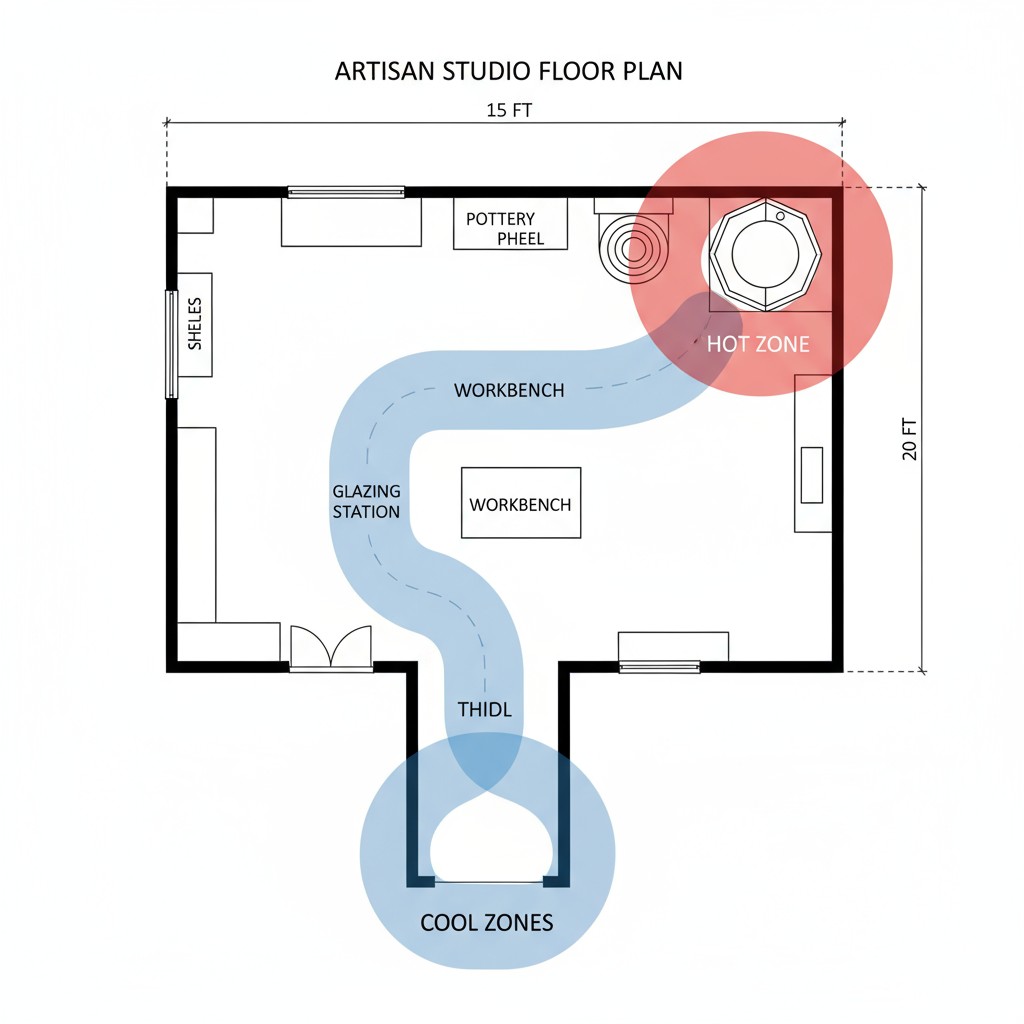
Begin by mentally mapping the studio into “hot” and “cool” zones. Hot zones include any area in the direct line of sight of kilns, forges, and glory holes, as well as the airspace directly above and around them where convection currents are strongest. Cool zones are the remaining areas: pathways, entrances, and workstations away from the heat. The goal is to position the sensor to cover only the cool zones where people actually move.
Laat u inspireren door Rayzeek bewegingssensor-portfolio's.
Vindt u niet wat u zoekt? Geen zorgen. Er zijn altijd alternatieve manieren om uw problemen op te lossen. Misschien kan een van onze portfolio's u helpen.
Mount High and Off-Axis
The most effective technique is to mount the sensor high on a wall or ceiling and aim it downward, carefully angled away from any hot zones. This high, off-axis position uses simple geometry to its advantage. It creates a field of view focused on the floor and walkways, leaving the equipment itself outside the detection pattern. By pointing the sensor away from the heat source, you severely limit its ability to “see” problematic radiation and convection.
Blinding the Sensor: Precision Control Through Lens Masking
In smaller or more complex studios, perfect placement might be impossible. A sensor may need to cover a pathway that runs near a kiln, making some overlap with a hot zone unavoidable. For this, a simple modification provides a surgical fix: lens masking.
Op zoek naar bewegingsgestuurde energiebesparende oplossingen?
Neem contact met ons op voor complete PIR-bewegingssensoren, bewegingsgestuurde energiebesparende producten, bewegingsschakelaars en commerciële oplossingen voor aanwezigheids- en afwezigheidsdetectie.
Identify the Problem Zones
With the sensor in its best possible position, determine which specific segments of its lens are “seeing” the heat source. You can often do this by watching the sensor’s trigger light in relation to your equipment’s heating and cooling cycles. When the kiln kicks on and the sensor trips, the part of the lens aimed in that direction is your target.
Apply the Mask
Once you’ve identified the problem segments, the fix is precise. Using a small piece of opaque material like electrical tape, create a blind spot on the inside of the Fresnel lens cover. This blocks infrared radiation from reaching the detector element behind that segment without interfering with the rest of the lens. You aren’t reducing the sensor’s overall sensitivity; you are surgically removing the problem area from its field of view.
Tuning for Patience: Why Conservative Settings Are Key
With placement and masking addressed, the final step is fine-tuning the sensor’s settings. In a thermally active environment, a patient, conservative sensor is better than a hypersensitive one. The goal is to ignore brief thermal events and respond only to the clear signature of a person.
Set Longer Timeouts
Many motion sensors have an adjustable time delay, which dictates how long the lights stay on after motion stops. A longer timeout of 15 to 30 minutes is ideal here. This conservative setting acts as a buffer, preventing the system from cycling on and off in response to transient convection currents or other momentary thermal spikes. It ensures the lights are on when the space is truly occupied, not just chasing thermal ghosts.
Reduce Sensitivity
Lowering the sensor’s sensitivity is another crucial adjustment. High sensitivity is designed for subtle movements, which in a studio makes it vulnerable to gentle air currents. By reducing sensitivity, you instruct the sensor to require a larger, more distinct thermal change before activating. This makes it far more likely to ignore the drift of warm air while still reliably detecting a person. It is a trade-off that favors reliability over hyper-reactivity.
Mogelijk bent u ook geïnteresseerd in

- Spanning: 2 AAA-batterijen
- Dag/Nacht-modus
- Uitschakelvertraging: 15min, 30min, 1u (standaard), 2u

- Plafondgemonteerde PIR-aanwezigheidssensor met potentiaalvrije relaisuitgang
- 12/24VDC of 12/24VAC laagspanningsvoeding
- COM-, NO- en NC-geïsoleerde relaiscontacten voor EMS-, HVAC- en gebouwbeheersystemen

- Laagspanning DC inbouw-plafondgemonteerde microgolfbewegingssensorschakelaar
- 12 VDC / 24 VDC-ingang met een bereik van 10-30 VDC
- Max. 10A werkstroom met instelbare uitschakelvertraging, luxdrempelwaarde en gevoeligheid
- Inbouw-plafondgemonteerde microgolfbewegingssensorschakelaar voor hogere belasting
- 100-265 VAC netspanningsingang, 10A-model
- 5,8 GHz microgolfdetectie met instelbare uitschakelvertraging, Lux-drempelwaarde en gevoeligheid
- Plafondinbouw microgolf bewegingssensor-schakelaar
- 100-265 VAC netspanningsingang, 5A-model
- 5,8 GHz microgolfdetectie met instelbare uitschakelvertraging, Lux-drempelwaarde en gevoeligheid
- RZ037 PIR-aanwezigheidssensor-dimmer voor plafondmontage op 220V-voeding
- 3A maximale werkstroom met 660W nominaal vermogen
- LUX-knop regelt lichtsensor AAN/UIT en door de gebruiker ingestelde dimhelderheid
- RZ037 PIR-aanwezigheidssensor-dimmer voor plafondmontage op 110V-voeding
- 3A maximale werkstroom met 330W nominaal vermogen
- LUX-knop regelt lichtsensor AAN/UIT en door de gebruiker ingestelde dimhelderheid

- Laagspanning DC microgolf bewegingssensor-schakelaar voor het plafond
- 12 VDC / 24 VDC-ingang met een bereik van 10-30 VDC
- Max. 10A werkstroom met instelbare uitschakelvertraging, luxdrempelwaarde en gevoeligheid
- Microgolf bewegingssensor-schakelaar voor het plafond met hogere belasting
- 100-265 VAC netspanningsingang, 10A-model
- 5,8 GHz microgolfdetectie met instelbare uitschakelvertraging, Lux-drempelwaarde en gevoeligheid
- Plafondmontage microgolf bewegingssensorschakelaar
- 100-265 VAC netspanningsingang, 5A-model
- 5,8 GHz microgolfdetectie met instelbare uitschakelvertraging, Lux-drempelwaarde en gevoeligheid

- Laagspannings-DC inbouw plafond PIR bewegingssensorschakelaar
- 12 VDC / 24 VDC-ingang met een bereik van 10-30 VDC
- Maximale werkstroom 10A met instelbare uitschakelvertraging, Lux-drempelwaarde en gevoeligheid

- Inbouw plafond PIR bewegingssensorschakelaar voor hogere belastingen
- 100-265 VAC netspanningsingang, 10A-model
- 360-graden detectie met instelbare uitschakelvertraging, Lux-drempelwaarde en gevoeligheid
- Inbouw plafond PIR bewegingssensorschakelaar
- 100-265 VAC netspanningsingang, 5A-model
- 360-graden detectie met instelbare uitschakelvertraging, Lux-drempelwaarde en gevoeligheid

- Draadloze schakelaar- en ontvangerset voor AAN/UIT-lichtregeling binnenshuis
- 100-230VAC, 50/60Hz ontvanger met 5A nominale stroom
- CR2032-gevoede draadloze schakelaar met 2.4GHz-communicatie
- Aanwezigheidsdetectie (Auto-AAN/Auto-UIT)
- 12–24V DC (10–30VDC), tot 10A
- 360° dekking, 8–12 m diameter
- Uitschakelvertraging 15 s–30 min
- Lichtsensor Uit/15/25/35 Lux
- Hoge/Lage gevoeligheid
- Automatisch AAN/Automatisch UIT aanwezigheidsmodus
- 100–265V AC, 10A (nuldraad vereist)
- 360° dekking; 8–12 m detectiediameter
- Uitschakelvertraging 15 s–30 min; Lux UIT/15/25/35; Gevoeligheid Hoog/Laag
- Automatisch AAN/Automatisch UIT aanwezigheidsmodus
- 100–265V AC, 5A (nuldraad vereist)
- 360° dekking; 8–12 m detectiediameter
- Uitschakelvertraging 15 s–30 min; Lux UIT/15/25/35; Gevoeligheid Hoog/Laag
When PIR Is Not the Answer: Exploring Alternatives
For the most extreme environments, where high ambient temperatures or multiple heat sources make interference unavoidable, even a well-tuned PIR sensor can fail. In these cases, it’s time to look at other technologies.
Microwave Sensors
Microwave sensors operate on a completely different principle. They actively emit low-power microwaves and detect motion by analyzing the Doppler shift in the waves that bounce back from moving objects. Because this technology detects physical movement rather than heat, it is completely immune to radiant heat, convection currents, and temperature changes, making it an excellent choice for hot workshops.
Dual-Technology Sensors
The most robust solution for challenging spaces is a dual-technology sensor, which combines both PIR and microwave sensors in a single unit. To trigger, both technologies must detect motion simultaneously. This layer of confirmation provides the highest possible resistance to false alarms. A plume of hot air might fool the PIR, but it won’t fool the microwave. A vibrating machine might fool the microwave, but it won’t fool the PIR. Only a person, who is both warm and physically moving, can satisfy both conditions, ensuring the system responds only when it should.







