
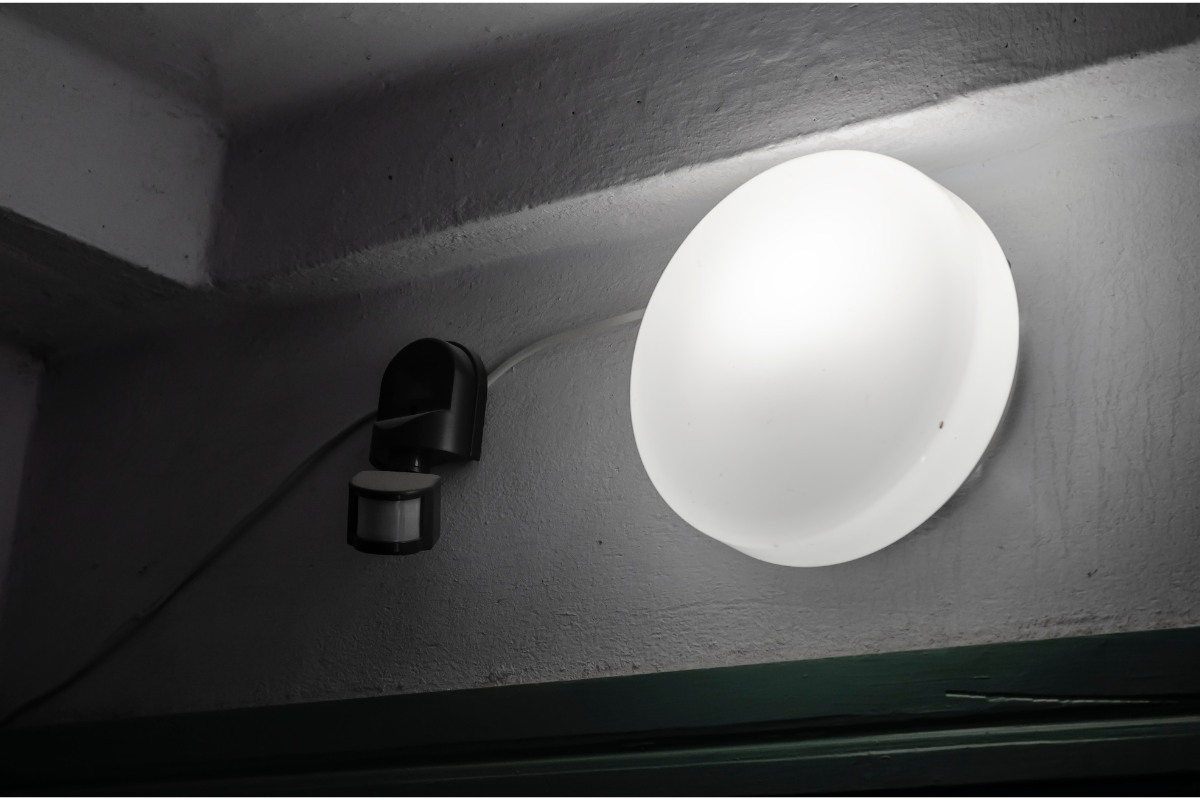
One of the latest crazes in home lighting is the use of motion sensors. But there’s nothing crazy about this craze. It makes perfect sense. Whether used for security or convenience, motion sensors can add a very useful high-tech touch to lights both outdoors and indoors.
Outdoor Applications
Security Benefits
The most obvious application, and one in wide use today, is to turn on outdoor floodlights when anyone approaches within the sensor’s range. Studies confirm common sense that a well-lit home is less vulnerable to a home invader than one that has large dark areas near points of entry.
Adding motion sensors and/or motion sensor lights is an effective way to solve that problem. They trigger the lights on approach, which has two advantages. A light that comes on unexpectedly tends to startle the unwanted visitor. That provides extra motivation to change their plans and move on to an easier target. Homeowners also save money on electricity by not having high-wattage bulbs burn all night long when and where they’re not really needed.
That goal can be accomplished with separate motion sensors that are connected to a whole system, one that includes lights, a horn, or other security components. Or, as is the case in many fixtures, the motion sensor can be integrated into the lamp housing itself. Both are effective, though in some cases separate motion sensors have a greater range and angle of coverage.
Szukasz energooszczędnych rozwiązań aktywowanych ruchem?
Skontaktuj się z nami w sprawie czujników ruchu PIR, energooszczędnych produktów aktywowanych ruchem, przełączników z czujnikiem ruchu oraz komercyjnych rozwiązań typu Occupancy/Vacancy.
Safety and Convenience
But security isn’t the only reason that motion sensors can be a huge benefit. They can supply extra safety and convenience, as well.
You pull up into the driveway or walk outside on a dark night. You can’t see a thing. That toy or bicycle is just waiting there for you to step on. That low garden fence you always forget about is ripe for bumping into. Motion sensors can turn on the lights at your approach and prevent accidents.
They can also make it much easier to turn on the lights when you just need a brief light. You don’t have to be near the switch; you just approach or wave an arm to pop the lights. Now you can find your keys, put away that pesky toy, or just make it into the house without any trouble.
Indoor Applications
Convenience and Efficiency
Many of the same considerations apply to indoor motion sensors, too. But indoor sensors come in an even wider variety of types and styles.
Existing wall switches or outlets can easily be converted to contain motion sensors. That makes it very easy to have a system that turns on the light when you enter, then turns it off when you leave.
Zainspiruj się portfolio czujników ruchu Rayzeek.
Nie znajdujesz tego, czego szukasz? Bez obaw. Zawsze istnieją alternatywne sposoby rozwiązania Twoich problemów. Może jedno z naszych portfolio okaże się pomocne.
Integration with Home Decor
Motion sensors can be integrated with hallway lamp sconces to provide illumination when you enter. You save electricity and bulb life by having the light not on when you’re not there.
Types of Motion Sensors
Look into the full range of motion sensors available: wireless, infrared, ultrasonic, weatherproof, and many more. Each type has its own advantages and is suited for different applications.
Bezprzewodowe czujniki ruchu
Wireless motion sensors are easy to install and can be placed virtually anywhere. They are ideal for areas where running wires would be difficult or unsightly.
Infrared Motion Sensors
Infrared motion sensors detect heat signatures and are highly effective for both indoor and outdoor use. They are commonly used in security systems due to their reliability.
Może Cię również zainteresować

- Napięcie: 2 baterie AAA
- Tryb Dzień/Noc
- Opóźnienie czasowe: 15min, 30min, 1h (domyślnie), 2h

- Sufitowy czujnik obecności PIR z wyjściem przekaźnikowym bezpotencjałowym
- Zasilanie niskonapięciowe 12/24 VDC lub 12/24 VAC
- Izolowane styki przekaźnika COM, NO i NC dla wejść systemów EMS, HVAC i sterowania budynkiem

- Niskonapięciowy, podtynkowy sufitowy mikrofalowy czujnik ruchu DC
- Wejście 12 VDC / 24 VDC w zakresie 10–30 VDC
- Maksymalny prąd roboczy 10 A z regulowanym opóźnieniem czasowym, progiem Lux i czułością
- Mikrofalowy czujnik ruchu do montażu podtynkowego w suficie o podwyższonej obciążalności
- Zasilanie sieciowe 100-265 VAC, model 10A
- Detekcja mikrofalowa 5,8 GHz z regulowanym opóźnieniem czasowym, progiem Lux i czułością
- Mikrofalowy czujnik ruchu do montażu podtynkowego w suficie
- Zasilanie sieciowe 100-265 VAC, model 5A
- Detekcja mikrofalowa 5,8 GHz z regulowanym opóźnieniem czasowym, progiem Lux i czułością
- Sufitowy czujnik obecności PIR ze ściemniaczem RZ037 do zasilania 220V
- Maksymalny prąd roboczy 3A przy obciążeniu znamionowym 660W
- Przycisk LUX steruje włączeniem/wyłączeniem czujnika światła oraz ustawionym przez użytkownika poziomem jasności
- Sufitowy czujnik obecności PIR ze ściemniaczem RZ037 do zasilania 110V
- Maksymalny prąd roboczy 3A przy obciążeniu znamionowym 330W
- Przycisk LUX steruje włączeniem/wyłączeniem czujnika światła oraz ustawionym przez użytkownika poziomem jasności

- Niskonapięciowy DC sufitowy mikrofalowy czujnik ruchu
- Wejście 12 VDC / 24 VDC w zakresie 10–30 VDC
- Maksymalny prąd roboczy 10 A z regulowanym opóźnieniem czasowym, progiem Lux i czułością
- Sufitowy mikrofalowy czujnik ruchu o podwyższonej obciążalności
- Zasilanie sieciowe 100-265 VAC, model 10A
- Detekcja mikrofalowa 5,8 GHz z regulowanym opóźnieniem czasowym, progiem Lux i czułością
- Sufitowy mikrofaliowy czujnik ruchu z przełącznikiem
- Zasilanie sieciowe 100-265 VAC, model 5A
- Detekcja mikrofalowa 5,8 GHz z regulowanym opóźnieniem czasowym, progiem Lux i czułością

- Niskonapięciowy prądu stałego (DC) przełącznik z czujnikiem ruchu PIR do montażu podtynkowego w suficie
- Wejście 12 VDC / 24 VDC w zakresie 10–30 VDC
- Maksymalny prąd roboczy 10A z regulacją opóźnienia czasowego, progu natężenia światła (Lux) oraz czułości

- Przełącznik z czujnikiem ruchu PIR o wyższym obciążeniu, do montażu podtynkowego w suficie
- Zasilanie sieciowe 100-265 VAC, model 10A
- Detekcja w promieniu 360 stopni z regulacją opóźnienia czasowego, progu natężenia światła (Lux) oraz czułości
- Przełącznik z czujnikiem ruchu PIR do montażu podtynkowego w suficie
- Zasilanie sieciowe 100-265 VAC, model 5A
- Detekcja w promieniu 360 stopni z regulacją opóźnienia czasowego, progu natężenia światła (Lux) oraz czułości

- Zestaw bezprzewodowego przełącznika i odbiornika do wewnętrznego sterowania oświetleniem WŁ./WYŁ.
- Odbiornik 100-230VAC, 50/60Hz o prądzie znamionowym 5A
- Przełącznik bezprzewodowy zasilany baterią CR2032 z komunikacją 2.4GHz
- Tryb obecności (Auto-ON/Auto-OFF)
- 12–24V DC (10–30VDC), do 10A
- Zasięg 360°, średnica wykrywania 8–12 m
- Opóźnienie czasowe 15 s–30 min
- Czujnik światła Wył./15/25/35 Lux
- Wysoka/Niska czułość
- Automatyczny tryb obecności (Auto-ON/Auto-OFF)
- 100–265V AC, 10A (wymagany przewód neutralny)
- Zasięg 360°; średnica wykrywania 8–12 m
- Opóźnienie czasowe 15 s–30 min; Lux WYŁ./15/25/35; Czułość Wysoka/Niska
- Automatyczny tryb obecności (Auto-ON/Auto-OFF)
- 100–265V AC, 5A (wymagany przewód neutralny)
- Zasięg 360°; średnica wykrywania 8–12 m
- Opóźnienie czasowe 15 s–30 min; Lux WYŁ./15/25/35; Czułość Wysoka/Niska
Ultradźwiękowe czujniki ruchu
Ultrasonic motion sensors use sound waves to detect movement. They are particularly useful in indoor settings where precise detection is required.
Weatherproof Motion Sensors
Weatherproof motion sensors are designed to withstand the elements, making them perfect for outdoor use. They ensure reliable performance in various weather conditions.
Podsumowanie
Motion sensors are a versatile and practical addition to any home lighting system. Whether for security, safety, or convenience, they offer numerous benefits that make them a worthwhile investment. Explore the different types and find the ones that best suit your needs to enhance your home lighting experience.







