
We’ve mentioned light switches in many articles because they are a very important part of lighting design. If you do everything else right but you select ugly light switches or install them in the wrong places, all your work is wasted. That is why we decided to write an article about basic things every homeowner needs to know before selecting light switches.
We will briefly describe different light switches – you will find out the difference between two- and three-way light switches. And we will also explain to you different light switch design options – why some people use old-fashioned switches and others choose chrome light switches. Then we will talk about the best light switch placement and how to properly combine switches with dimmers. Enjoy the article.
The Difference Between Two- and Three-Way Light Switches
People often think that a two-way light switch is installed in two locations and a three-way switch in three locations, but that is not true. A two-way light switch has two terminals – one terminal is the switch and the other terminal is the light. But the switch itself is installed only in one location (it’s called a two-way switch because of the two terminals). Lights with three-way switches can be turned on/off from two locations (but it’s called a three-way switch because it has three terminals). What we’re trying to say is that the light itself counts as one piece in the switch chain, so be sure to remember this when you are buying light switches.
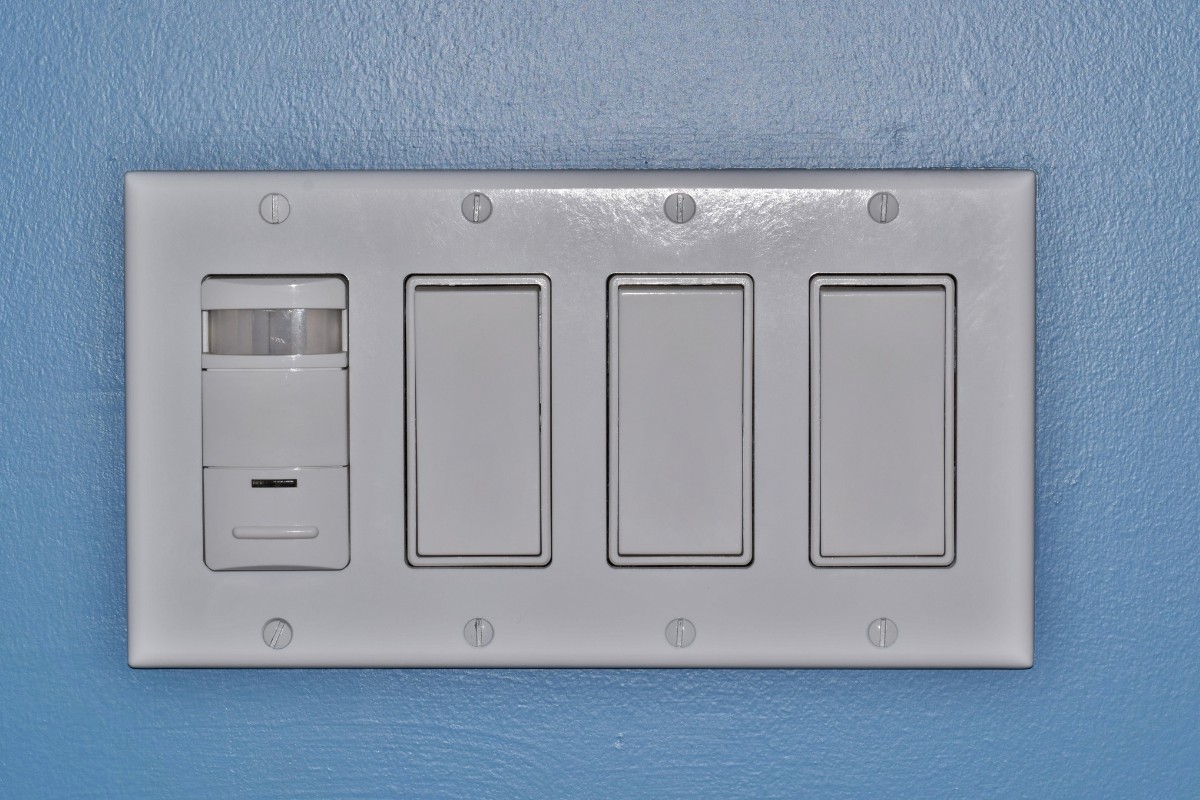
Here is some information about modern types of light switches as some people consider them light switch replacements. There are wireless switches that you won’t need to install wires in your walls, remote switches that you can turn on/off the light by remote control, motion sensor light switches that the light will turn on when the sensor detects movement, and momentary contact switches, which are also known as door jam switches that they turn on the light when the doors are open.
There is another type of light switch that needs to be mentioned here: the panic switch. Panic switches are usually installed in master bedrooms, and their job is to turn off all outdoor lights at the same time, which is useful if you realize that you have forgotten to turn off outdoor lights and you don’t feel like walking.
Light Switch Design
The appearance of light switches is also important because they are quite noticeable. Nowadays, you can get light switch covers in hundreds of different shapes and colors, so you can match them to the style of the rooms where the switches will be installed.
If your room looks antique, you can buy antique-looking light switch covers. If you prefer wood, you can choose among many different wooden light switches. Waterproof light switches are also available as they can be used near pools, etc.
Vous recherchez des solutions d’économie d’énergie activées par le mouvement ?
Contactez-nous pour obtenir une gamme complète de détecteurs de mouvement PIR, de produits d’économie d’énergie activés par le mouvement, d’interrupteurs à détecteur de mouvement et de solutions commerciales de présence/vacance.
Where to Install Light Switches
It’s very important to install light switches in the right places, but unfortunately, we can’t give you specific instructions. You need to take some time and think about possible places for light switches. Don’t forget to consider the doors (are they installed on the left or right side?), because it is very unpleasant to walk around doors to reach the light controls.
It’s recommended to install light switches at every entrance to a room, especially if the room is bigger (like a living room). Outdoor lights must have switches inside (you don’t want neighbors’ kids turning on/off your light in the middle of the night), but it’s also recommended to add motion sensors to outdoor lights (because you need an outdoor light when you are coming home, not when you already are at home).
You can also take a different approach (for example, you can program the outdoor lights to turn on when garage doors are opened by remote control). Panic switches are mostly installed in the master bedroom, but you can also install them in the hallway on the first floor (if you want your kids to turn off the lights before they go to bed).
Ces produits pourraient vous intéresser

- Tension : 2 piles AAA
- Mode Jour/Nuit
- Temporisation : 15 min, 30 min, 1 h (par défaut), 2 h

- Détecteur de présence PIR pour montage au plafond avec sortie relais à contact sec
- Alimentation basse tension 12/24VDC ou 12/24VAC
- Contacts relais isolés COM, NO et NC pour les entrées de régulation CVC, GTC et de gestion de l'énergie

- Interrupteur détecteur de mouvement hyperfréquence encastré pour plafond basse tension continue
- Entrée 12 VDC / 24 VDC avec plage de 10-30 VDC
- Courant de fonctionnement maximal de 10A avec temporisation, seuil Lux et sensibilité réglables
- Interrupteur détecteur de mouvement à micro-ondes encastré au plafond pour charges plus élevées
- Entrée de tension secteur 100-265 VAC, modèle 10A
- Détection hyperfréquence (micro-ondes) 5,8 GHz avec temporisation, seuil Lux et sensibilité réglables
- Interrupteur détecteur de mouvement à micro-ondes encastré au plafond
- Entrée de tension secteur 100-265 VAC, modèle 5A
- Détection hyperfréquence (micro-ondes) 5,8 GHz avec temporisation, seuil Lux et sensibilité réglables
- Variateur détecteur de présence PIR RZ037 pour montage au plafond pour alimentation 220V
- Courant de fonctionnement maximal de 3A avec une charge nominale de 660W
- Le bouton LUX contrôle la marche/arrêt du capteur de lumière et la luminosité de variation réglée par l'utilisateur
- Variateur détecteur de présence PIR RZ037 pour montage au plafond pour alimentation 110V
- Courant de fonctionnement maximal de 3A avec une charge nominale de 330W
- Le bouton LUX contrôle la marche/arrêt du capteur de lumière et la luminosité de variation réglée par l'utilisateur

- Interrupteur détecteur de mouvement à micro-ondes basse tension CC pour montage au plafond
- Entrée 12 VDC / 24 VDC avec plage de 10-30 VDC
- Courant de fonctionnement maximal de 10A avec temporisation, seuil Lux et sensibilité réglables
- Interrupteur détecteur de mouvement à micro-ondes pour montage au plafond pour charges plus élevées
- Entrée de tension secteur 100-265 VAC, modèle 10A
- Détection hyperfréquence (micro-ondes) 5,8 GHz avec temporisation, seuil Lux et sensibilité réglables
- Interrupteur à détecteur de mouvement hyperfréquence pour montage au plafond
- Entrée de tension secteur 100-265 VAC, modèle 5A
- Détection hyperfréquence (micro-ondes) 5,8 GHz avec temporisation, seuil Lux et sensibilité réglables

- Interrupteur à détecteur de mouvement PIR encastré pour plafond à basse tension CC
- Entrée 12 VDC / 24 VDC avec plage de 10-30 VDC
- Courant de fonctionnement maximal de 10A avec temporisation, seuil Lux et sensibilité réglables

- Interrupteur à détecteur de mouvement PIR encastré pour plafond pour charges plus élevées
- Entrée de tension secteur 100-265 VAC, modèle 10A
- Détection à 360 degrés avec temporisation, seuil Lux et sensibilité réglables
- Interrupteur à détecteur de mouvement PIR encastré pour plafond
- Entrée de tension secteur 100-265 VAC, modèle 5A
- Détection à 360 degrés avec temporisation, seuil Lux et sensibilité réglables

- Kit d’interrupteur sans fil et récepteur pour le contrôle de l’éclairage intérieur MARCHE/ARRÊT
- Récepteur 100-230VAC, 50/60Hz avec courant nominal de 5A
- Interrupteur sans fil alimenté par pile CR2032 avec communication 2.4GHz
- Détection d'occupation (Auto-ON/Auto-OFF)
- 12–24V DC (10–30VDC), jusqu'à 10A
- Couverture 360°, diamètre de 8–12 m
- Temporisation 15 s–30 min
- Capteur de luminosité Désactivé/15/25/35 Lux
- Sensibilité Haute/Basse
- Mode d'occupation Auto-ON/Auto-OFF
- 100–265V AC, 10A (neutre requis)
- Couverture 360° ; diamètre de détection 8–12 m
- Temporisation 15 s–30 min ; Lux Désactivé/15/25/35 ; Sensibilité Haute/Basse
- Mode d'occupation Auto-ON/Auto-OFF
- 100–265V AC, 5A (neutre requis)
- Couverture 360° ; diamètre de détection 8–12 m
- Temporisation 15 s–30 min ; Lux Désactivé/15/25/35 ; Sensibilité Haute/Basse
How Many Light Switches Do You Need
The next question is, how many switches do you need? You need to make sure that every switch is installed with a reason – you don’t want to install too many switches just to be on the safe side. Having too many switches can attract attention, which doesn’t look as good. So, the right number of switches is a compromise between great appearance and perfect functionality – you should talk to your light designer about this issue.
Combining Light Switches with Dimmers
Light dimmers have displaced light switches in many American homes. People like the idea of controlling the strength of the light, and dimmers can do just that. So, when you are selecting light controls, think about places (rooms) where you would like to control the intensity of the light and use dimmers instead of switches.
There is another option as well – dimmers can be combined with light switches. For example, you can have a dimmer installed at one entrance to the room and a switch installed at the other entrance. This means that the light can be turned on/off at both entrances, but at one entrance, the light can also be regulated by the light dimmer (when the light is turned on with the light switch, its power will depend on the dimmer position).
Conclusion
So, now you can see that light switches aren’t the easiest part of lighting design – you will need to select between two-, three-, or even four-way switches, maybe choose one of the modern styles of switches, select appropriate switch covers, decide where you are going to install them and figure out how many switches you need. Finally, you will also think about different switch-dimmer combinations. But if you do everything right, light switches will not only make your life easier, but they will also improve the appearance of your home.







