
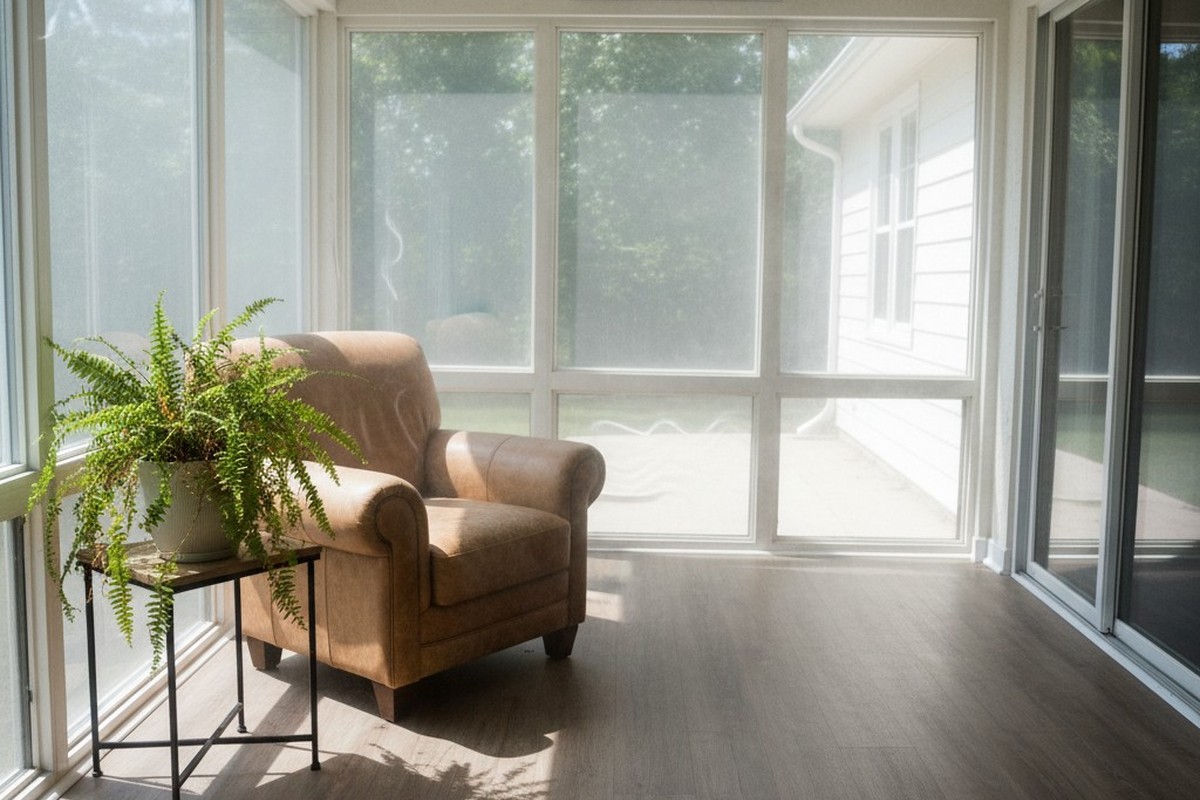
A sunroom is not a room. In terms of physics, it is a solar collector attached to the side of a house. When you build a structure composed of 60% to 80% glazing, you are inviting the sun to perform a very specific trick: short-wave radiation enters through the glass, strikes the floor or furniture, converts to long-wave heat radiation, and gets trapped. The glass that let the light in refuses to let the heat out. That isn’t a defect. It’s just how greenhouses work.

Trouble starts when homeowners treat this space like a standard bedroom. In a normal room, thermal mass is manageable. In a sunroom—especially one with tile or LVP (Luxury Vinyl Plank) flooring—the floor itself becomes a thermal battery. By 2:00 PM on a clear day in Savannah or Charleston, that floor has absorbed enough energy to radiate heat well past sunset. If you wait until you walk in at 5:00 PM to turn on the air conditioning, you have already lost the battle. The air temperature might drop, but the room will feel oppressive because the surfaces themselves are radiating heat at 90°F. No amount of “turbo mode” on a standard wall unit can instantly neutralize a thermal battery that has been charging for six hours.
Why Your Mini-Split is Lying to You
The standard solution for these rooms is the ductless mini-split. You know the ones: white rectangles mounted high on the wall. They are efficient, quiet, and fundamentally blind to the reality of a sunroom. The issue lies in the sensor location. Almost every major manufacturer (Mitsubishi, LG, Daikin) places the temperature thermistor inside the return air intake at the very top of the unit, usually seven feet off the ground.
In a room with normal walls, this works fine. In a sunroom, it creates a “sensor shadow” failure loop. As the sun beats down, heat rises and stratifies. The air at the ceiling might be 85°F while the air at sofa level is a comfortable 72°F. Conversely—and more dangerously for the equipment—the unit might blow cold air that sinks, pools on the floor, and leaves the ceiling hot. The sensor at the top thinks the room is still boiling and runs the compressor at maximum speed, freezing the occupants below. Or, in the “short-cycle” nightmare scenario, the unit satisfies the air pocket immediately around itself, assumes the job is done, and shuts off after three minutes. The compressor kicks on and off a hundred times a day, stressing the boards and failing to dehumidify the space.
Quizás le interese

- Tensión: 2 pilas AAA
- Modo Día/Noche
- Temporización: 15 min, 30 min, 1 h (por defecto), 2 h

- Sensor de presencia PIR para montaje en techo con salida de relé de contacto seco
- Alimentación de baja tensión de 12/24VDC o 12/24VAC
- Contactos de relé aislados COM, NO y NC para entradas de EMS, HVAC y control de edificios

- Interruptor con sensor de movimiento por microondas empotrable en techo de baja tensión DC
- Entrada de 12 VDC / 24 VDC con rango de 10-30 VDC
- Corriente de funcionamiento máxima de 10A con retardo de tiempo, umbral de Lux y sensibilidad ajustables
- Interruptor con sensor de movimiento por microondas empotrable en techo para cargas más elevadas
- Entrada de tensión de red de 100-265 VAC, modelo de 10A
- Detección por microondas de 5,8 GHz con temporizador, umbral Lux y sensibilidad ajustables
- Interruptor con sensor de movimiento por microondas empotrable para techo
- Entrada de tensión de red de 100-265 VAC, modelo de 5A
- Detección por microondas de 5,8 GHz con temporizador, umbral Lux y sensibilidad ajustables
- Regulador con sensor de presencia PIR RZ037 de techo para alimentación de 220V
- Corriente de funcionamiento máxima de 3A con carga nominal de 660W
- El botón LUX controla el encendido/apagado del sensor de luz y la regulación de brillo ajustada por el usuario
- Regulador con sensor de presencia PIR RZ037 de techo para alimentación de 110V
- Corriente de funcionamiento máxima de 3A con carga nominal de 330W
- El botón LUX controla el encendido/apagado del sensor de luz y la regulación de brillo ajustada por el usuario

- Interruptor con sensor de movimiento por microondas de techo para CC de bajo voltaje
- Entrada de 12 VDC / 24 VDC con rango de 10-30 VDC
- Corriente de funcionamiento máxima de 10A con retardo de tiempo, umbral de Lux y sensibilidad ajustables
- Interruptor con sensor de movimiento por microondas de techo para mayor carga
- Entrada de tensión de red de 100-265 VAC, modelo de 10A
- Detección por microondas de 5,8 GHz con temporizador, umbral Lux y sensibilidad ajustables
- Interruptor con sensor de movimiento por microondas de techo
- Entrada de tensión de red de 100-265 VAC, modelo de 5A
- Detección por microondas de 5,8 GHz con temporizador, umbral Lux y sensibilidad ajustables

- Interruptor con sensor de movimiento PIR para montaje empotrable en techo de CC de bajo voltaje
- Entrada de 12 VDC / 24 VDC con rango de 10-30 VDC
- Corriente máxima de trabajo de 10 A con tiempo de retardo, umbral de luxes y sensibilidad ajustables

- Interruptor con sensor de movimiento PIR empotrable en techo para mayor carga
- Entrada de tensión de red de 100-265 VAC, modelo de 10A
- Detección de 360 grados con tiempo de retardo, umbral de luxes y sensibilidad ajustables
- Interruptor con sensor de movimiento PIR empotrable en techo
- Entrada de tensión de red de 100-265 VAC, modelo de 5A
- Detección de 360 grados con tiempo de retardo, umbral de luxes y sensibilidad ajustables

- Kit de emisor inalámbrico y receptor para el control de iluminación de encendido/apagado en interiores
- Receptor de 100-230 V CA, 50/60 Hz con corriente nominal de 5 A
- Interruptor inalámbrico alimentado por CR2032 con comunicación de 2,4 GHz
- Presencia (encendido automático/apagado automático)
- 12–24 V CC (10–30 V CC), hasta 10 A
- Cobertura de 360°, 8–12 m de diámetro
- Tiempo de retardo de 15 s a 30 min
- Sensor de luz Desactivado/15/25/35 Lux
- Sensibilidad alta/baja
- Modo de presencia con encendido/apagado automático
- 100–265V CA, 10A (requiere neutro)
- Cobertura de 360°; diámetro de detección de 8–12 m
- Temporización: 15 s–30 min; Lux OFF/15/25/35; Sensibilidad Alta/Baja
- Modo de presencia con encendido/apagado automático
- 100–265V CA, 5A (requiere neutro)
- Cobertura de 360°; diámetro de detección de 8–12 m
- Temporización: 15 s–30 min; Lux OFF/15/25/35; Sensibilidad Alta/Baja
Homeowners often try to patch this with window film. While products like 3M Prestige can reject some solar energy, they don’t solve the control logic problem. Film reduces the rate of heat gain, but it does not tell the air conditioner that the room is still uncomfortable. You are treating the symptom (heat load) while ignoring the disease (blind sensors). The AC unit is still making decisions based on the air temperature seven feet up a wall that might be in a shadow, completely disconnected from the radiant heat reality of the living space.
Decoupling the Brain from the Brawn
The fix requires a fundamental shift in control architecture: you must decouple the sensing logic from the air handling hardware. This is where a device like Rayzeek comes in. Think of it less as a “smart remote” and more as a state auditor. By placing a battery-powered sensor in the actual living zone—on a coffee table or a side shelf—you force the system to acknowledge the real temperature experienced by a human being, not the temperature of the ceiling drywall.
The Rayzeek hub acts as an intermediary. It reads the data from the remote sensor, compares it to your setpoint, and then fires IR (Infrared) commands to the mini-split to force it into compliance. If the room is 78°F but the mini-split thinks it is 72°F, Rayzeek sends a “Cool / 68°F / High Fan” command to force the unit to run until the actual room cools down. It overrides the unit’s internal delusions. This setup does require a robust 2.4GHz WiFi signal, which can be tricky in sunrooms added to the exterior of brick or stucco homes. Before committing to this path, verify that your phone holds a steady signal in the room. If the WiFi drops, the brain is cut off from the body.
¿Busca soluciones de ahorro de energía activadas por movimiento?
Póngase en contacto con nosotros para obtener sensores de movimiento PIR completos, productos de ahorro de energía activados por movimiento, interruptores con sensor de movimiento y soluciones comerciales de presencia/vacancia.
The Solar Arc: Where to Put the Sensor

Deploying an external sensor in a glass room is a game of angles. You cannot simply stick the sensor on the wall opposite the windows. If you do, you risk the “Ghost Heat” phenomenon. Imagine the sun’s path from 10:00 AM to 4:00 PM. If a beam of direct sunlight hits the plastic casing of the sensor for even twenty minutes, the reading will spike to 100°F or more. The system will panic, ramping the AC to maximum capacity to fight a heat spike that doesn’t actually exist in the room’s air mass.
You must trace the solar arc. The sensor needs to live in the “Neutral Shadow”—a spot that receives good airflow but zero direct UV hits. Often, this is under a side table, or tucked behind a large plant pot on the north side of the room. It needs to be at body height, roughly three to four feet off the floor. Do not place it near the floor (too cold) or near the ceiling (too hot).
A warning for the DIY crowd looking for shortcuts: do not attempt to control these units by cutting the power with a cheap smart plug. Modern inverter-driven mini-splits have complex shutdown procedures to protect their electronics. If you use a $15 smart plug to hard-cut the power, you are risking a $400 control board failure. The control must be done via the IR command path (the language the remote speaks), which is what dedicated controllers utilize.
Hysteresis and the Fallacy of Scheduling
The mainstream advice for saving energy is to “set a schedule.” In a sunroom, a schedule is a liability. A rigid rule that says “Turn on at 4:00 PM” fails because the weather isn’t rigid. On a cloudy Tuesday, 4:00 PM might be fine. On a scorching Thursday, waiting until 4:00 PM means the room has already heat-soaked into the danger zone, and the AC will run inefficiently for hours trying to catch up.
You need temperature triggers, not time triggers. This is where hysteresis (or deadband) settings become critical. You want the system to wake up exactly when the room hits a threshold—say, 76°F—regardless of the time of day. This prevents the thermal mass of the floor from ever fully charging. However, you must set a wide enough deadband (e.g., cool to 72°F, then stop) to prevent the unit from jittering on and off every ten minutes. The goal is long, steady run times that pull humidity out of the air, followed by long rest periods.
Inspírese con los portafolios de sensores de movimiento Rayzeek.
¿No encuentra lo que busca? No se preocupe. Siempre existen formas alternativas de resolver sus problemas. Quizá alguno de nuestros portafolios pueda ayudarle.
Final Field Notes
One final reality check regarding humidity: cooling is dehumidification. In the humid Southeast, if you let a sunroom sit unconditioned for weeks because “nobody is using it,” you are creating a mold incubator. We have seen wicker furniture turn green and vinyl record collections warp in rooms that were simply “turned off.” Even if you don’t occupy the room, you must maintain a defensive baseline—keep the humidity below 60%.
The sunroom is the most volatile room in the house. It defies the logic of the rest of the insulated, drywall-box home. You cannot rely on the equipment’s internal brain because the equipment is installed in a place that defies its programming. By moving the sensor and automating the response based on real-time heat gain, you stop fighting the physics of the glass box and start managing it.







