

For many pet owners, the promise of smart home automation quickly sours into frustration. Motion-activated lights, meant to save energy, are instead triggered by a cat crossing the room, cycling on and off all night. The intended efficiency vanishes, replaced by wasted electricity and constant annoyance. The problem isn’t the pet, but the failure of conventional motion sensors to distinguish between human occupants and feline traffic.
Rayzeek addresses this problem not with complex algorithms, but with deliberate lens geometry. The solution is vertical cutoff, a design that elevates the sensor’s detection plane above the floor where cats and other small pets roam. By combining this geometric constraint with calibrated sensitivity, Rayzeek reliably detects humans while remaining completely unaware of pets below its field of view. Its effectiveness hinges on a clear understanding of mounting position and the detection boundaries it creates in a typical home.
Why Standard Motion Sensors Fail in Pet-Friendly Homes
While motion sensors are proven energy-savers in empty rooms, a pet introduces a variable that standard designs can’t handle. A cat strolling down a hallway registers as movement, activating the lights. When the cat returns minutes later, the timer resets. Instead of reducing energy consumption, this pattern multiplies it. Families who invested in automation to cut costs find their technology is actually increasing waste.
The problem goes beyond energy bills. An automated bedroom light that flicks on every time the cat stirs becomes a major sleep disruption. A climate control system set to activate with occupancy warms or cools an empty room where only a pet is lingering. The intended convenience becomes an adversarial relationship with the technology, leading many users to disable their smart systems entirely and forfeit the benefits they sought. The market has long offered motion sensors, but few have solved the fundamental challenge of ignoring infrared movement at floor level.
How Standard Sensors Create False Triggers
Passive infrared (PIR) sensors work by detecting changes in infrared radiation. When any warm body—be it a person or a pet—moves across a detection zone, the sensor registers the shifting heat signature and triggers a response. The mechanism is fundamentally indiscriminate; it can’t tell the difference between a human and a cat based on heat alone. The critical factor is not what moves, but where it moves.
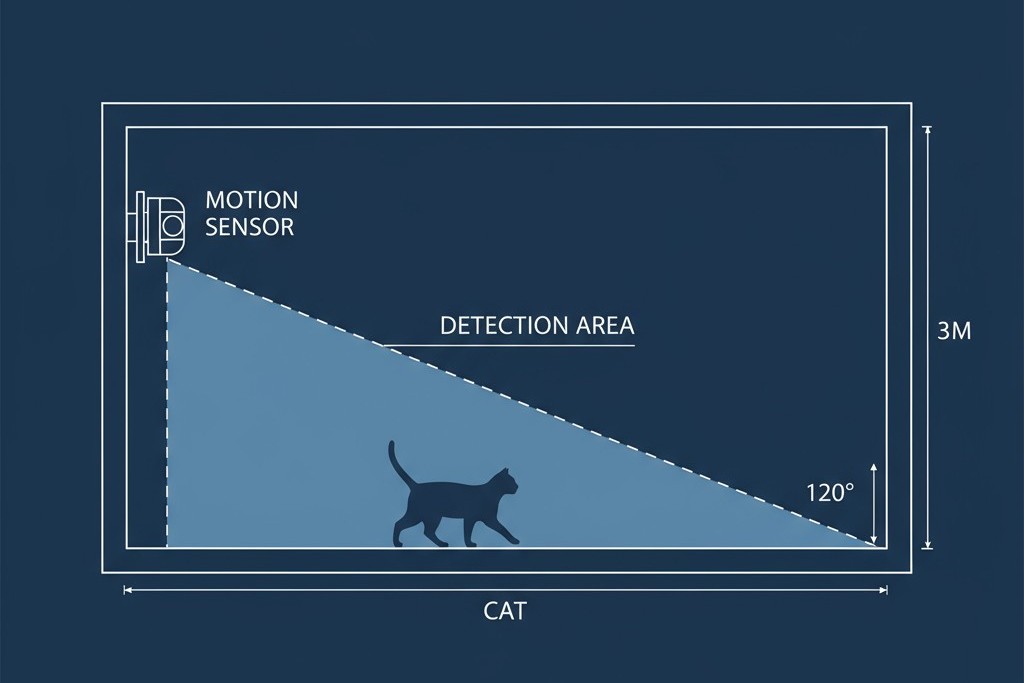
Most motion sensors cast a wide, horizontal detection plane that covers a room from the floor up, ensuring any human movement is captured. This design is perfectly logical for general occupancy detection, as a person sitting, standing, or walking will intersect the zone. However, this broad coverage guarantees that any warm body moving across the floor will also trigger an alert. Because cats, dogs, and other pets live at ground level, they exist squarely within this primary detection field. The sensor isn’t failing; it’s performing exactly as designed. The mismatch arises when the application demands selectivity that a floor-to-ceiling detection plane cannot provide.
Vertical Cutoff: Elevating the Detection Plane
Vertical cutoff is a lens design that simply stops the sensor from looking down. Instead of casting a detection field that extends from the ceiling to the floor, the lens physically restricts the lower boundary of its vision. The sensor is angled to see outward and slightly downward, but never steeply enough to see the floor directly beneath or near its mounting point. Movement below this threshold remains invisible.
The lens achieves this by manipulating which angles of infrared radiation can reach the sensor. A standard PIR sensor uses a Fresnel lens with segments covering a wide vertical range. By eliminating or masking the lower lens segments, the Rayzeek design removes the downward-facing angles from the detection field.
İlginizi Çekebilecek Diğer Ürünler

- Voltaj: 2 Adet AAA Pil
- Gündüz/Gece Modu
- Zaman gecikmesi: 15dk, 30dk, 1sa (varsayılan), 2sa

- Kuru kontak röle çıkışlı, tavan tipi PIR varlık sensörü
- 12/24VDC veya 12/24VAC düşük voltaj güç beslemesi
- EMS, HVAC ve bina kontrol girdileri için COM, NO ve NC izole röle kontakları

- Düşük voltaj DC sıva altı tavan tipi mikrodalga hareket sensörlü anahtar
- 10-30 VDC aralığına sahip 12 VDC / 24 VDC giriş
- Ayarlanabilir zaman gecikmesi, Lüks eşiği ve hassasiyet özelliklerine sahip maks. 10A çalışma akımı
- Yüksek yük kapasiteli sıva altı tavan tipi mikrodalga hareket sensörlü anahtar
- 100-265 VAC şebeke voltajı girişi, 10A model
- Ayarlanabilir zaman gecikmesi, Lüks eşiği ve hassasiyete sahip 5,8 GHz mikrodalga algılama
- Sıva altı tavana monte mikrodalga hareket sensörlü anahtar
- 100-265 VAC şebeke gerilimi girişi, 5A model
- Ayarlanabilir zaman gecikmesi, Lüks eşiği ve hassasiyete sahip 5,8 GHz mikrodalga algılama
- 220V güç için tavana monte RZ037 PIR varlık sensörlü dimmer
- 660W nominal yük ile 3A maksimum çalışma akımı
- LUX düğmesi, ışık sensörünün AÇIK/KAPALI konumunu ve kullanıcı tarafından ayarlanan dimmer parlaklığını kontrol eder
- 110V güç için tavana monte RZ037 PIR varlık sensörlü dimmer
- 330W nominal yük ile 3A maksimum çalışma akımı
- LUX düğmesi, ışık sensörünün AÇIK/KAPALI konumunu ve kullanıcı tarafından ayarlanan dimmer parlaklığını kontrol eder

- Düşük voltajlı DC tavan montajlı mikrodalga hareket sensörlü anahtar
- 10-30 VDC aralığına sahip 12 VDC / 24 VDC giriş
- Ayarlanabilir zaman gecikmesi, Lüks eşiği ve hassasiyet özelliklerine sahip maks. 10A çalışma akımı
- Yüksek yüklü tavan montajlı mikrodalga hareket sensörlü anahtar
- 100-265 VAC şebeke voltajı girişi, 10A model
- Ayarlanabilir zaman gecikmesi, Lüks eşiği ve hassasiyete sahip 5,8 GHz mikrodalga algılama
- Tavan montajlı mikrodalga hareket sensörlü anahtar
- 100-265 VAC şebeke gerilimi girişi, 5A model
- Ayarlanabilir zaman gecikmesi, Lüks eşiği ve hassasiyete sahip 5,8 GHz mikrodalga algılama

- Düşük voltajlı DC sıva altı tavan montajlı PIR hareket sensörlü anahtar
- 10-30 VDC aralığına sahip 12 VDC / 24 VDC giriş
- Ayarlanabilir zaman gecikmesi, Lüks eşiği ve hassasiyet ile maks. 10A çalışma akımı

- Yüksek yüklü sıva altı tavan montajlı PIR hareket sensörlü anahtar
- 100-265 VAC şebeke voltajı girişi, 10A model
- Ayarlanabilir zaman gecikmesi, Lüks eşiği ve hassasiyet ile 360 derece algılama
- Sıva altı tavan montajlı PIR hareket sensörlü anahtar
- 100-265 VAC şebeke gerilimi girişi, 5A model
- Ayarlanabilir zaman gecikmesi, Lüks eşiği ve hassasiyet ile 360 derece algılama

- İç mekan AÇMA/KAPAMA aydınlatma kontrolü için kablosuz anahtar ve alıcı seti
- 5A nominal akımlı 100-230VAC, 50/60Hz alıcı
- 2.4GHz haberleşmeli CR2032 pille çalışan kablosuz anahtar
- Varlık (Otomatik AÇMA/Otomatik KAPATMA)
- 12–24V DC (10–30VDC), 10A'e kadar
- 360° kapsama alanı, 8–12 m çap
- Zaman gecikmesi 15 sn–30 dk
- Işık sensörü Kapalı/15/25/35 Lux
- Yüksek/Düşük hassasiyet
- Otomatik AÇMA/Otomatik KAPATMA varlık modu
- 100–265V AC, 10A (nötr hattı gereklidir)
- 360° kapsama alanı; 8–12 m algılama çapı
- Zaman gecikmesi 15 sn–30 dk; Lux KAPALI/15/25/35; Hassasiyet Yüksek/Düşük
- Otomatik AÇMA/Otomatik KAPATMA varlık modu
- 100–265V AC, 5A (nötr hattı gereklidir)
- 360° kapsama alanı; 8–12 m algılama çapı
- Zaman gecikmesi 15 sn–30 dk; Lux KAPALI/15/25/35; Hassasiyet Yüksek/Düşük
This creates a raised detection boundary with a clear geometry. For example, if a sensor is mounted at eight feet with a lens that prevents it from seeing more than 30 degrees below the horizontal, its detection plane won’t start at the wall. Instead, it begins several feet out, floating above the floor at close range. Directly below the sensor is a complete dead zone. At mid-room, the plane might hover three to four feet off the ground. Only at the far wall does it descend toward the floor as the angle shallows.
This geometry creates a “safe zone” where small animals can move freely without triggering a response. A walking human, whose torso is well above this plane, will be detected reliably.
Mounting Height and Detection Zone Geometry
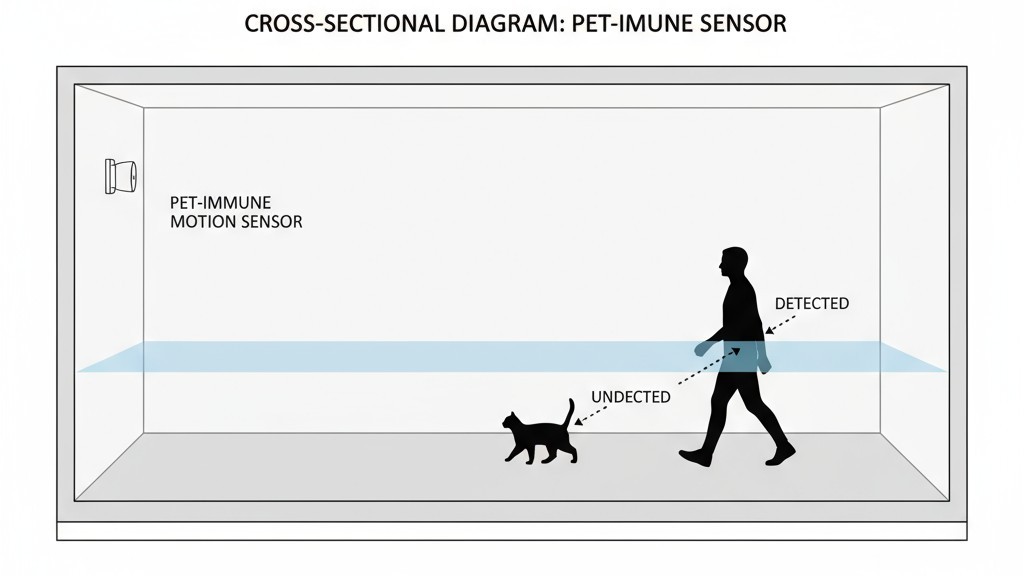
Mounting height is the single most important variable for success. An eight-foot mounting height doesn’t create an eight-foot-high detection plane; rather, the plane’s height varies with distance from the sensor. The goal is to mount the sensor high enough that this floating plane remains above a cat but below a human torso throughout most of the room.
In homes with standard eight- to nine-foot ceilings, mounting a Rayzeek sensor near the ceiling produces an ideal detection plane that hovers roughly three to four feet above the floor in the center of the room. This is well above a cat, which rarely exceeds a foot or two in height, even when sitting up. A human torso, however, easily intersects this plane.
The coverage is not uniform. The dead zone is directly beneath the sensor, while the pet-immune buffer exists across the middle of the room. At the far edges, the detection plane lowers, but this is rarely an issue since pets don’t levitate and human movement is still easily caught. The system is most vulnerable in spaces with low ceilings (seven feet or less), as this compresses the geometry and shrinks the safe zone. In these cases, mounting at the maximum possible height is essential.
Rayzeek Hareket Sensörü Portföylerinden İlham Alın.
Aradığınızı bulamadınız mı? Endişelenmeyin. Sorunlarınızı çözmenin her zaman alternatif yolları vardır. Portföylerimizden biri size yardımcı olabilir.
Sensitivity Tuning: A Secondary Safeguard
While vertical cutoff solves the spatial problem, sensitivity tuning addresses the threshold problem. Sensitivity controls how much infrared change is needed to trigger the sensor. It’s a powerful complement to the lens geometry, but it can’t replace it. Relying on sensitivity alone is a flawed strategy, as the thermal signature of a large cat can be similar to that of a small child.
When used together, the system becomes more robust. A cat that manages to enter the detection plane—perhaps by jumping onto furniture—can still be ignored if the sensitivity is tuned for larger thermal masses. For homes with only small cats, sensitivity can be left at a moderate level, as the vertical cutoff does most of the work. For homes with large dogs that might rear up into the detection plane, lowering the sensitivity slightly adds another layer of protection without compromising human detection. The geometric lens is the primary filter; sensitivity is the fine-tuning.
Practical Mounting in Typical Homes
The principles are universal, but the best mounting position depends on the room’s layout, ceiling height, and traffic patterns. The objective is always to position the sensor where people will reliably cross the detection plane while pets remain underneath it.
Hareket Algılamalı Enerji Tasarrufu Çözümleri Mi Arıyorsunuz?
Eksiksiz PIR hareket sensörleri, hareket algılamalı enerji tasarruflu ürünler, hareket sensörlü anahtarlar ve ticari Varlık/Yokluk (Occupancy/Vacancy) çözümleri için bizimle iletişime geçin.
Corner Placement
Mounting a sensor in a corner near the ceiling provides the widest field of view and the most consistent coverage. This position minimizes dead zones and ensures anyone entering the room will be detected. In a typical living room or bedroom, a corner-mounted sensor sees over most low furniture, though tall bookcases can create blind spots. Choose the corner with the clearest sightlines to doorways and main activity areas.
Hallways and Narrow Spaces
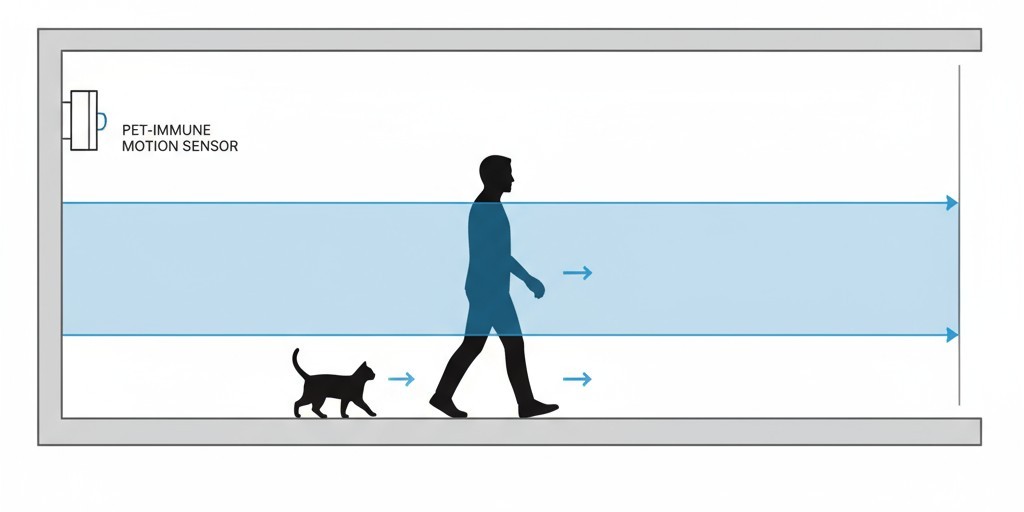
In a hallway, the best placement is at one end, aimed down its length. The vertical cutoff ensures a cat can walk the entire corridor without being seen, while a person is detected instantly. If ceiling mounting is impractical, a high wall mount can work, angled slightly downward but not so steeply that it sees the floor up close.
The entire system, however, relies on one key assumption: that pets stay near the floor. What about cats that climb? A cat that routinely jumps onto a high countertop or bookshelf may enter the detection plane. This is a limitation of any geometric approach. You can mitigate this by positioning the sensor to avoid direct sightlines to furniture where cats perch, or by lowering sensitivity. The technology is optimized for normal pet behavior, which is overwhelmingly centered on the floor, not for homes where cats spend their time operating at human height.







