

A conference room can run perfectly in a walk-through and still fail in the only moment that matters: mid-sentence on a video call.
In a Jersey City financial services HQ in fall 2019, a flagship boardroom went dark during a pitch. The controls contractor insisted the sensor “passed walk test.” The AV team had already done their ritual checks. None of that mattered once the room had to support a real meeting.
A commissioning consultant sat in the presenter chair, stayed mostly still, and watched the clock. The lights dropped at 14 minutes—right on the configured timeout. A “working” room had simply been tested for the wrong human posture.
The real fear isn’t the darkness itself. It’s the embarrassment of having to wave your arms while a client watches on the other screen.
The trap is thinking “keep lights on” is a binary choice: either aggressive energy shutoff or a room that burns all day. In practice, there is a middle path that works across a portfolio. You tune and validate conference rooms for seated behavior and meeting-length tails, and use a clear control contract (often vacancy mode) so users don’t get surprised.
앉아서 하는 회의가 정상 작동 중인 센서를 오작동하게 만드는 이유
대부분의 회의실 감지기 장애는 센서가 실제로 감지하는 범위에 대한 오해에서 시작됩니다.
The recurring complaint comes in plain language—usually “the lights turn off during Zoom” or “the sensor doesn’t see us”—and it isn’t mysterious. A ceiling PIR can be excellent at detecting a person walking into a room and mediocre at detecting six people sitting with hands on laptops, shoulders squared to a camera, moving just enough to type and nod.
That’s why a Cambridge, MA biotech tenant in 2020–2021 didn’t just see tickets; they saw rituals. People propped doors open to catch corridor motion. Someone would periodically stand and wave. A manager on a Zoom call broke eye contact mid-sentence to flail both arms. At that moment, nobody cared about watts. The room had simply lost the users’ trust.
Teams often jump immediately to hardware selection: “What sensor should we buy?” The Baltimore, MD healthcare admin offices project in 2023 offers a useful counterexample. The goal was standardizing huddle rooms across multiple floors—same ceiling grid, same table, same sensor.
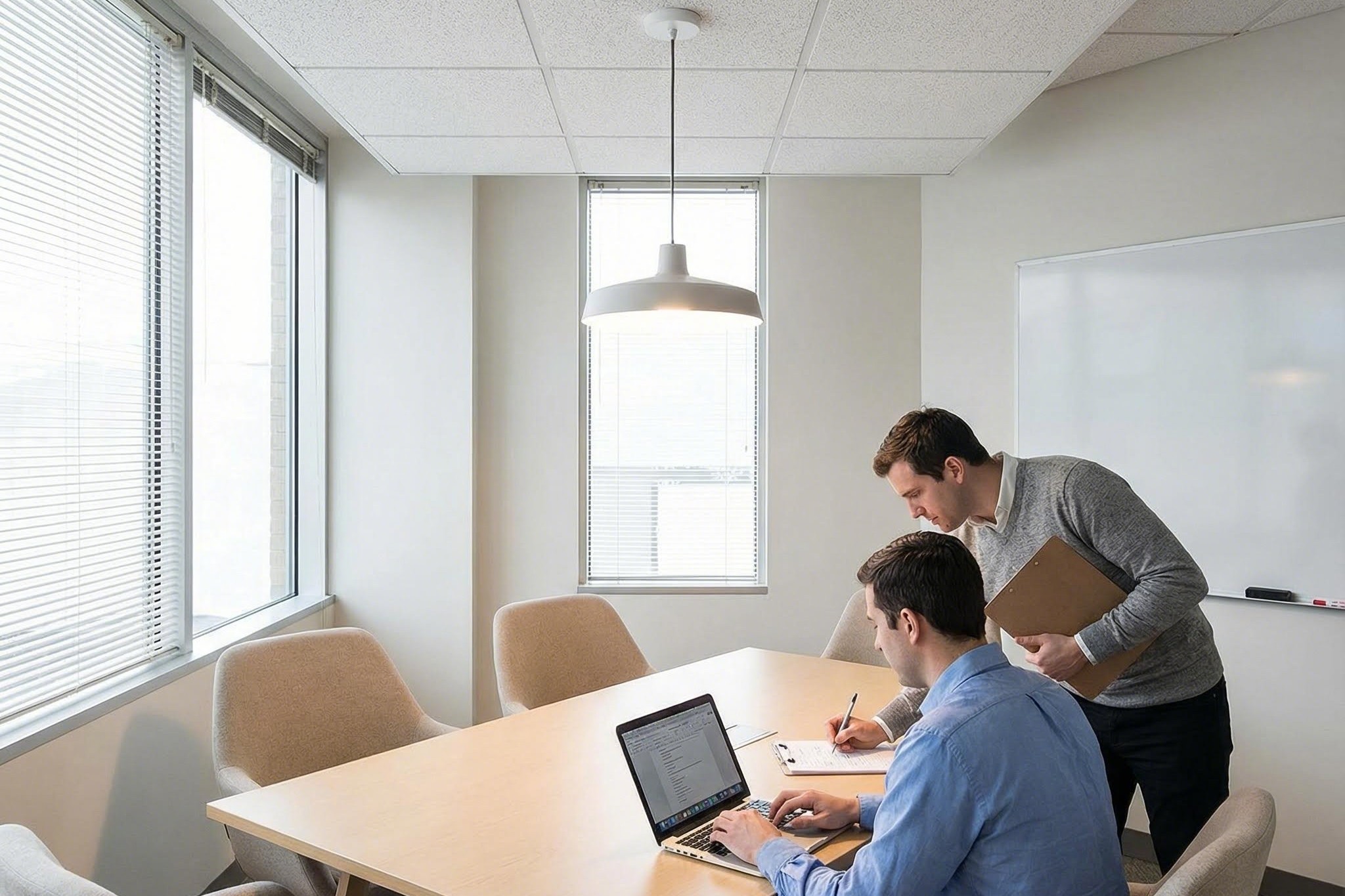
The fix didn’t require a magical new model number. It required a seated-presence coverage map: sit in each chair, hands on a laptop, and mark whether the sensor retriggers before the delay expires. The far corner seat failed with a single center-mounted PIR. A small placement change—offset toward the primary seated zone—plus sensitivity tuning made the room pass. Standardization didn’t become safe until someone actually measured the seats.
A practical way to think about conference rooms is that a “walk test” is a wiring test, not a meeting test. The important validation looks boring on paper: a timed observation where occupants behave normally—seated, minimal gesturing, occasional head movement—run against the actual vacancy delay. It gets repeated from worst-case seats: far corner, against glass, presenter position. The output is a matrix, not a debate: seat × minutes to dropout, pass/fail. When a room fails at 12–15 minutes and the delay is set to 10–15, the root cause is obvious.
This matters because “walk test proves it works” is one of the most expensive myths in the industry. Walk tests were never designed to validate the “silent period” of a meeting—the long stretch where nobody stands up, nobody crosses zones, and the only movement is small. That silent period is where the room either earns trust or teaches people to hack it.
Timeout choice is where the silent period collides with reality. In one Boston biotech client’s post-occupancy look at meeting behavior, the median meeting length was around 28 minutes. That number is not the point; the tail is. Calls running 55–70 minutes were common for cross-site reviews. Short timeouts punish the tail, which is exactly where the stakes are often highest.
That’s why a 2023 14-floor NYC tenant fit-out with 12–15 minute auto-off in small huddle rooms created an immediate operational pattern: gaffer tape over ceiling sensors, and a helpdesk tag spike. They saw about 3–5 tickets a day labeled “room lights unreliable.” Users don’t respond to aggressive tuning by reporting it forever. They respond by working around it.
A short delay can look like savings on paper and feel like failure in practice. The operational cost shows up quickly in tickets, dispatches, and AV teams adding lighting hacks to meeting start checklists. Worse, users learn new behaviors (door ajar, repeated toggles) that cause relay wear. A single lighting ticket that takes ~12 minutes to handle, a few times a week, can erase much of the incremental savings from trimming a vacancy delay from 30 minutes down to 10 minutes—especially once someone has disabled the sensor entirely out of frustration.
The core idea is simple: conference rooms should be commissioned to seated presence and meeting-length tails, not to walk tests and spreadsheet minutes.
모션 감지 에너지 절약 솔루션을 찾고 계신가요?
완제품 PIR 모션 센서, 모션 감지 에너지 절약 제품, 모션 센서 스위치 및 상업용 재실/공실(Occupancy/Vacancy) 솔루션에 대해 문의해 주세요.
A default policy that stays on, without becoming always-on
There’s a reason commissioning people talk about a “control contract” for a room. It’s the promise the room makes: how lights turn on, how they stay on, and how they turn off.
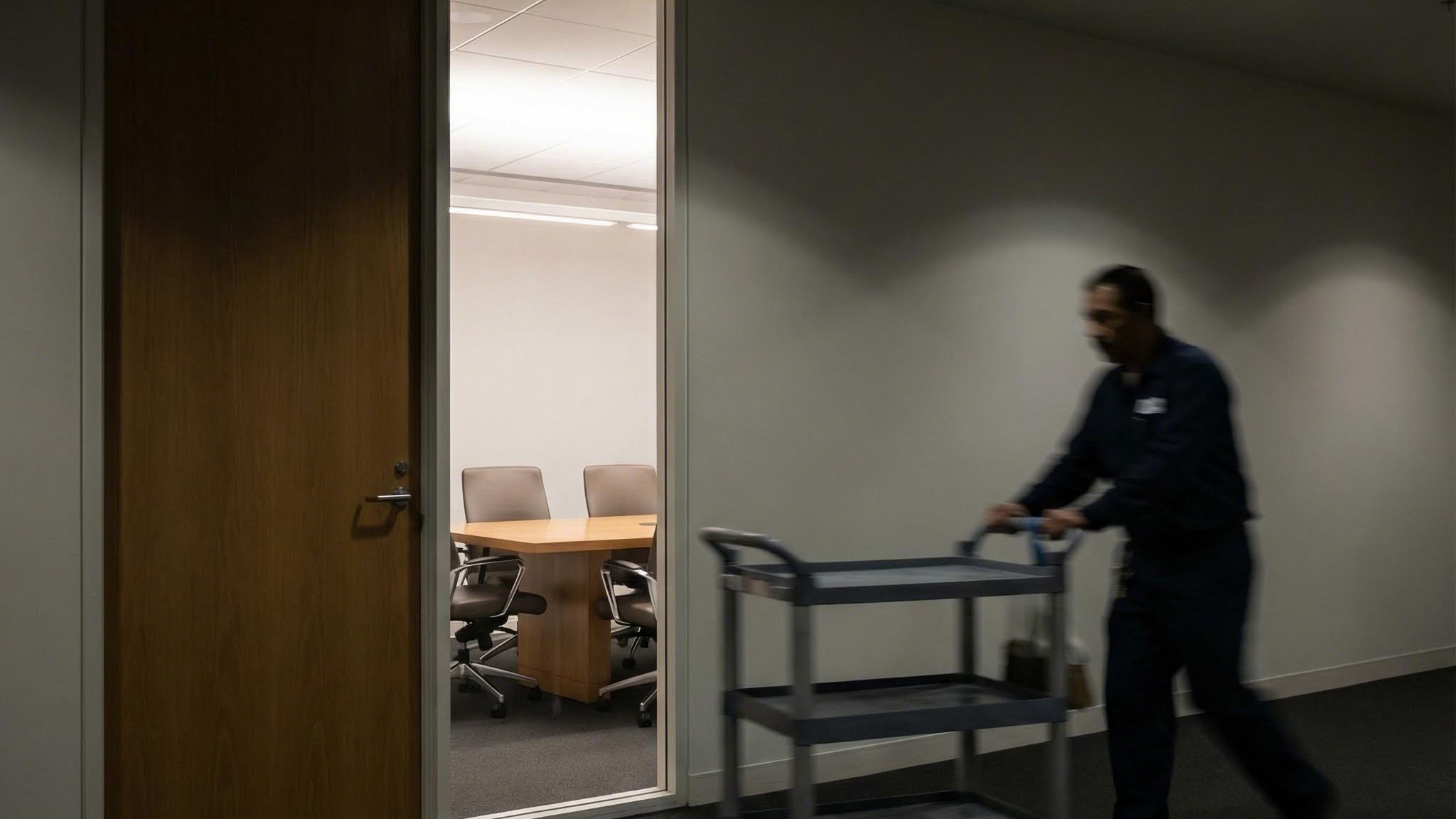
In a Columbus, OH state university admin building in summer 2021, the problem wasn’t lights turning off mid-meeting—it was lights turning on at night. Glass sidelites let corridor motion “leak” into conference rooms. The cleaning crew triggered sensors while passing. Staff started calling the rooms “haunted.” That narrative was the real problem, because it spreads faster than a work order.
The fix wasn’t “more automation.” It was a clearer contract: vacancy mode (manual-on, auto-off), plus a sane off delay so a night cleaner could finish quickly without constant retriggers. The jokes stopped. Predictability won.
For many video-heavy conference rooms, vacancy mode is the calmest contract. People expect to choose lighting for a call—camera exposure, glare, face lighting—and manual-on reduces surprise. It also removes a political landmine: the “why did this room turn on when nobody’s here?” complaint that often leads to aggressive policies that break meeting functionality. That doesn’t mean vacancy mode is friction by default. In the Cambridge huddle rooms, a simple keypad label—“Tap ON once; room shuts off after you leave”—did more for user behavior than any hidden sensitivity tweak.
A defensible default for a mixed portfolio usually looks like this:
- Treat client-facing video rooms as “reputational rooms,” not just enclosed spaces.
- Default to vacancy mode (manual-on, auto-off) for huddle rooms and small conference rooms.
- Set vacancy delay to a band that matches real meetings, not walk-throughs—often around 20–30 minutes as a starting point, with the understanding that tail meetings exist.
- Keep the “energy work” elsewhere: scheduling, daylight dimming, after-hours sweeps, and spaces that don’t fail in public (copy rooms, storage, back-of-house).
This is where compliance anxiety tends to appear: “manual-on isn’t allowed,” “the utility incentive says 10 minutes,” or “the inspector will ding it.” Code requirements and utility program rules do vary by jurisdiction, and there’s no universal sentence that covers every AHJ or incentive form. The practical move is to treat conference rooms as a functional exception category when the project is otherwise aggressive, and to document intent clearly rather than hiding it.
어쩌면 다음 제품에도 관심이 있으실 수 있습니다

- 무전압 접점(dry-contact) 릴레이 출력을 갖춘 천장 장착형 PIR 재실 감지 센서
- 12/24VDC 또는 12/24VAC 저전압 전원 공급
- EMS, HVAC 및 빌딩 제어 입력을 위한 COM, NO, NC 절연 릴레이 접점

- 저전압 DC 천장 매립형 마이크로웨이브 모션 센서 스위치
- 10-30 VDC 범위의 12 VDC / 24 VDC 입력
- 시간 지연, 조도(Lux) 임계값 및 감도 조절이 가능한 최대 10A 작동 전류
- 고부하용 천장 매립형 마이크로웨이브 모션 센서 스위치
- 100-265 VAC 상용전압 입력, 10A 모델
- 시간 지연, 조도(Lux) 임계값 및 감도 조절이 가능한 5.8 GHz 마이크로웨이브 감지
- 천장 매립형 마이크로웨이브 모션 센서 스위치
- 100-265 VAC 상용전압 입력, 5A model
- 시간 지연, 조도(Lux) 임계값 및 감도 조절이 가능한 5.8 GHz 마이크로웨이브 감지
- 220V 전원용 천장 장착형 RZ037 PIR 재실 감지 센서 디머
- 정격 부하 660W, 최대 작동 전류 3A
- 조도 센서 켜짐/꺼짐(ON/OFF) 및 사용자 설정 디밍 밝기를 제어하는 LUX 버튼
- 110V 전원용 천장 장착형 RZ037 PIR 재실 감지 센서 디머
- 정격 부하 330W, 최대 작동 전류 3A
- 조도 센서 켜짐/꺼짐(ON/OFF) 및 사용자 설정 디밍 밝기를 제어하는 LUX 버튼

- 저전압 DC 천장 매립형 마이크로웨이브 모션 센서 스위치
- 10-30 VDC 범위의 12 VDC / 24 VDC 입력
- 시간 지연, 조도(Lux) 임계값 및 감도 조절이 가능한 최대 10A 작동 전류
- 고부하 천장 매립형 마이크로웨이브 모션 센서 스위치
- 100-265 VAC 상용전압 입력, 10A 모델
- 시간 지연, 조도(Lux) 임계값 및 감도 조절이 가능한 5.8 GHz 마이크로웨이브 감지
- 천장 매립형 마이크로웨이브 모션 센서 스위치
- 100-265 VAC 상용전압 입력, 5A model
- 시간 지연, 조도(Lux) 임계값 및 감도 조절이 가능한 5.8 GHz 마이크로웨이브 감지

- 저전압 DC 매립형 천장 장착 PIR 모션 센서 스위치
- 10-30 VDC 범위의 12 VDC / 24 VDC 입력
- 최대 작동 전류 10A (시간 지연, 조도 값, 감도 조절 가능)

- 고부하 매립형 천장 장착 PIR 모션 센서 스위치
- 100-265 VAC 상용전압 입력, 10A 모델
- 360도 감지 (시간 지연, 조도 값, 감도 조절 가능)
- 매립형 천장 장착 PIR 모션 센서 스위치
- 100-265 VAC 상용전압 입력, 5A model
- 360도 감지 (시간 지연, 조도 값, 감도 조절 가능)

- 실내 조명 ON/OFF 제어용 무선 스위치 및 수신기 키트
- 100-230VAC, 50/60Hz 수신기 (정격 전류 5A)
- CR2032 배터리 구동 무선 스위치 (2.4GHz 통신)
- 재실 감지 (Auto-ON/Auto-OFF)
- 12–24V DC (10–30VDC), 최대 10A
- 360° 감지 범위, 직경 8–12 m
- 시간 지연 15초–30분
- 조도 센서 Off/15/25/35 Lux
- 감도 높음/낮음
- Auto-ON/Auto-OFF 재실 모드
- 100–265V AC, 10A (중성선 필수)
- 360° 감지 범위, 감지 직경 8–12 m
- 시간 지연 15초–30분, 조도 OFF/15/25/35, 감도 높음/낮음
- Auto-ON/Auto-OFF 재실 모드
- 100–265V AC, 5A (중성선 필요)
- 360° 감지 범위, 감지 직경 8–12 m
- 시간 지연 15초–30분, 조도 OFF/15/25/35, 감도 높음/낮음

- 100V-230VAC
- 전송 거리: 최대 20m
- 무선 모션 센서
- 유선 제어

- 전압: AAA 배터리 2개 / 5V DC (Micro USB)
- 주간/야간 모드
- 시간 지연: 15분, 30분, 1시간(기본값), 2시간

- EU 플러그 전원 어댑터

- UK 플러그 전원 어댑터
That is exactly how a Princeton-area NJ corporate campus project in 2022 got unstuck. Paperwork pushed for a 10-minute shutoff everywhere, so the team ran a 45-minute mock meeting test. Two rooms failed seated presence; one didn’t due to better line-of-sight and placement. The compromise was explicit: short delays in copy rooms and storage, sane settings in conference rooms. This was written down as a functional exception with a rationale that non-technical stakeholders could repeat.
The cost of not doing this shows up in the wrong place. In early 2024 at a Philadelphia tech startup, a COO wanted a 5-minute timeout to match a sustainability pledge slide deck. Two rooms were piloted. Sales calls were interrupted. A sticky note appeared on the wall: “MOVE OR DIE.” The organization backed off not because comfort “won,” but because someone translated the problem into brand risk and operational cost. Sustainability stuck when it was implemented somewhere else.
A control contract works when it reduces the number of surprises. The rest of the system—sensor selection, placement, and tuning—exists to keep that contract from being broken.
Sensor choice matters less than geometry—until it doesn’t
Procurement teams like a single answer: one sensor SKU, one standard detail, one setting template. Conference rooms punish that instinct.
The Baltimore seated-presence map is a good model because it forces the room back onto physics and geometry: table, chairs, door, glass, where people actually sit. Ceiling grid constraints matter. Presenter position matters. A “360°” coverage claim on a datasheet doesn’t mean “sees seated micro-movement equally from every chair.” It means something closer to “has a pattern that looks full from above if the movement is the kind it detects.”
In 6–8 person conference rooms, the common cheap layout is a single ceiling PIR centered over the table. That layout fails in a predictable way across tenants and years (2019–2024): once people settle into laptop-present mode for 20+ minutes, motion drops below threshold and the room cycles off. Glass walls can delay the complaint because daylight masks the effect—until winter afternoons, when face lighting becomes more critical on camera and the failure gets escalated. This is why “it only happens sometimes” is not reassurance. It’s a symptom of geometry and seasonal conditions interacting with a fragile detection scheme.
Dual-technology sensors (PIR + ultrasonic) are often worth the budget argument in reputational rooms, especially when privacy or IT security blocks camera-based analytics and when furniture layouts are fixed. Ultrasonic has a reputation for false-ons, and that risk is real in the wrong adjacency—corridors, sidelites, HVAC turbulence, thin partitions. But conference rooms have asymmetric failure costs: a false-on is annoying; a false-off mid-call is humiliating. And a false-on problem can often be addressed with sensitivity and placement, or by choosing vacancy mode so “false-on” is largely removed from the contract.
A Washington, DC law firm in 2022 saw this play out in a way that facilities and AV teams both cared about. A single ceiling PIR was swapped for a dual-tech ceiling sensor and re-aimed. Nuisance offs dropped enough that the AV team stopped keeping a “tap the switch” script in the room start-up checklist. That’s a useful KPI because it’s operational: when the AV checklist shrinks, maintenance burden shrinks.
There’s a practical placement heuristic embedded in these stories: coverage should be engineered for worst-case seated zones, not for the doorway. That often means offsetting toward the table rather than centering, adding a second zone where the presenter sits, or avoiding line-of-sight blockers that turn a chair back into a dead spot. A room doesn’t need “more sensors” as a reflex. It needs evidence that every seat stays detected for the chosen delay.
When something inevitably goes wrong, what fixes should be refused—even if they sound clever?
Red-team the usual fixes (then rebuild what actually works)
The mainstream mantra sounds responsible: shorter timeouts save energy. In conference rooms, however, it often just changes who pays.
The Philadelphia “5 minutes” pilot didn’t create a culture of efficiency; it created a sticky note and interrupted sales calls. The NYC 12–15 minute huddle room settings didn’t create durable savings. They created gaffer tape over sensors and 3–5 “room lights unreliable” tickets a day, plus users learning to leave doors ajar and wave at ceilings. Those workarounds don’t just add annoyance; they eliminate the very savings the setting was supposed to create.
The quick-fix list that tends to show up in the field is short, and it’s mostly bad:
- Tape the sensor or block the lens.
- Prop the door to catch corridor motion.
- Tell users to “just wave” when lights dim.
- Have AV “force lights on” during a call, no matter what.
That last one is the most seductive, and usually the most brittle. In a Midtown Manhattan co-working buildout in late 2022, an AV programmer proposed holding lights on whenever a video bar detected an active call. It sounded modern until someone walked through failure cases: privacy policies that disable camera analytics, sleeping peripherals, a call that ends abruptly but doesn’t release control, or a private phone call where the video bar never wakes. If the lighting system can’t behave correctly when AV is down, it will fail publicly and create blame ping-pong across trades.
The rebuild is straightforward: AV can be an auxiliary trigger, a nice-to-have assist, but the lighting contract must be true even if the AV rack is dead.
The more durable rebuild is conditional, not universal:
- Reputational rooms (client-facing, video-call heavy): Prioritize predictability, validate seated presence, default to vacancy mode or robust sensing with longer delays, and accept “functional exceptions” to aggressive portfolio rules when needed.
- Utility rooms (copy, storage, back-of-house): Pursue the aggressive minutes, because the failure mode isn’t public embarrassment and users don’t build rituals around it.
Energy targets matter, but minimizing the worst outcome—public failure—matters more. You don’t want to teach users to defeat the system just to save a few watts.
Make it maintainable: logs, rollback plans, and a Monday-morning test
Intermittent conference room complaints are hard to solve without visibility. That’s why some commissioning practitioners keep a “two-visit rule”: if a room needs a second visit, access to configuration exports or event history becomes non-negotiable. Otherwise, troubleshooting turns into guesswork. Vendor labels differ—timeout, vacancy delay, grace period—and the only reliable way to avoid arguments is to pull the actual settings and match them to observed behavior.
Rayzeek 동작 센서 포트폴리오에서 영감을 얻어보세요.
원하는 제품을 찾지 못하셨나요? 걱정하지 마세요. 문제를 해결할 수 있는 대안은 언제나 있습니다. 저희 포트폴리오 중 하나가 도움이 될 수 있습니다.
A practical Monday-morning move is a simple seated-presence pass/fail run. Pick the worst seats (far corner, against glass, presenter position), run a timed observation against the configured delay, and record seat × minutes to dropout. If the room fails that test, the fix should be one actionable change—placement, sensing technology mix, or delay—not a cascade of complex integrations.
Conference rooms don’t need to be always-on to be reliable. They need a contract that users can predict, and evidence that the room can keep that promise even when humans sit still on camera.






