

The robbery happens at 2:00 PM on a Tuesday in July. The sunroom is locked, the perimeter is secured, and the alarm system is armed in “Away” mode. A standard Passive Infrared (PIR) motion sensor is mounted in the corner, staring unblinkingly across the tiled floor.
An intruder forces the lock on the sliding glass door, steps inside, walks the entire length of the room, and kicks open the interior door to the main house. No alarm sounds. The central station never calls. The police are never dispatched.
The batteries were full. The Wi-Fi was solid. The sensor failed because of a fundamental law of thermodynamics that most consumer security marketing conveniently ignores: contrast. In the industry, we call this the “Glass Box” effect. When the ambient temperature of a room climbs to match the surface temperature of human skin—roughly 93°F to 98°F—a standard motion detector becomes physically blind. It is staring right at the intruder, but in the thermal spectrum, that intruder is invisible.
Physics is Undefeated: The Delta-T Reality
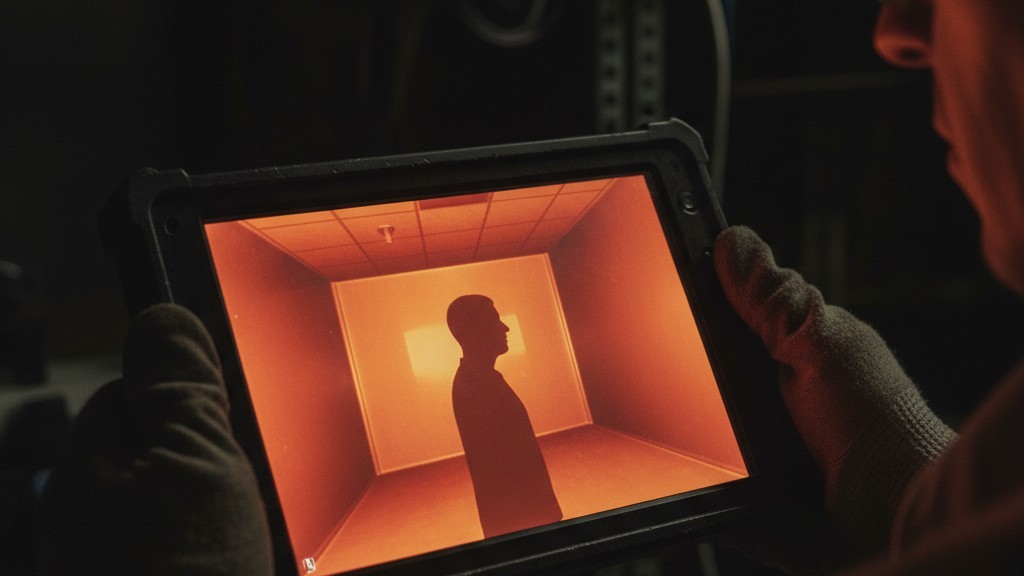
To see why this failure is inevitable, stop viewing a motion sensor as a camera that “sees” movement. It isn’t. A standard PIR sensor is a crude thermal optic. It uses a pyroelectric element to detect rapid changes in infrared energy. It hunts for a temperature difference, or “Delta-T,” between a moving object and the static background.
When a person (98.6°F internal, roughly 92-95°F skin surface) walks across a room that is 72°F, the sensor sees a blazing hot beacon moving against a cool wall. The voltage spikes, the relay clicks, and the siren wails.
But physics is undefeated. As the room heats up, that contrast narrows. In a sunroom or greenhouse in the American Southwest, or even a conservatory in a humid Midwest summer, the interior temperature can easily drift into the 90s. As the background temperature climbs to 95°F or 96°F, the Delta-T drops to near zero. The sensor is scanning for a heat signature that no longer exists. The intruder is effectively camouflaged by the air itself.
This is distinct from the problem of large, super-heated objects triggering false alarms. You may have noticed that a car pulling into a driveway in August will set off an exterior sensor instantly. That’s because the engine block is 200°F, creating a massive Delta-T against the 105°F asphalt. A human being, however, is a low-contrast target. Attempting to fix this by cranking the sensitivity dial on a standard PIR to the maximum won’t help it see a person; you are just lowering the threshold for noise. You trade the missed intrusion for a cycle of false alarms caused by shifting shadows or drafts, without actually solving the thermal blindness.
The Glass House Environment
Sunrooms and greenhouses are particularly hostile environments for standard intrusion detection because they combine this thermal masking with rapid environmental shifts. Unlike a drywall-enclosed living room, a glass structure is a solar collector. We see this constantly in commercial horticulture security: a client installs standard big-box sensors in an orchid house, and by noon, the system is useless.

The issue is compounded by airflow. In a desperate attempt to cool these rooms, owners often run exhaust fans or high-velocity AC units. If a sensor is placed incorrectly, pockets of superheated air moving across the lens can trick the pyroelectric element. Conversely, in a greenhouse environment, the movement of plants under a fan can create a rhythmic thermal modulation that looks suspiciously like a person walking. This leads to “alarm fatigue,” where the homeowner or site manager eventually disables the zone entirely because they are tired of the police showing up for a dancing fern.
Procura Soluções de Poupança de Energia Ativadas por Movimento?
Contacte-nos para soluções completas de sensores de movimento PIR, produtos de poupança de energia ativados por movimento, interruptores com sensor de movimento e soluções comerciais de ocupação/vacância.
Furthermore, the materials themselves fight you. Low-E glass and aluminum frames are notorious for blocking or scattering RF signals if you rely on wireless sensors. But even if the signal gets through, the thermal physics inside the room remain the primary failure point. You cannot software-patch your way out of the fact that 95°F skin against a 95°F wall equals zero data.
The Hardware Fix: Microwave and Dual-Tech
The only reliable solution for high-heat environments is to stop relying solely on thermal detection. In the professional trade, we use “Dual-Technology” sensors. These units combine a standard PIR element with a microwave Doppler radar in the same housing.
The microwave sensor works on a completely different principle. It emits a low-energy field of microwave energy (usually K-band) and listens for the reflection. It ignores heat entirely, tracking mass and displacement instead. If a solid object moves through the room, it disturbs the microwave field, creating a Doppler shift.
We have validated this on the test bench repeatedly. In one test with a Bosch Blue Line Gen2 TriTech, we heated a garage to 105°F. A technician wearing heavy insulating clothing walked past a standard PIR, which registered absolutely nothing. The PIR was blind. But the Dual-Tech sensor triggered immediately. The PIR element was confused, but the microwave element saw the mass of the technician moving and overrode the thermal blindness.
These sensors are standard in commercial banks and warehouses, but rarely included in DIY home security kits because they cost three to four times as much as a basic PIR and use more battery power. For a sunroom containing valuable assets or connecting to the main home, however, the cost difference—perhaps $80 instead of $20—is negligible compared to the cost of a breach. Look for models explicitly labeled “Dual Tech” or “Microwave + PIR” from established manufacturers like Honeywell (DT8050 series) or Optex.
Inspire-se com os portfólios de sensores de movimento da Rayzeek.
Não encontra o que pretende? Não se preocupe. Existem sempre formas alternativas de resolver os seus problemas. Talvez um dos nossos portfólios possa ajudar.
Placement Strategy: Don’t Stare at the Sun
Even with the right hardware, geometry matters. A common amateur mistake is mounting the sensor in a corner facing the windows, thinking this covers the entry points. This is the worst possible placement.
First, standard PIR sensors cannot see through glass (they detect the temperature of the glass itself, not what is behind it), so pointing them at a window offers no perimeter advantage. Second, facing the glass exposes the sensor to “sun wash.” At sunrise or sunset, direct sunlight hitting the sensor lens can cause a rapid heating of the plastic housing—a “pyroelectric shock”—which generates a false alarm.
Always mount sensors on the same wall as the glass, facing inward toward the solid interior of the house. This forces the intruder to walk através the sensor’s field of view (the most sensitive direction) rather than toward it, and keeps the sensitive optics in the shade.
You might be tempted to skip motion sensors entirely and rely on glass break detectors. While these are excellent secondary layers, they should not be your primary defense in a greenhouse or heavy-drape sunroom. The acoustic signature of breaking glass is easily dampened by heavy foliage, humidity, or thermal curtains. If you must choose one volumetric sensor, a properly mounted Dual-Tech motion detector is the superior catch-all.
Final Protocol
If you own a sunroom, conservatory, or greenhouse, do not assume your security system works just because the keypad light is green. You must stress-test it under failure conditions.
Poderá Também Estar Interessado Em

- Tensão: 2 pilhas AAA
- Modo Dia/Noite
- Temporização: 15min, 30min, 1h(padrão), 2h

- Sensor de presença PIR para montagem no teto com saída de relé de contacto seco
- Alimentação de baixa tensão de 12/24VDC ou 12/24VAC
- Contactos de relé isolados COM, NO e NC para entradas de controlo de edifícios, HVAC e EMS

- Interruptor com sensor de movimento por micro-ondas encastrável no teto de baixa tensão DC
- Entrada de 12 VDC / 24 VDC com intervalo de 10-30 VDC
- Corrente máxima de trabalho de 10A com temporizador, limiar Lux e sensibilidade ajustáveis
- Interruptor com sensor de movimento de micro-ondas encastrável no teto para cargas mais elevadas
- Entrada de tensão de linha de 100-265 VAC, modelo de 10A
- Deteção por micro-ondas a 5,8 GHz com temporizador, limiar Lux e sensibilidade ajustáveis
- Interruptor com sensor de movimento de micro-ondas encastrável no teto
- Entrada de tensão de linha de 100-265 VAC, modelo de 5A
- Deteção por micro-ondas a 5,8 GHz com temporizador, limiar Lux e sensibilidade ajustáveis
- Dimmer com sensor de presença PIR RZ037 de montagem no teto para alimentação de 220V
- Corrente máxima de funcionamento de 3A com carga nominal de 660W
- O botão LUX controla o sensor de luz ON/OFF e o brilho de regulação definido pelo utilizador
- Dimmer com sensor de presença PIR RZ037 de montagem no teto para alimentação de 110V
- Corrente máxima de funcionamento de 3A com carga nominal de 330W
- O botão LUX controla o sensor de luz ON/OFF e o brilho de regulação definido pelo utilizador

- Interruptor com sensor de movimento por micro-ondas de montagem no teto em DC de baixa tensão
- Entrada de 12 VDC / 24 VDC com intervalo de 10-30 VDC
- Corrente máxima de trabalho de 10A com temporizador, limiar Lux e sensibilidade ajustáveis
- Interruptor de sensor de movimento por micro-ondas para montagem no teto para cargas mais elevadas
- Entrada de tensão de linha de 100-265 VAC, modelo de 10A
- Deteção por micro-ondas a 5,8 GHz com temporizador, limiar Lux e sensibilidade ajustáveis
- Interruptor de sensor de movimento por micro-ondas para montagem no teto
- Entrada de tensão de linha de 100-265 VAC, modelo de 5A
- Deteção por micro-ondas a 5,8 GHz com temporizador, limiar Lux e sensibilidade ajustáveis

- Interruptor de sensor de movimento PIR para montagem de embutir no teto em CC de baixa tensão
- Entrada de 12 VDC / 24 VDC com intervalo de 10-30 VDC
- Corrente máxima de trabalho de 10A com temporizador, limiar Lux e sensibilidade ajustáveis

- Interruptor de sensor de movimento PIR para montagem de embutir no teto para cargas mais elevadas
- Entrada de tensão de linha de 100-265 VAC, modelo de 10A
- Deteção de 360 graus com temporizador, limiar Lux e sensibilidade ajustáveis
- Interruptor de sensor de movimento PIR para montagem de embutir no teto
- Entrada de tensão de linha de 100-265 VAC, modelo de 5A
- Deteção de 360 graus com temporizador, limiar Lux e sensibilidade ajustáveis

- Kit de interruptor sem fios e recetor para controlo de iluminação interior ON/OFF
- Recetor de 100-230VAC, 50/60Hz com corrente nominal de 5A
- Interruptor sem fios alimentado a pilha CR2032 com comunicação a 2.4GHz
- Ocupação (Ligado automático/Desligado automático)
- 12–24V DC (10–30VDC), até 10A
- Cobertura de 360°, diâmetro de 8–12 m
- Temporização de 15 s–30 min
- Sensor de luz Desligado/15/25/35 Lux
- Sensibilidade Alta/Baixa
- Modo de presença Ligado Automático/Desligado Automático
- 100–265V AC, 10A (neutro necessário)
- Cobertura de 360°; diâmetro de deteção de 8–12 m
- Temporização de 15 s–30 min; Lux Desligado/15/25/35; Sensibilidade Alta/Baixa
- Modo de presença Ligado Automático/Desligado Automático
- 100–265V AC, 5A (neutro necessário)
- Cobertura de 360°; diâmetro de deteção de 8–12 m
- Temporização de 15 s–30 min; Lux Desligado/15/25/35; Sensibilidade Alta/Baixa
Wait for a hot afternoon when the room is at its peak temperature. Put your system in “Walk Test” mode. Walk through the room at a normal pace. If the sensor does not catch you, you are relying on security theater, not security.
Upgrade to Dual-Technology sensors for these zones. Check the operating temperature specs—if the datasheet tops out at 100°F and your room hits 110°F, that warranty is void. Physics does not negotiate, and neither do burglars.







