
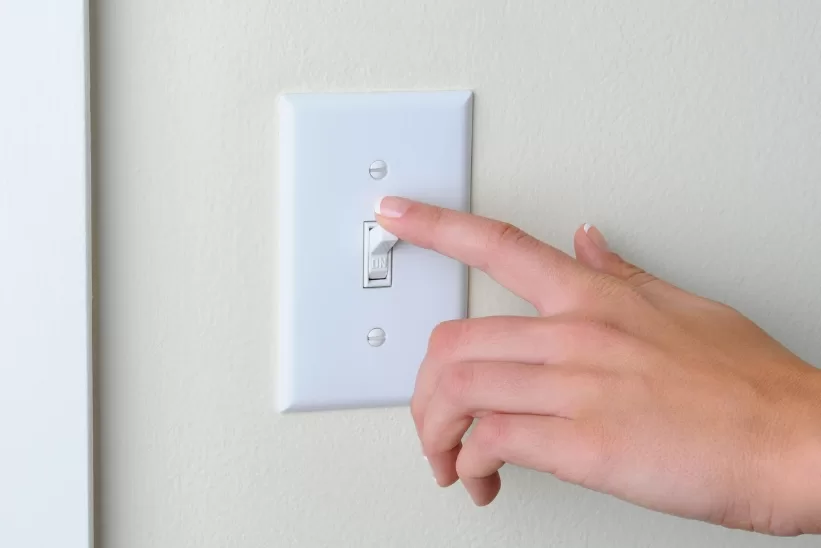
Light switches are vital electrical components that control light fixtures, appliances, and other items. There are many types of switches, such as toggle, rocker, slide, or pushbutton switches. Style does not usually influence the operation of the switch or the electrical wiring, although it can make the selection process difficult. However, narrowing down the choices to the most common switch types simplifies choosing the right one for your needs.
Here are the common types of light switches.
Contents
- Single-Pole Switch
- Double-Pole Switch
- Three-Way Switch
- Four-Way Switch
- Dimmer Switch
- Motion Sensor Switch(Occupancy Switch)
- Smart Switch
- How to Choose a Light Switch
Single-Pole Switch
Singple-pole switches can be used in a wide variety of applications. You can tell if your light switch is single-pole as it will usually have ON/OFF symbols on the face of the switch. If it is a toggle or rocker type switch, the ON/OFF symbol might be hidden.
If you look closely, you will see that a new single pole switch has two brass-colored screw terminals attached to the switch body, as well as a green screw attached to the metal strap. This switch is used in normal operation to regulate the flow of current through the hot wires of the circuit.
In single-pole switches, each of the brass-colored screw terminals is connected to a hot wire, and there is normally no neutral wire connection. The circuit ground wire (usually a bare copper wire) is connected to the green ground screw of the switch. Single-pole switches are the universal type of light switch used in households.
Double-Pole Switch
Double-pole switches are often used in industrial applications. However, it can also be found in a number of home wiring systems, where it is often used to control 240-volt appliances, such as an electric furnace or air conditioner, electric water heater or whirlpool tub heater. Double-pole switches are much less common in the home than single-pole switches: if you don’t have appliances that require a double-pole switch, you may not have one at all.
Since 240-volt circuits use two separate “hot” wires, these switches have four brass-colored screw terminals to allow control of both hot wires in the circuit: incoming wires connect to one set of screws and outgoing wires connect to the other set of screws. These switches are typically rated at 30 to 40 amps, rather than the 15 to 20 amps of traditional single-pole wall switches. A green grounding screw is also included in the circuit grounding wire so a double-pole switch has overall 5 terminals.
Three-Way Switch
Three-way switches are used in stairwells, garages or basements with two entrances, in hallways, and in other situations where two independent wall switches control a single light fixture or appliance. Three-way switches must be used in pairs so that you can control the light at either end of the entrance.
A 3-way switch includes three terminal screws. The switch can be connected to either the power supply or the luminaire/fixture, depending on where it is located in the circuit configuration. The two three-way switches are connected by wires tied to “traveler” wires. A three-way switch also has a green grounding screw, to which the circuit’s bare copper grounding wire is connected.
The term ‘3-way’ is usually used in the US, whereas the same type of switch might be called a “2-way” switch in EU regions like the UK.
Vous recherchez des solutions d'économie d'énergie activées par le mouvement ?
Contactez-nous pour obtenir des détecteurs de mouvement RPT complets, des produits d'économie d'énergie activés par le mouvement, des interrupteurs à détecteur de mouvement et des solutions commerciales de présence/absence.
Four-Way Switch
Although not commonly used, four-way switches are often found in long hallways and in large rooms with more than two entrances. Two three-way switches are used to control an outlet or light fixture from multiple locations. Now you can have control from more than three locations, for example, five locations and three four-way switches between the two three locations.
The four-way switch has four terminals and a ground terminal. Two of the four terminals are usually brass colored, while the other two are not. In a three-way switch, there is no “COM” or “common” terminal. The four-way switch becomes a switching unit for the traveling wires between the three-way switches.
Similarly, the term ‘4-way’ is usually used in the US, whereas the same type of switch might be called a “3-way” switch in EU regions like the UK.
Dimmer Switch
A dimmer switch gives you more freedom with your lighting by allowing you to adjust the brightness level of the bulbs. Dimmers are divided into several subcategories: dimmer switches and inline dimmers.
A dimmer switch is like a switch with an extra dimmer control and it also has various control styles. For example, a rotary dimmer uses a knob that can be turned to increase or decrease the brightness. To turn the light completely off or on, users need to press the knob. A slide dimmer usually has a rocker switch that turns the light on and off, as well as a slider that adjusts or dims the brightness. Some dimmers have very subtle sliders that virtually blend in with the rest of the switch.
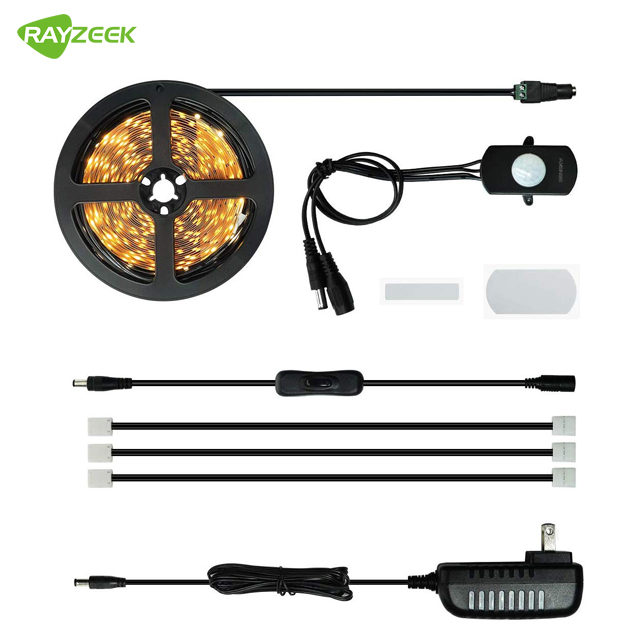
Inline dimmers are also called plug-in dimmers that can be connected inline with your low voltage DC lighting, such as light strips or cabient night lights.
Motion Sensor Switch(Occupancy Switch)
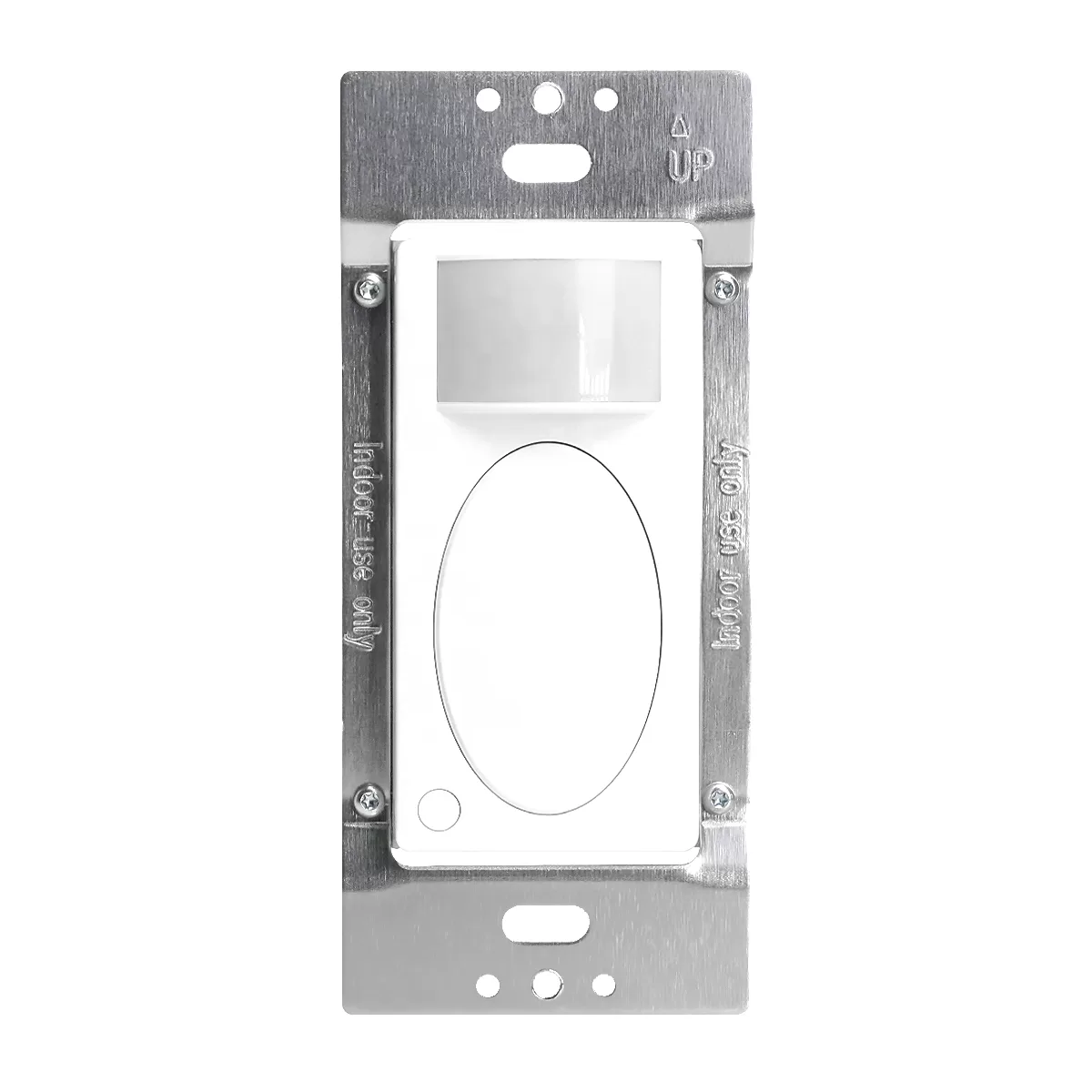
An occupancy switch, or motion sensor light switch, uses a motion sensor that detects when someone enters a room and turns on the light. The light will remain on for a set amount of time. As long as the sensor detects no further movement, it will turn the light off to save electricity.
Ces produits pourraient vous intéresser

- Détecteur de présence PIR pour montage au plafond avec sortie relais à contact sec
- Alimentation basse tension 12/24VDC ou 12/24VAC
- Contacts de relais isolés COM, NO et NC pour les entrées de gestion technique des bâtiments (GTB), de CVC et de contrôle des bâtiments

- Interrupteur détecteur de mouvement à micro-ondes basse tension DC encastrable au plafond
- Entrée 12 VDC / 24 VDC avec une plage de 10-30 VDC
- Courant de fonctionnement max de 10A avec temporisation, seuil Lux et sensibilité réglables
- Interrupteur détecteur de mouvement à micro-ondes encastrable au plafond pour charges plus élevées
- Entrée de tension secteur 100-265 VAC, modèle 10A
- Détection micro-ondes 5,8 GHz avec temporisation, seuil Lux et sensibilité réglables
- Interrupteur détecteur de mouvement à micro-ondes encastrable au plafond
- Entrée de tension secteur 100-265 VAC, modèle 5A
- Détection micro-ondes 5,8 GHz avec temporisation, seuil Lux et sensibilité réglables
- Variateur détecteur de présence PIR RZ037 pour montage au plafond pour alimentation 220V
- Courant de fonctionnement maximum de 3A avec charge nominale de 660W
- Le bouton LUX contrôle l'activation/désactivation du capteur de lumière et la luminosité de variation définie par l'utilisateur
- Variateur détecteur de présence PIR RZ037 pour montage au plafond pour alimentation 110V
- Courant de fonctionnement maximum de 3A avec charge nominale de 330W
- Le bouton LUX contrôle l'activation/désactivation du capteur de lumière et la luminosité de variation définie par l'utilisateur

- Interrupteur de détecteur de mouvement à micro-ondes pour montage au plafond, CC basse tension
- Entrée 12 VDC / 24 VDC avec une plage de 10-30 VDC
- Courant de fonctionnement max de 10A avec temporisation, seuil Lux et sensibilité réglables
- Interrupteur de détecteur de mouvement à micro-ondes pour montage au plafond à charge plus élevée
- Entrée de tension secteur 100-265 VAC, modèle 10A
- Détection micro-ondes 5,8 GHz avec temporisation, seuil Lux et sensibilité réglables
- Interrupteur de détecteur de mouvement à micro-ondes pour montage au plafond
- Entrée de tension secteur 100-265 VAC, modèle 5A
- Détection micro-ondes 5,8 GHz avec temporisation, seuil Lux et sensibilité réglables

- Interrupteur de détecteur de mouvement PIR encastré au plafond, CC basse tension
- Entrée 12 VDC / 24 VDC avec une plage de 10-30 VDC
- Courant de fonctionnement max. 10A avec temporisation, seuil Lux et sensibilité réglables

- Interrupteur de détecteur de mouvement PIR encastré au plafond à charge plus élevée
- Entrée de tension secteur 100-265 VAC, modèle 10A
- Détection à 360 degrés avec temporisation, seuil Lux et sensibilité réglables
- Interrupteur de détecteur de mouvement PIR encastré au plafond
- Entrée de tension secteur 100-265 VAC, modèle 5A
- Détection à 360 degrés avec temporisation, seuil Lux et sensibilité réglables

- Kit d'interrupteur et récepteur sans fil pour le contrôle de l'éclairage intérieur ON/OFF
- Récepteur 100-230VAC, 50/60Hz avec courant nominal de 5A
- Interrupteur sans fil alimenté par pile CR2032 avec communication 2.4GHz
- Mode d'occupation (Auto-ON/Auto-OFF)
- 12–24V DC (10–30VDC), jusqu'à 10A
- Couverture à 360°, diamètre de 8–12 m
- Temporisation de 15 s à 30 min
- Capteur de lumière Désactivé/15/25/35 Lux
- Sensibilité Haute/Basse
- Mode d'occupation Auto-ON/Auto-OFF
- 100–265V AC, 10A (neutre requis)
- Couverture à 360° ; diamètre de détection de 8–12 m
- Temporisation de 15 s à 30 min ; Lux DÉSACTIVÉ/15/25/35 ; Sensibilité Haute/Basse
- Mode d'occupation Auto-ON/Auto-OFF
- 100–265V AC, 5A (neutre requis)
- Couverture à 360° ; diamètre de détection de 8–12 m
- Temporisation de 15 s à 30 min ; Lux DÉSACTIVÉ/15/25/35 ; Sensibilité Haute/Basse

- 100V-230VAC
- Distance de transmission : jusqu'à 20m
- Détecteur de mouvement sans fil
- Contrôle filaire

- Tension : 2x piles AAA / 5V DC (Micro USB)
- Mode Jour/Nuit
- Temporisation : 15min, 30min, 1h (par défaut), 2h

- Adaptateur secteur prise UE

- Adaptateur secteur prise UK
The motion sensor switches usually have two working modes: occupancy mode and vacancy mode. As occupancy mode is the most commonly used mode that automatically controls the lights ON and OFF for users, thus motion sensor switch is referred to as an occupancy switch as well. Vacancy mode requires users to manually turn on the light by pressing the switch. It’s not as convenient as hands-free occupancy mode and is less commonly used in households.
Additionally, most motion sensor switches also have a light sensor for daylight detection, so they won’t turn on based on motion during the day when you don’t need additional lighting. In addition, they can be used in a bathroom to control both light and fans, so you don’t have to worry about remembering to turn the fan on and off.
Laissez-vous inspirer par les gammes de capteurs de mouvement Rayzeek.
Vous ne trouvez pas ce que vous cherchez ? Ne vous inquiétez pas. Il existe toujours d'autres solutions pour résoudre vos problèmes. L'une de nos gammes de produits pourra peut-être vous aider.
Smart Switch
Smart switch refers to a new style of wall switch with internal circuitry that allows lamps or appliances to be controlled by one of many non-traditional methods, such as a voice assistant (like Alexa) or an Internet or smartphone app. For example, many modern smart switches allow you to control lights and turn them on or off with a smartphone app that can be downloaded from anywhere with an Internet connection. They can also be programmed to automatically turn lights or appliances of your choice on or off.
Although smart switches are typically installed in the same location as a standard wall switch, most require a neutral wire connection to draw a small amount of current flow required for operation. Therefore, you will likely need a circuit upgrade to use these switches. There are a collection of smart switches that use ground wire instead of neutral wire for electricity. If you are incapable of upgrading the circuit, choose the ground wire required switch instead.
Other smart switches do not require a neutral network and connect to the Internet wirelessly through a hub. Be sure to purchase a smart switch that is compatible with your hub or voice automation system, as well as the lights you need to control.
How to Choose a Light Switch
The choice of the appropriate wall light switch depends on whether the luminaire or fixture is controlled within the electrical circuit, the type of circuit being controlled, and the degree of automation or remote operation required.
All standard 120-volt household circuits are compatible with single-pole switches, three-way switches, and four-way switches. And it all depends on whether you want to control a fixture from one, two, three, or more locations on the wall.
Double-pole switches are special devices that are only used when it is necessary to control 240-volt circuits that supply electricity to large appliances. When you need the convenience of automating the operation of the switch or appliance or controlling it remotely via the Internet, a smart switch can be used.







